Artwork
Chandra
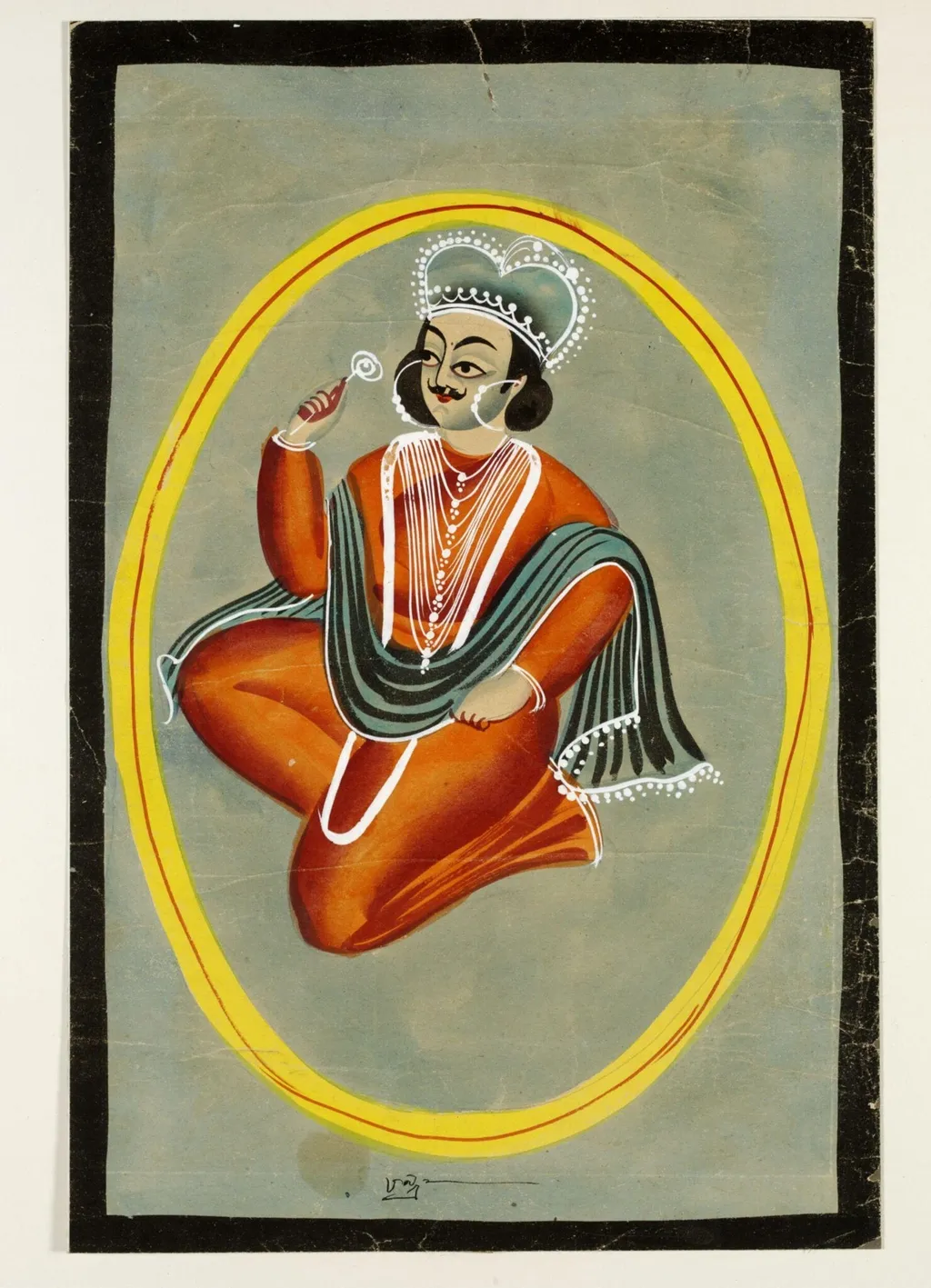
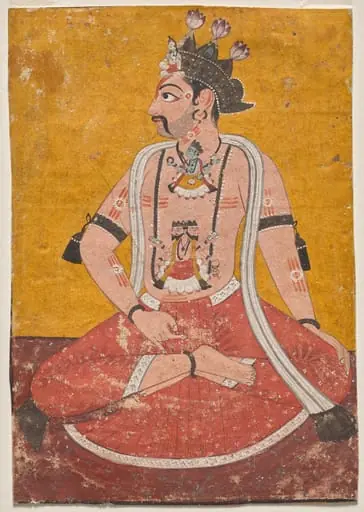
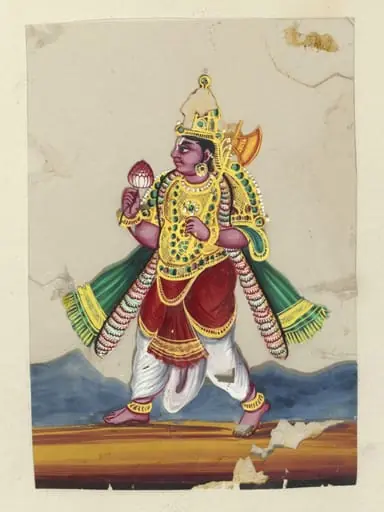
Chandra is a paint painting by the Impressionist artist Unknown. It dates from 1885 and is held in the collection of the Victoria and Albert Museum.
About this work
Overview
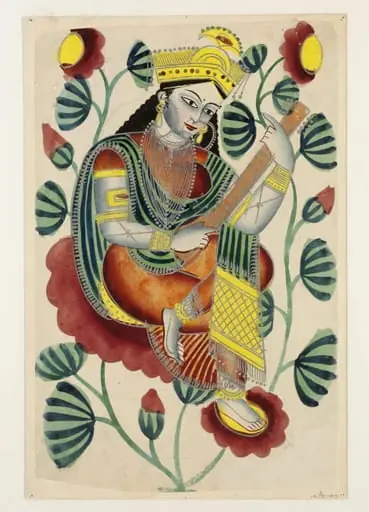
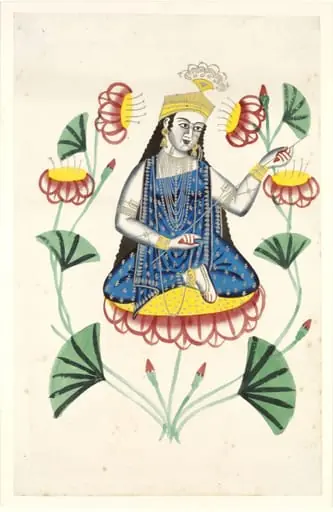
This 1885 opaque watercolour on paper portrays Chandra, the Hindu deity of the moon, executed by an unidentified artist. The work was once in the possession of Miss M. Steele, who inherited it from her mother. Its medium and composition reflect late 19th-century Indian artistic practices, though its stylistic origins remain unattributed to a specific school or region.
Subject & Meaning
Chandra is depicted seated in a meditative posture, crowned and robed in vivid orange and green, signifying divine status. The object held in his right hand may represent a lotus or lunar symbol, common in iconography associated with the moon god. The surrounding yellow oval with a red border likely denotes a sacred aura or celestial sphere, reinforcing his spiritual role within Hindu cosmology.
Technique & Style
The painting employs opaque watercolour with strong, clean outlines and saturated hues, typical of regional Indian miniature and devotional traditions.
The painting employs opaque watercolour with strong, clean outlines and saturated hues, typical of regional Indian miniature and devotional traditions. The flat, unmodulated background and emphasis on pattern over depth distinguish it from Western naturalism. Though sometimes mischaracterized, its aesthetic does not align with Impressionism but rather with indigenous illustrative conventions of the period.
History & Provenance
The painting entered private hands through Miss M. Steele, who inherited it from her mother. No earlier documentation of its creation or commission survives. Its journey from its origin to colonial-era collection remains undocumented, though its preservation suggests it was valued as a devotional or curatorial object within a British-Indian household.
Context
Created during British colonial rule in India, such works often blended traditional iconography with new patronage systems. While many artists produced devotional images for temples or domestic altars, others catered to European collectors seeking exoticized religious imagery. This piece likely served one of these functions, bridging spiritual practice and colonial-era collecting habits.
Legacy
As a surviving example of 19th-century Indian devotional painting, it contributes to the understanding of how Hindu iconography was preserved and transmitted outside institutional religious contexts. Its survival in a private colonial collection highlights the complex cultural exchanges of the period, though its artist and original purpose remain obscured by time.
Artist & collection

 Domestic Scene
 Giacomo and Cardinal Marco, investing Andrea, Abbot of San Zeno, with his Benefice
 The Nymph of Fontainebleau
 Portrait of a Woman
 Madonna and Child with Saints in the Enclosed Garden
 Venus and Minerva
 Family Group of Four on Sofa
 Wall painting from Room H of the Villa of P. Fannius Synistor at Boscoreale