Artwork
Lakshmi
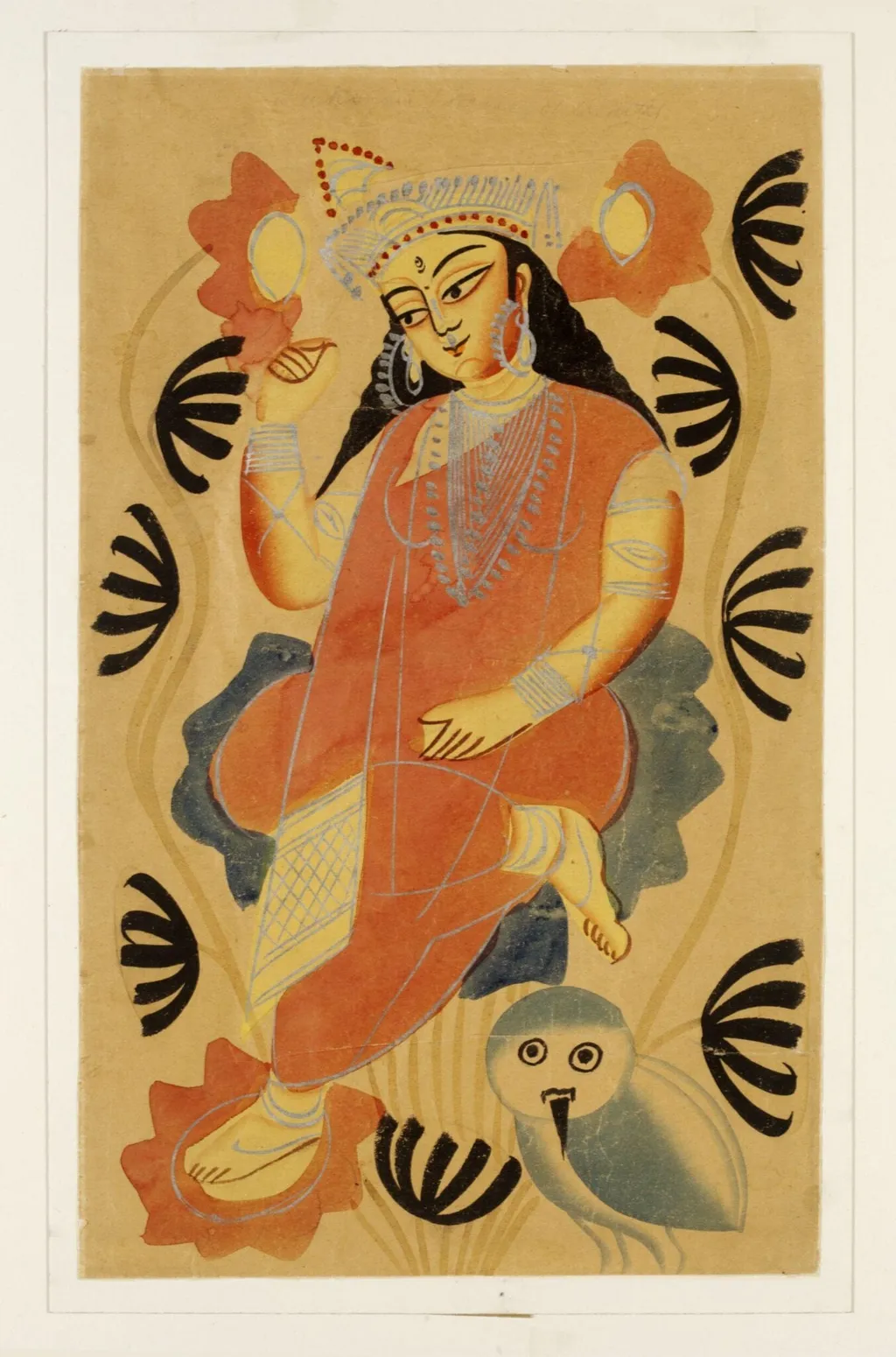
Lakshmi is a paint painting by the Impressionist artist Unknown. It dates from 1885 and is held in the collection of the Victoria and Albert Museum.
About this work
Overview
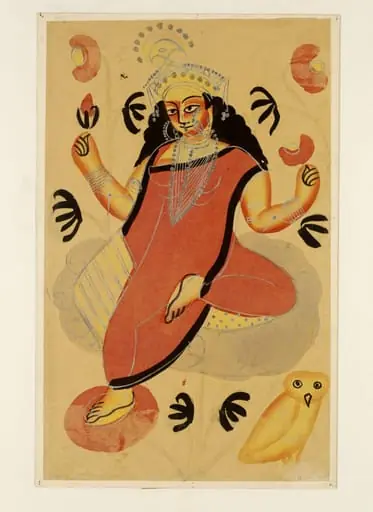
Created in 1885, this opaque watercolor on paper portrays the Hindu goddess Lakshmi seated upon a lotus. She is rendered in vivid red and gold garments, a crown of red dots, and holds an object in her left hand while a small owl rests at her feet. The composition is set against a backdrop of dark foliage and orange blossoms, employing bold outlines and flat areas of colour.
Subject & Meaning
Lakshmi, the deity of wealth and prosperity, is shown in a traditional pose that emphasizes her association with abundance. The accompanying owl, an unusual attribute for Lakshmi, may allude to wisdom or nocturnal vigilance, adding a layer of symbolic nuance to the divine figure.
Technique & Style
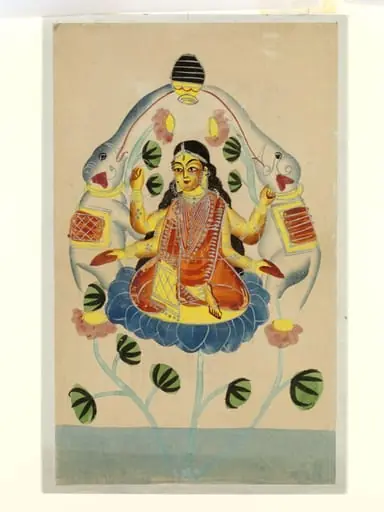
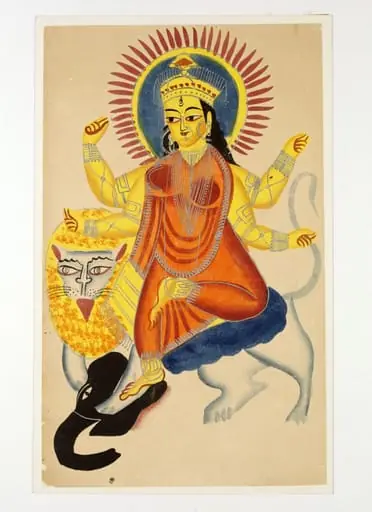
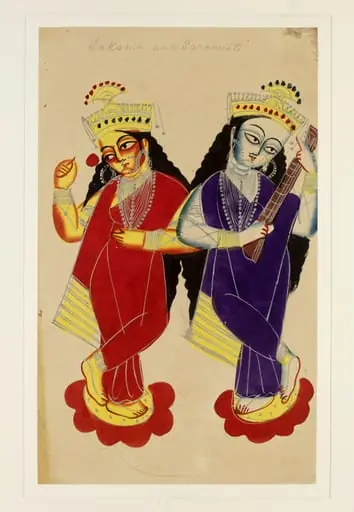
The work exemplifies the Kalighat school of Bengal painting, noted for its crisp linearity, simplified forms, and use of opaque watercolour. Unlike the delicate gradations typical of classical Indian miniatures, the artist employs stark contours and uniform colour fields, producing a graphic, almost modern visual language.
History & Provenance
The painting entered the museum’s collection in 1950 through the bequest of Miss M. Steele. Steele had inherited the piece from her mother, a Sanskrit scholar at Cambridge, who received it in 1894. The work may have originally been part of a family collection assembled by Steele’s grandmother, who spent time living in India.
Context
During the late nineteenth century, Kalighat artists responded to colonial influences and urban patronage, blending traditional iconography with contemporary aesthetics. This piece reflects that hybrid environment, merging devotional subject matter with a style that appealed to both Indian and European audiences of the period.
Artist & collection

 Domestic Scene
 Giacomo and Cardinal Marco, investing Andrea, Abbot of San Zeno, with his Benefice
 The Nymph of Fontainebleau
 Portrait of a Woman
 Madonna and Child with Saints in the Enclosed Garden
 Venus and Minerva
 Family Group of Four on Sofa
 Wall painting from Room H of the Villa of P. Fannius Synistor at Boscoreale