Artwork
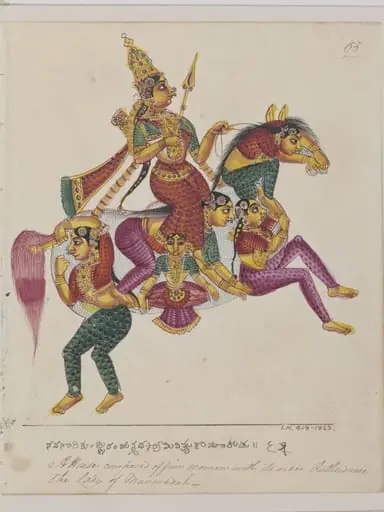
Manmatha or Kama, the God of Love
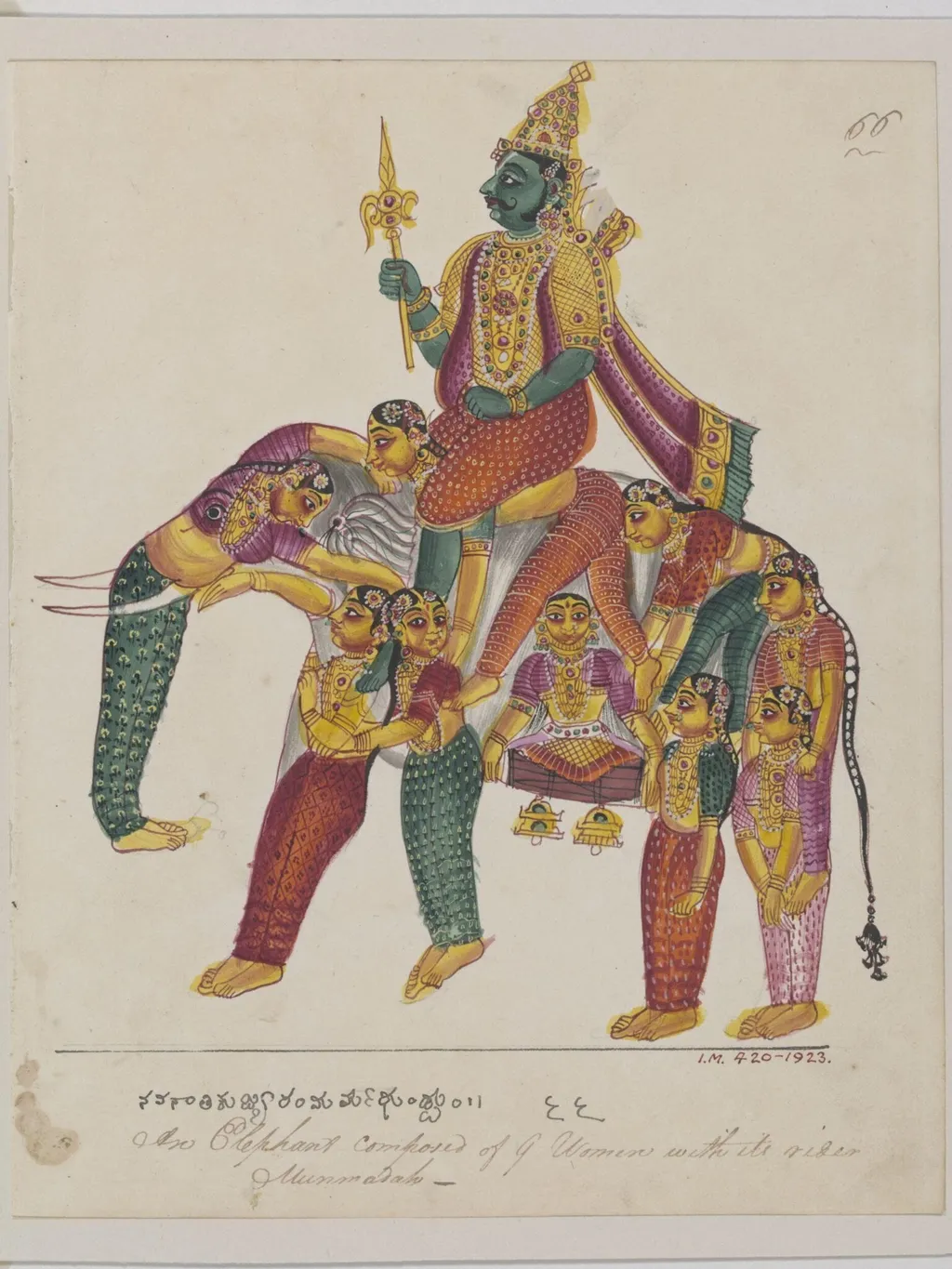
Manmatha or Kama, the God of Love is a paint painting by the Romanticist artist Unknown. It dates from 1820 and is held in the collection of the Victoria and Albert Museum. This gouache and watercolour painting, dated circa 1820, originates from Tiruchirappalli in South India.
About this work
Overview
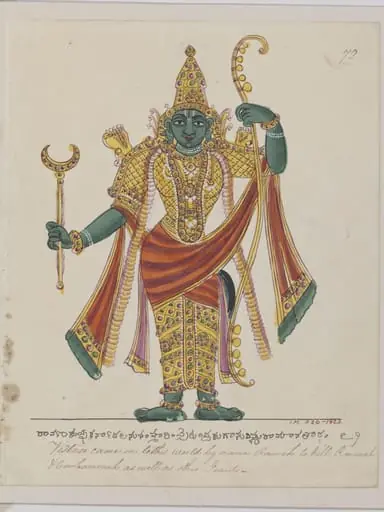
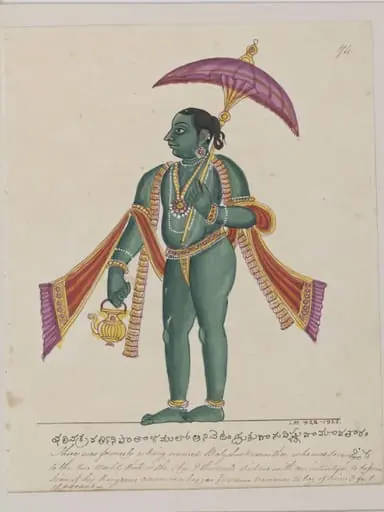
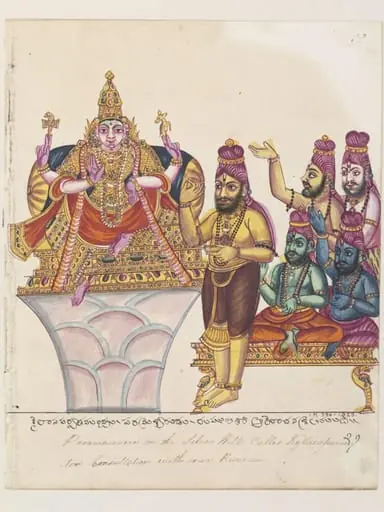
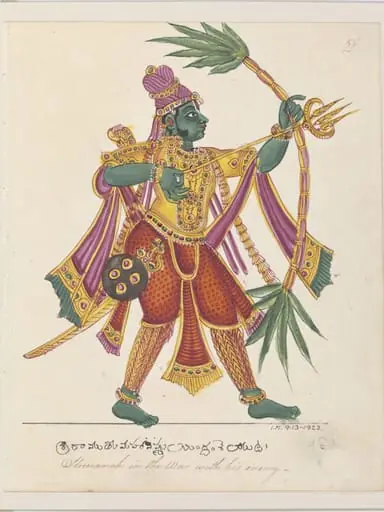
The composition reflects regional artistic traditions and devotional iconography, blending mythological narrative with inventive visual symbolism.
This gouache and watercolour painting, dated circa 1820, originates from Tiruchirappalli in South India. It belongs to a series of one hundred depictions of Hindu deities, each rendered with meticulous detail. The work portrays Manmatha, the god of love, mounted on an unusual elephant constructed entirely from nine women. The composition reflects regional artistic traditions and devotional iconography, blending mythological narrative with inventive visual symbolism.
Subject & Meaning
Manmatha, also known as Kama, is the Hindu deity of desire and erotic love. Here, he rides an elephant formed by nine women whose bodies curve to create its form—limbs as legs, torsos as trunk and back. The elephant, a symbol of strength and royal authority, is reimagined as an embodiment of sensual union. His flaming torch signifies the burning power of desire, while his jeweled crown underscores his divine status within the pantheon.
Technique & Style
Executed in gouache and watercolour, the painting employs vibrant pigments—red, green, and purple—to highlight the women’s garments and the god’s ornate attire. Fine brushwork defines facial expressions, which remain serene despite the unusual physical arrangement. The flat, decorative space and stylized anatomy reflect South Indian miniature traditions, prioritizing symbolic clarity over naturalistic perspective. Details like jewelry and fabric folds are rendered with precision, typical of workshop-produced devotional series.
History & Provenance
Created in the early 19th century in Tiruchirappalli, the painting was part of a commissioned set of one hundred deity illustrations, likely intended for private devotion or courtly display. Such series were common in Tamil Nadu under the patronage of local rulers and temple communities. The work’s survival suggests it was preserved within a collector’s archive, possibly linked to British colonial-era documentation of Indian religious art, though its exact provenance remains undocumented beyond its place of origin.
Context
This image emerged during a period when South Indian artists continued producing traditional Hindu iconography despite increasing colonial influence. Unlike European Romanticism, which emphasized emotion through dramatic landscapes and individual heroism, this work channels spiritual symbolism through structured, communal forms. The fusion of divine figure and human anatomy reflects a long-standing Indian aesthetic where the body becomes a vessel for cosmic ideas, not personal expression.
Legacy
The painting contributes to a broader corpus of South Indian devotional art that reimagines mythological themes through inventive visual metaphors. While largely overlooked in Western art histories, such works have gained scholarly attention for their complex symbolism and regional craftsmanship. Today, it stands as an example of how traditional iconography adapted within colonial-era artistic practices, preserving indigenous narratives through disciplined, collaborative studio methods.
Artist & collection

 Domestic Scene
 Giacomo and Cardinal Marco, investing Andrea, Abbot of San Zeno, with his Benefice
 The Nymph of Fontainebleau
 Portrait of a Woman
 Madonna and Child with Saints in the Enclosed Garden
 Venus and Minerva
 Family Group of Four on Sofa
 Wall painting from Room H of the Villa of P. Fannius Synistor at Boscoreale