Artwork
Nawab I'tisam al-Mulk
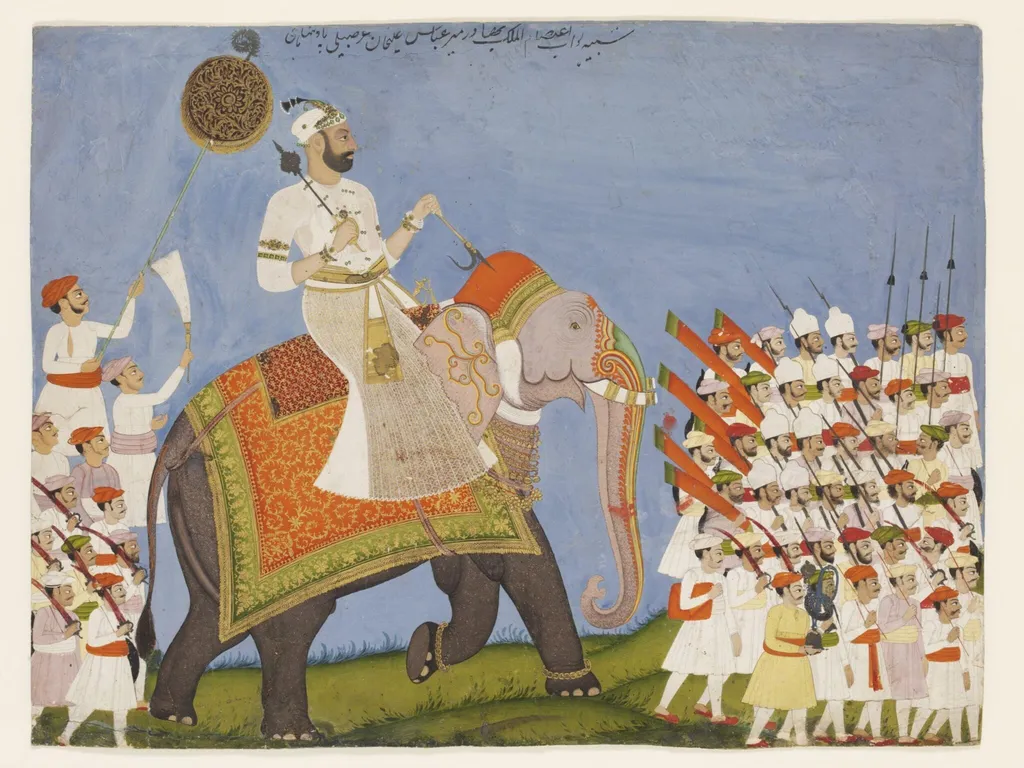
Nawab I'tisam al-Mulk is a paint painting by the Rococo painting artist Unknown. It dates from 1765 and is held in the collection of the Victoria and Albert Museum.
About this work
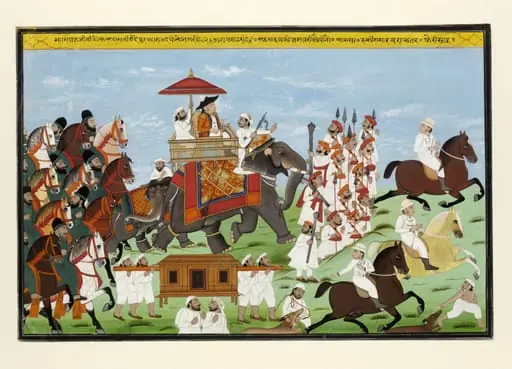
This painting shows a man on an elephant.
He's dressed up and has lots of jewelry on.
The people with him are carrying special items that mean he's important.
He's Nawab I'tisam al-Mulk, and his name is written above his head.
This painting is interesting because it was made in a specific place.
It was done in Hyderabad, Deccan, around 1795.
Check out the Victoria and Albert Museum.
Overview
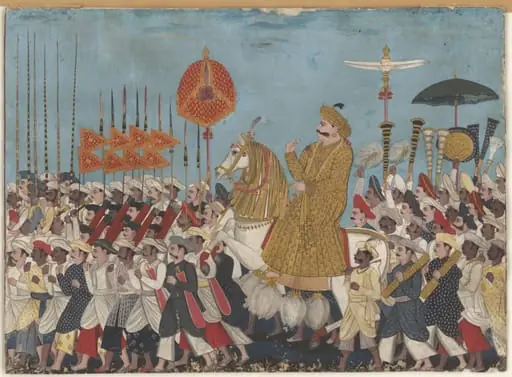
This painting depicts Nawab I'tisam al-Mulk, a regional ruler in the Deccan, mounted on an elaborately adorned elephant. Created around 1795 in Hyderabad, it reflects the visual language of courtly power in late 18th-century South India. The subject is clearly identified by a Persian inscription above his head, anchoring the image in a specific historical and political context.
Subject & Meaning
The nawab is portrayed as a sovereign figure, surrounded by symbols of authority: a ceremonial fly-whisk and shield carried by attendants.
The nawab is portrayed as a sovereign figure, surrounded by symbols of authority: a ceremonial fly-whisk and shield carried by attendants. These objects, rooted in Mughal and Deccani traditions, signal his status and right to rule. His richly jeweled attire and the ornate elephant harness reinforce his position within a hierarchical court culture, where visual display was integral to political identity.
Technique & Style
Executed in watercolor and gold on paper, the work exhibits the refined detail characteristic of Deccani painting. Rich pigments, intricate patterns on textiles and elephant trappings, and a flattened spatial composition reflect local aesthetic preferences. The use of gold highlights and precise line work distinguishes it from Mughal naturalism, emphasizing symbolic presence over realistic depth.
History & Provenance
The painting originated in the court of Hyderabad during the reign of the Asaf Jahi dynasty. It likely served as a portrait for ceremonial or archival purposes, documenting the nawab’s authority. It entered the Victoria and Albert Museum’s collection through British colonial acquisitions, becoming part of a broader effort to document Indian artistic traditions under imperial oversight.
Context
By 1795, Hyderabad was a semi-autonomous state under British influence, yet its court maintained distinct artistic traditions. This painting reflects the persistence of Deccani styles amid shifting political alliances. The emphasis on regalia and ceremonial objects suggests a desire to assert cultural legitimacy, even as central authority waned under colonial pressure.
Legacy
The painting remains a key example of late Deccani portraiture, illustrating how local rulers used visual culture to sustain their prestige. It contributes to scholarly understanding of regional identity in pre-colonial India and continues to inform exhibitions on South Asian court art, offering insight into the intersection of power, symbolism, and artistic practice.
Artist & collection

 Domestic Scene
 Giacomo and Cardinal Marco, investing Andrea, Abbot of San Zeno, with his Benefice
 The Nymph of Fontainebleau
 Portrait of a Woman
 Madonna and Child with Saints in the Enclosed Garden
 Venus and Minerva
 Family Group of Four on Sofa
 Wall painting from Room H of the Villa of P. Fannius Synistor at Boscoreale