Artwork
Înficoșătoarea Judecată de Apoi
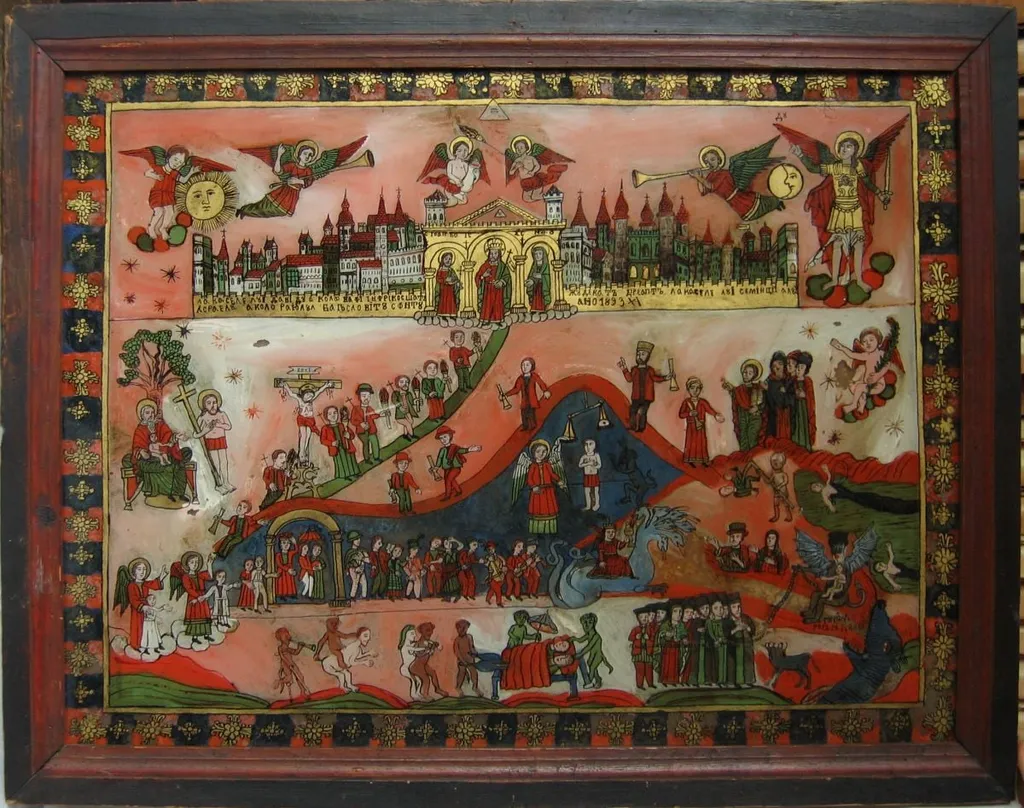
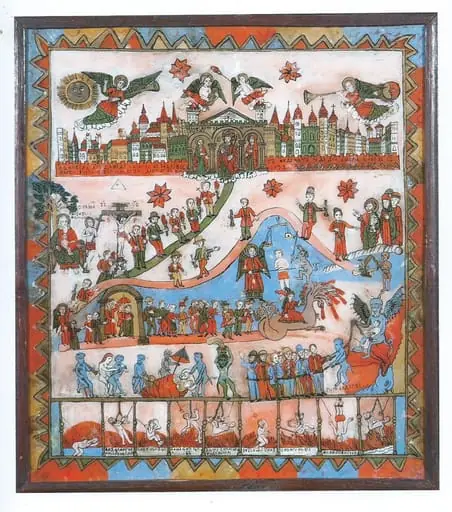
Înficoșătoarea Judecată de Apoi is a drawing by Unknown. It dates from 1850 and is held in the collection of the ASTRA National Museum Complex. This work presents a vivid, densely populated scene that unites celestial and earthly realms in a single composition.
About this work
Overview
This work presents a vivid, densely populated scene that unites celestial and earthly realms in a single composition.
This work presents a vivid, densely populated scene that unites celestial and earthly realms in a single composition. Bright pigments and intricate gold borders frame a narrative of divine judgment, with figures arranged across vertical planes—from hovering angels above to a bustling, chaotic crowd below. The visual energy is heightened by dynamic movement and contrasting scales, suggesting a moment of cosmic transition.
Subject & Meaning
The painting depicts the Last Judgment, a common theme in medieval and early Renaissance religious art. Angels at the summit, sounding trumpets, signal divine intervention, while the figures below respond in varied ways: some in revelry, others in distress. A dragon on the right symbolizes chaos or evil, observed by both human and angelic witnesses, reinforcing the tension between salvation and damnation.
Technique & Style
The artist employs fine linear detailing and cross-hatching to model form and suggest depth within a flat, decorative space. Rich, saturated colors contrast with metallic gold accents along the borders, enhancing the sacred tone. Figures are stylized rather than naturalistic, prioritizing symbolic clarity over anatomical precision, typical of late Gothic traditions.
History & Provenance
The painting likely originated in a religious context, possibly as an altarpiece or devotional panel in a Central or Eastern European church. Its survival suggests it was valued within a community that maintained traditional iconography through periods of political and religious change, though its exact origin and early ownership remain undocumented.
Context
Created during a time when apocalyptic themes were widely circulated in Christian Europe, the work reflects theological concerns about moral accountability and divine justice. Its fusion of heavenly order and earthly disorder aligns with liturgical narratives used to instruct congregations, especially in regions where literacy was limited and imagery served as moral instruction.
Legacy
Though not widely known outside regional collections, the painting exemplifies how local artists adapted broader religious motifs with distinctive visual languages. Its preservation offers insight into how communities visualized eschatology, bridging folk traditions with ecclesiastical doctrine through accessible, emotionally charged imagery.
Artist & collection

 Domestic Scene
 Giacomo and Cardinal Marco, investing Andrea, Abbot of San Zeno, with his Benefice
 The Nymph of Fontainebleau
 Portrait of a Woman
 Madonna and Child with Saints in the Enclosed Garden
 Venus and Minerva
 Family Group of Four on Sofa
 Wall painting from Room H of the Villa of P. Fannius Synistor at Boscoreale