Artwork
Ornamental Foliage, with an Owl and other Birds
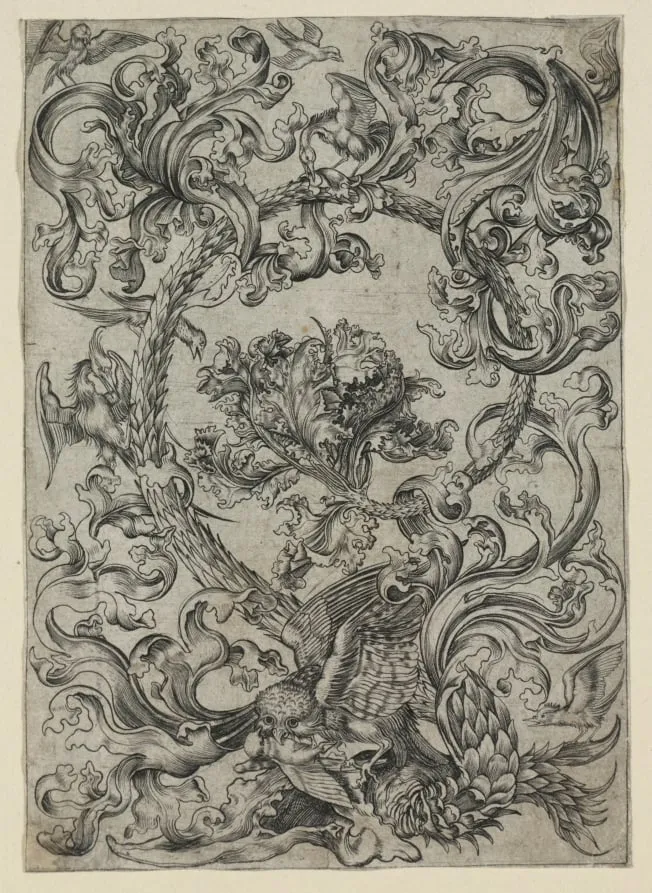
Ornamental Foliage, with an Owl and other Birds is a print by the Renaissance artist Unknown. It dates from 1404 and is held in the collection of the Cleveland Museum of Art.
About this work
Overview
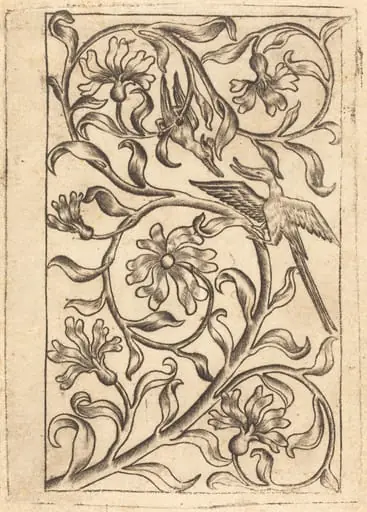
This black-and-white print features an intricate composition of intertwined vines, leaves, and blossoms, densely packed to fill the entire surface.
This black-and-white print features an intricate composition of intertwined vines, leaves, and blossoms, densely packed to fill the entire surface. At its center, an owl is nestled among smaller birds and twisting, ornamental branches. The design reflects a late medieval aesthetic where natural forms are stylized into decorative patterns, typical of manuscript illumination and architectural ornamentation from the 15th century.
Subject & Meaning
The owl, often associated with wisdom or vigilance in medieval symbolism, is surrounded by birds that may represent various aspects of the natural world or allegorical traits. The dense foliage does not merely decorate but suggests a microcosm of nature, organized into a harmonious, almost architectural framework. The arrangement implies a controlled, idealized vision of the wild, common in devotional and scholarly contexts.
Technique & Style
Executed with fine, precise linework, the print employs sharp, continuous strokes to create texture and depth without shading. The style blends observed botanical elements with imaginative, rhythmic curves, characteristic of Northern European decorative arts. Every space is filled, avoiding emptiness—a hallmark of the period’s ornamental tradition, where pattern and detail served both aesthetic and symbolic functions.
History & Provenance
Produced in the 1400s, this print likely originated as a model for artisans working in manuscript illumination, woodcarving, or stained glass. Such designs circulated among workshops as templates, often copied or adapted across regions. Its survival suggests it was valued as a reference, possibly preserved in a monastic or guild collection, though its specific origin remains undocumented.
Context
In the 15th century, decorative arts increasingly integrated natural motifs into religious and secular spaces. This print aligns with the broader trend of naturalism tempered by stylization, seen in illuminated choir books and cathedral capitals. Unlike later Renaissance naturalism, it prioritizes pattern and symmetry over anatomical accuracy, reflecting a pre-humanist visual language rooted in medieval symbolism.
Legacy
Though not attributed to a known master, the print exemplifies the transmission of ornamental forms that influenced early Renaissance design. Its emphasis on intricate detail and botanical abstraction paved the way for later decorative systems in printmaking and architecture. Such works remain valuable for understanding how artisans translated nature into structured visual language before the rise of scientific observation.
Artist & collection

 Domestic Scene
 Giacomo and Cardinal Marco, investing Andrea, Abbot of San Zeno, with his Benefice
 The Nymph of Fontainebleau
 Portrait of a Woman
 Madonna and Child with Saints in the Enclosed Garden
 Venus and Minerva
 Family Group of Four on Sofa
 Wall painting from Room H of the Villa of P. Fannius Synistor at Boscoreale
 Ornament with Owl Mocked by Day Birds
 Ornament with Hop Vine
 Ascending Ornament
 Ornament with a Cupid, a Satyr, and Grotesque Figures
 Ornament Panel: Two Children Wearing Helmets
 Three Children Blowing Horns
 Ornament Panel: Victoria Augusta
 Ornament
 Ornament Panel: Triton Ridden by a Child
 Ornament with Wild Folk
 Ascending Ornament
 Vine Ornament with Two Birds