Artwork
Portrait of Raja Ram Singh of Amber (r. 1667-1688) with a Deccan Sword (recto); Calligraphy (verso)
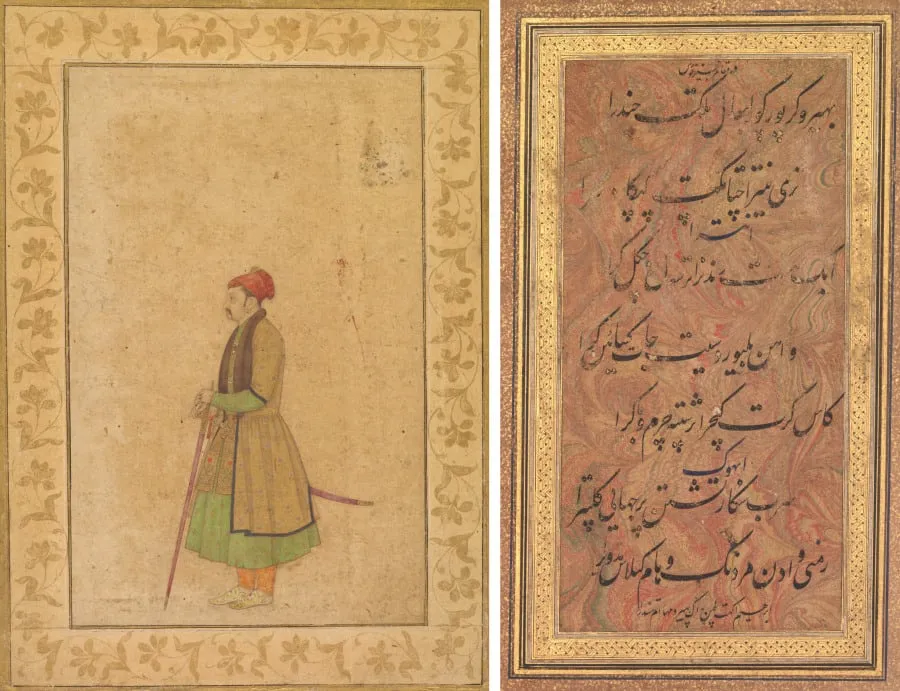
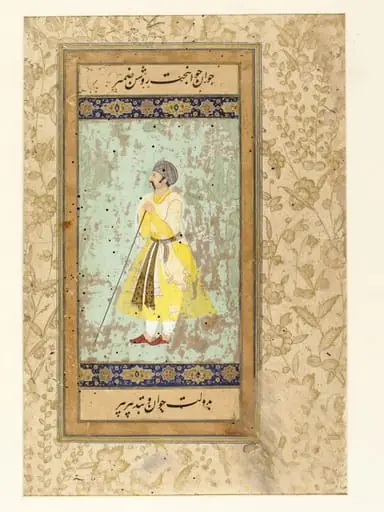
Portrait of Raja Ram Singh of Amber (r. 1667-1688) with a Deccan Sword (recto); Calligraphy (verso) is an unspecified painting by the Baroque artist Unknown. It dates from 1682 and is held in the collection of the Cleveland Museum of Art. The miniature portrays Raja Ram Singh of Amber, a Hindu noble who served the Mughal court from the mid‑17th to late‑17th century.
About this work
Overview
Dressed in an elaborate coat of honor with a fur collar, gold thread embroidery and precious stones, he holds a curved, enameled sword.
The miniature portrays Raja Ram Singh of Amber, a Hindu noble who served the Mughal court from the mid‑17th to late‑17th century. Dressed in an elaborate coat of honor with a fur collar, gold thread embroidery and precious stones, he holds a curved, enameled sword. His expression is subdued, conveying fatigue tempered by composure, a visual contrast between regal adornments and personal weariness.
Subject & Meaning
Ram Singh’s portrait underscores his dual identity as a regional ruler and a Mughal courtier. An Urdu verse on the verso praises his military success, suggesting that wherever he led an expedition, victory followed. The sword, possibly a gift from the emperor upon his accession in 1667, symbolizes imperial favor and the martial responsibilities he bore for a sovereign empire that was not his own.
Technique & Style
Executed in the Mughal miniature tradition, the work combines naturalistic facial modeling with intricate surface decoration. The artist renders the fur collar and jeweled coat with fine brushwork, while the enamelled hilt of the sword is depicted in vivid detail. The palette balances rich reds, golds, and deep blues, and the composition places the figure centrally, allowing the viewer to focus on his contemplative gaze.
History & Provenance
Originally part of a Mughal album, the painting was inscribed with a verse in Urdu attesting to Ram Singh’s value to the empire. His career spanned service under Shah Jahan and Aurangzeb, including participation in campaigns and involvement in court intrigues such as the failed succession of Shah Jahan’s heirs and the escape of Shivaji. The work now resides in a museum collection, paired with a calligraphic verso.
Artist & collection

 Domestic Scene
 Giacomo and Cardinal Marco, investing Andrea, Abbot of San Zeno, with his Benefice
 The Nymph of Fontainebleau
 Portrait of a Woman
 Madonna and Child with Saints in the Enclosed Garden
 Venus and Minerva
 Family Group of Four on Sofa
 Wall painting from Room H of the Villa of P. Fannius Synistor at Boscoreale
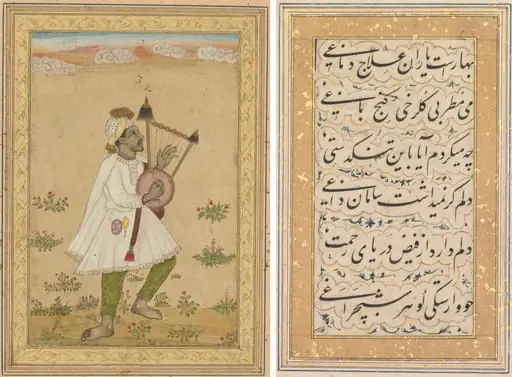 An African Lyre Player (recto); Calligraphy (verso)
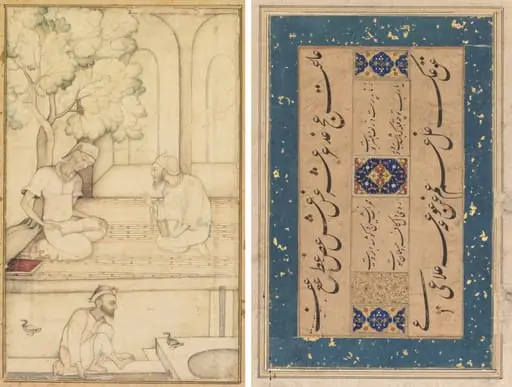 Kabir and Two Followers on a Terrace (recto); Calligraphy (verso)
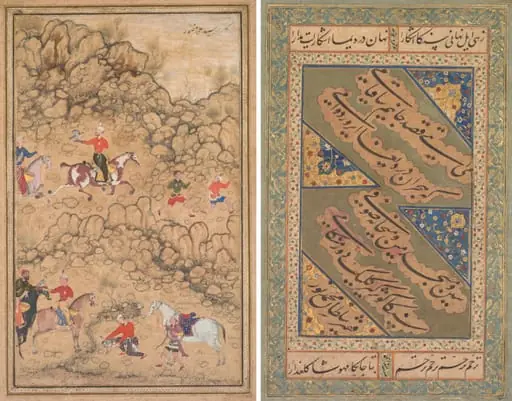 Hunting with falcons in a landscape; verso: Calligraphy of Chaghatai Turkish poems in praise of wine, Sultan Muhammad Nur (Persian, c. 1472–1536) and Mirza Muhammad (probably Persian, active c. 1520s)
 Untitled
 A princess on a terrace with attendants at night (recto); Calligraphy (verso)
 Calligraphy framed by an ornamental border with poppies and pairs of birds, from the Late Shah Jahan Album (verso)
 Portrait of an Unidentified Noble from Shah Jahan's Court
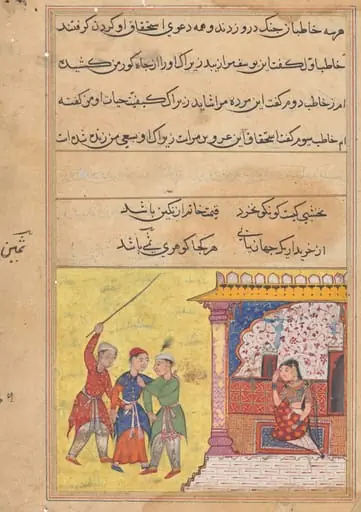 The three suitors again begin to quarrel among themselves for the hand of the devotee’s daughter, from a Tuti-nama (Tales of a Parrot): Twentieth Night