Artwork
Qadam Khan
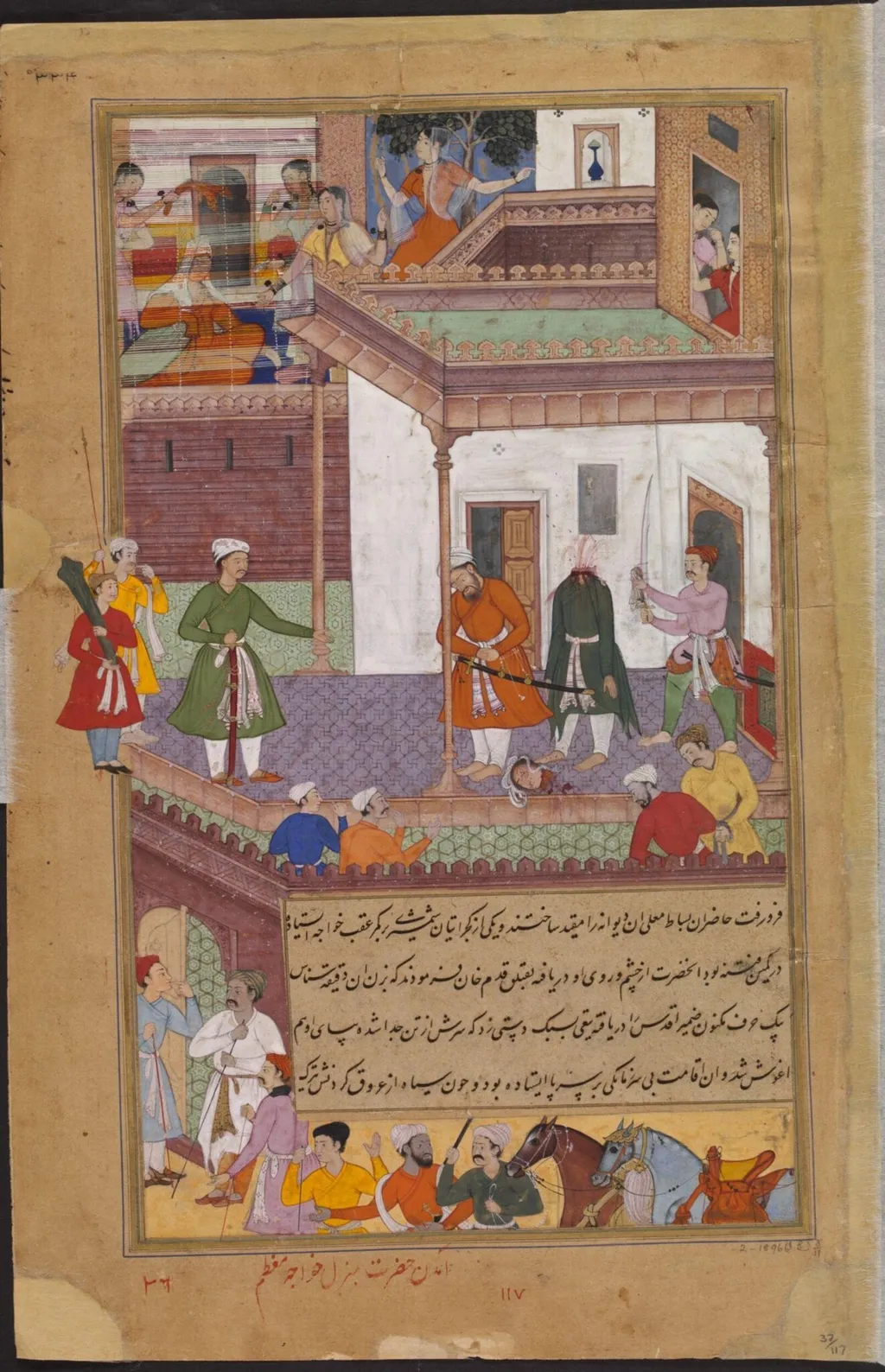
Qadam Khan is a paint painting by the Mughal Painting artist Unknown. It dates from 1592 and is held in the collection of the Victoria and Albert Museum. This Mughal miniature, created around 1590–1595, illustrates a violent episode from Emperor Akbar’s reign, recorded in the Akbarnama.
About this work
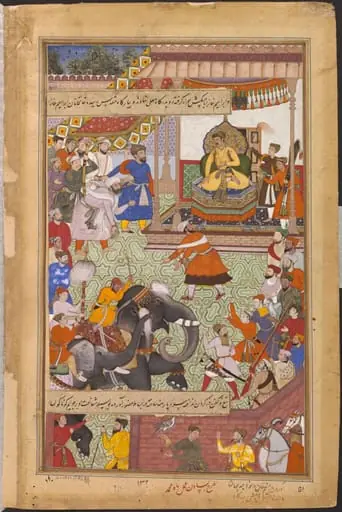
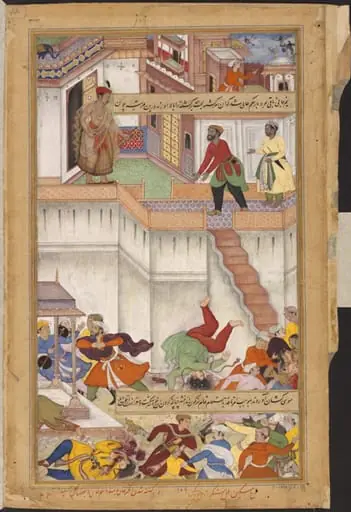
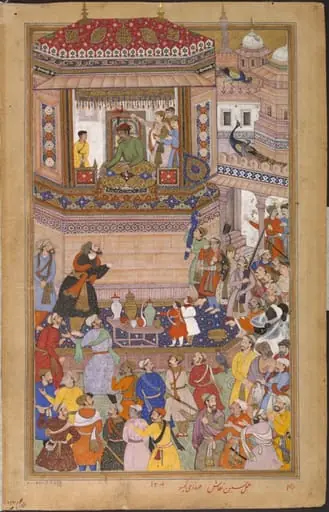
You see a Mughal miniature painting of a frenzied man stabbing a woman. The scene is crowded with onlookers and palace details. The artist shows raw emotion—not just violence, but shock and chaos.
This painting tells a real story from 1564. Akbar the emperor arrived just after the murder. Records say he tied up the killer himself.
Check out the Victoria and Albert Museum to see this rare piece.
Overview
The scene is rendered with intense detail, reflecting the historical gravity of the moment and the artist’s skill in conveying tension.
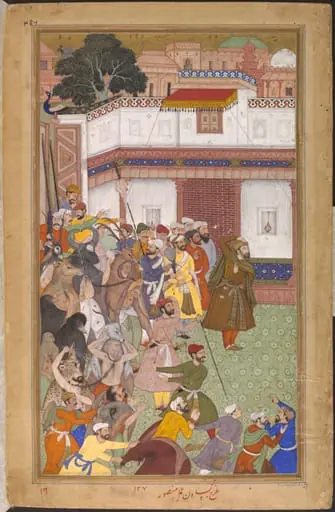
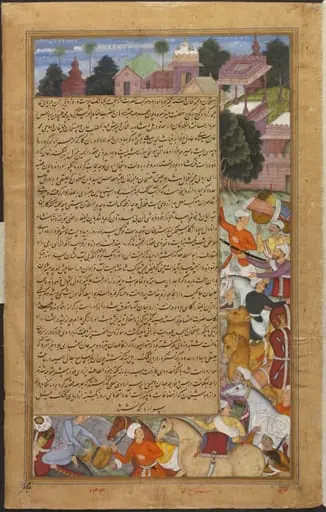
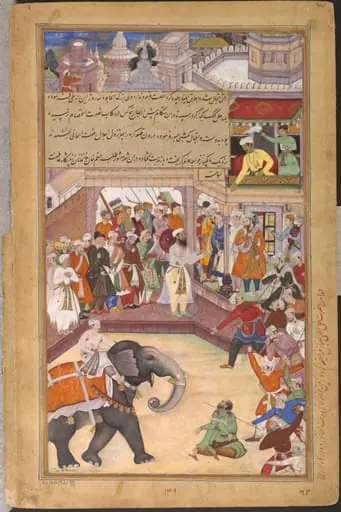
This Mughal miniature, created around 1590–1595, illustrates a violent episode from Emperor Akbar’s reign, recorded in the Akbarnama. Painted as part of an official imperial chronicle, it captures the immediate aftermath of a nobleman’s murder of his wife and the swift execution of a would-be assassin by Qutlaq Qadam Khan, the emperor’s loyal attendant. The scene is rendered with intense detail, reflecting the historical gravity of the moment and the artist’s skill in conveying tension.
Subject & Meaning
The painting depicts the murder of Zuhra Agha by her husband, Khwaja Mu’azzam, triggered by fear of her removal from Agra. As Akbar arrives, chaos erupts: servants scramble, onlookers react in horror, and a second attacker is intercepted. The narrative underscores imperial authority and justice—Akbar’s intervention halts further bloodshed, while Qadam Khan’s decisive action reinforces loyalty to the crown. The scene transforms personal tragedy into a political allegory of order restored.
Technique & Style
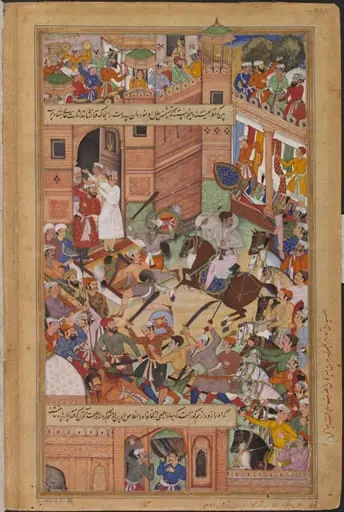
Executed in the Mughal miniature tradition, the painting uses fine brushwork, rich pigments, and intricate architectural details to frame the drama. Figures are rendered with expressive gestures, their postures conveying shock and urgency. The composition is tightly packed, guiding the viewer’s eye through layers of action—from the central stabbing to the decapitation in the background. Atmospheric depth is suggested through layered space, not perspective, typical of Persianate court painting.
History & Provenance
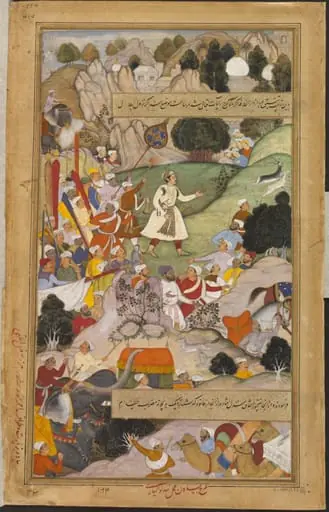
The image originates from the Akbarnama, commissioned by Akbar in 1589 and completed by Abu’l Fazl by 1596. It was painted by one of at least 49 artists working under imperial patronage, though their identity remains unknown. The painting survives as a partial copy, with its reverse side bearing another work by the same hand. It entered the Victoria and Albert Museum’s collection in 1896 as part of a larger album of Mughal illustrations.
Context
The Akbarnama was not merely a historical record but a tool of imperial propaganda, legitimizing Akbar’s rule through curated narratives. This episode, though personal, was included to highlight the emperor’s moral authority and swift justice. The inclusion of such violent scenes reflects the Mughal court’s interest in documenting both political stability and the consequences of disorder, reinforcing the emperor’s role as arbiter of law and order.
Legacy
As one of the few surviving illustrations from the Akbarnama’s original set, this painting offers insight into Mughal artistic practices and historical consciousness. Its unflinching depiction of violence, combined with precise documentation, distinguishes it from idealized court imagery. Today, it remains a key artifact for understanding how Mughal rulers used art to encode political narratives and assert control over both history and perception.
Artist & collection

 Domestic Scene
 Giacomo and Cardinal Marco, investing Andrea, Abbot of San Zeno, with his Benefice
 The Nymph of Fontainebleau
 Portrait of a Woman
 Madonna and Child with Saints in the Enclosed Garden
 Venus and Minerva
 Family Group of Four on Sofa
 Wall painting from Room H of the Villa of P. Fannius Synistor at Boscoreale