Artwork
Raja Nau Nihal Singh and Raja Dhian Singh
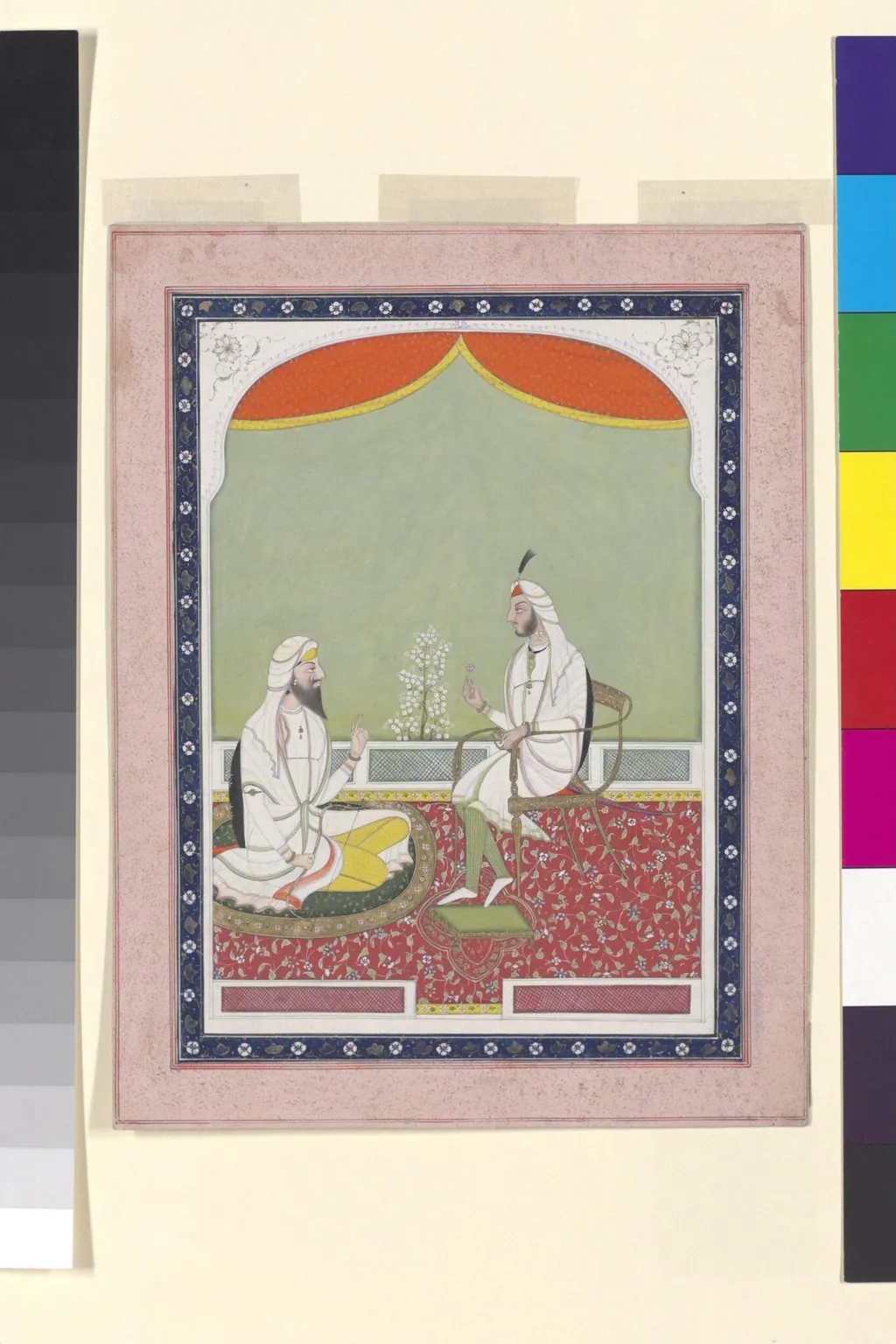
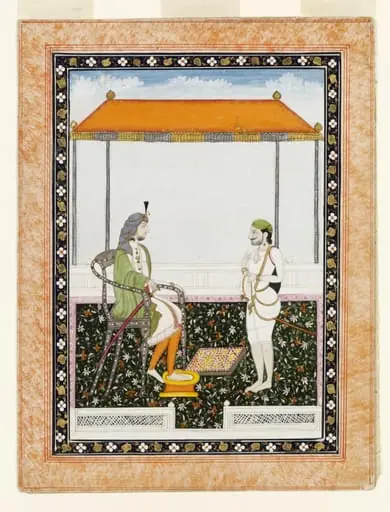
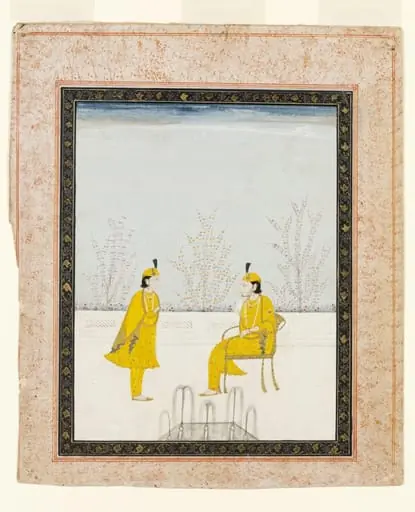
Raja Nau Nihal Singh and Raja Dhian Singh is a paint painting by the Patna School of Painting artist Unknown. It dates from 1838 and is held in the collection of the Victoria and Albert Museum.
About this work
Overview
The oil painting portrays two figures from early nineteenth‑century Punjab: a young Sikh prince seated on a Western‑style chair and his Hindu prime minister positioned at his feet. The composition reflects the courtly atmosphere of the Sikh Empire during the final years of Maharaja Ranjit Singh’s rule, capturing a moment of political intimacy and tension.
Subject & Meaning
The seated figure is Nau Nihal Singh (1821–1840), the favored grandson of Maharaja Ranjit Singh, who participated in his grandfather’s military campaigns.
The seated figure is Nau Nihal Singh (1821–1840), the favored grandson of Maharaja Ranjit Singh, who participated in his grandfather’s military campaigns. At his feet sits Dhian Singh (1796–1843), the Hindu chief minister who wielded considerable influence in the court. Their juxtaposition hints at the complex alliances and rivalries that shaped the empire’s succession crisis after Ranjit Singh’s death.
Technique & Style
Executed with a pronounced chiaroscuro, the work models the two men against a darkened background, emphasizing the contrast between the illuminated figures and their surroundings. The Western chair and the detailed rendering of fabrics reveal the artist’s familiarity with European portrait conventions, while the subtle rendering of facial features retains a regional sensibility.
History & Provenance
Originally part of the collection of Lord Auckland, Governor‑General of India from 1836 to 1842, the painting entered the Victoria and Albert Museum in 1953 as a gift from Auckland’s great‑nephew, O. E. Dickinson. Its provenance links the artwork to the British administrative presence in India during the early colonial period.
Context
The portrait was created in a period of intense factionalism within the Sikh court. After Ranjit Singh’s death in 1839, his son Kharak Singh ascended the throne but quickly fell victim to intrigues led by the Dogra family, including Dhian Singh. Both Kharak Singh and his son Nau Nihal Singh died under suspicious circumstances, events that reshaped the empire’s power structure.
Artist & collection

 Domestic Scene
 Giacomo and Cardinal Marco, investing Andrea, Abbot of San Zeno, with his Benefice
 The Nymph of Fontainebleau
 Portrait of a Woman
 Madonna and Child with Saints in the Enclosed Garden
 Venus and Minerva
 Family Group of Four on Sofa
 Wall painting from Room H of the Villa of P. Fannius Synistor at Boscoreale