Artwork
Red Amida
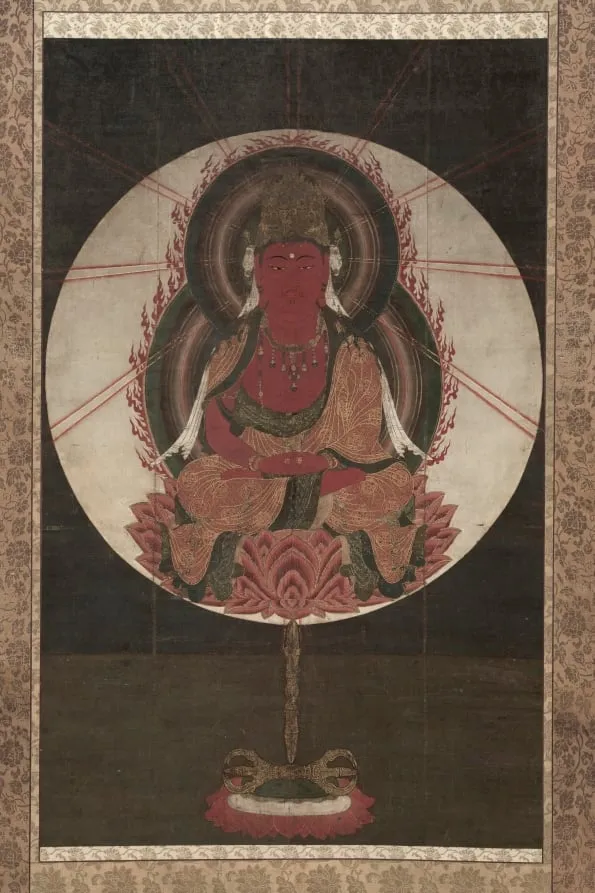
Red Amida is an unspecified painting by Unknown. It dates from 1304 and is held in the collection of the Cleveland Museum of Art.
About this work
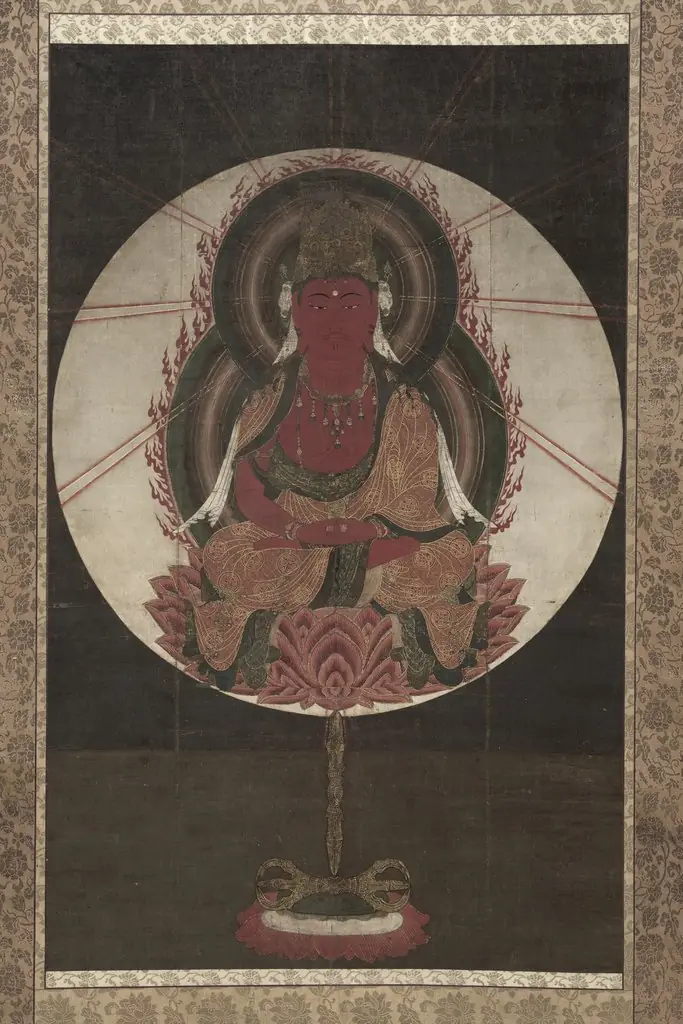
Most Buddhas wear red robes, but this one is red all over—skin, clothes, even the light around him.
A bright red Buddha sits on a flower, hands folded in calm. Gold lines trace his robe and halo. Tiny figures peek from his crown.
Most Buddhas wear red robes, but this one is red all over—skin, clothes, even the light around him. The flower beneath him has sharp, forked shapes called *vajras*, tools from old Indian rituals. They’re not weapons here, just symbols.
To see more like this, look up Japan, Kamakura period (1185–1333).
Overview
The painting portrays the Crimson Crystal Buddha, known as Red Amida, rendered entirely in vivid red. The figure sits serenely on a lotus, hands folded in meditation, surrounded by a golden halo and delicate gold outlines that accentuate his robes and aura.
Subject & Meaning
Red Amida represents the Buddha of Infinite Life, a deity associated with boundless compassion and longevity. The crown is populated by five miniature figures symbolizing the Five Wisdom Buddhas, each embodying a distinct facet of enlightened insight.
Technique & Style
The work employs a striking monochrome palette, applying red pigment to skin, garments, and surrounding light. Gold line work delineates the robe and halo, while the lotus base features vajra motifs—forked, spear‑like forms that reference ritual implements rather than weapons.
History & Provenance
Such depictions are rare, especially those where the entire figure is red rather than merely the robe. The iconography aligns with Japanese Buddhist art of the Kamakura period (1185–1333), a time when devotional images of Amida gained widespread popularity.
Context
In Buddhist symbolism, the vajra represents indestructibility and spiritual power, derived from ancient Indian ceremonial tools. Their inclusion beneath the Buddha links the image to specific rites described in sacred Buddhist texts, underscoring the painting’s ritual significance.
Artist & collection

 Domestic Scene
 Giacomo and Cardinal Marco, investing Andrea, Abbot of San Zeno, with his Benefice
 The Nymph of Fontainebleau
 Portrait of a Woman
 Madonna and Child with Saints in the Enclosed Garden
 Venus and Minerva
 Family Group of Four on Sofa
 Wall painting from Room H of the Villa of P. Fannius Synistor at Boscoreale