Artwork
Sfânta Treime nou-testamentară
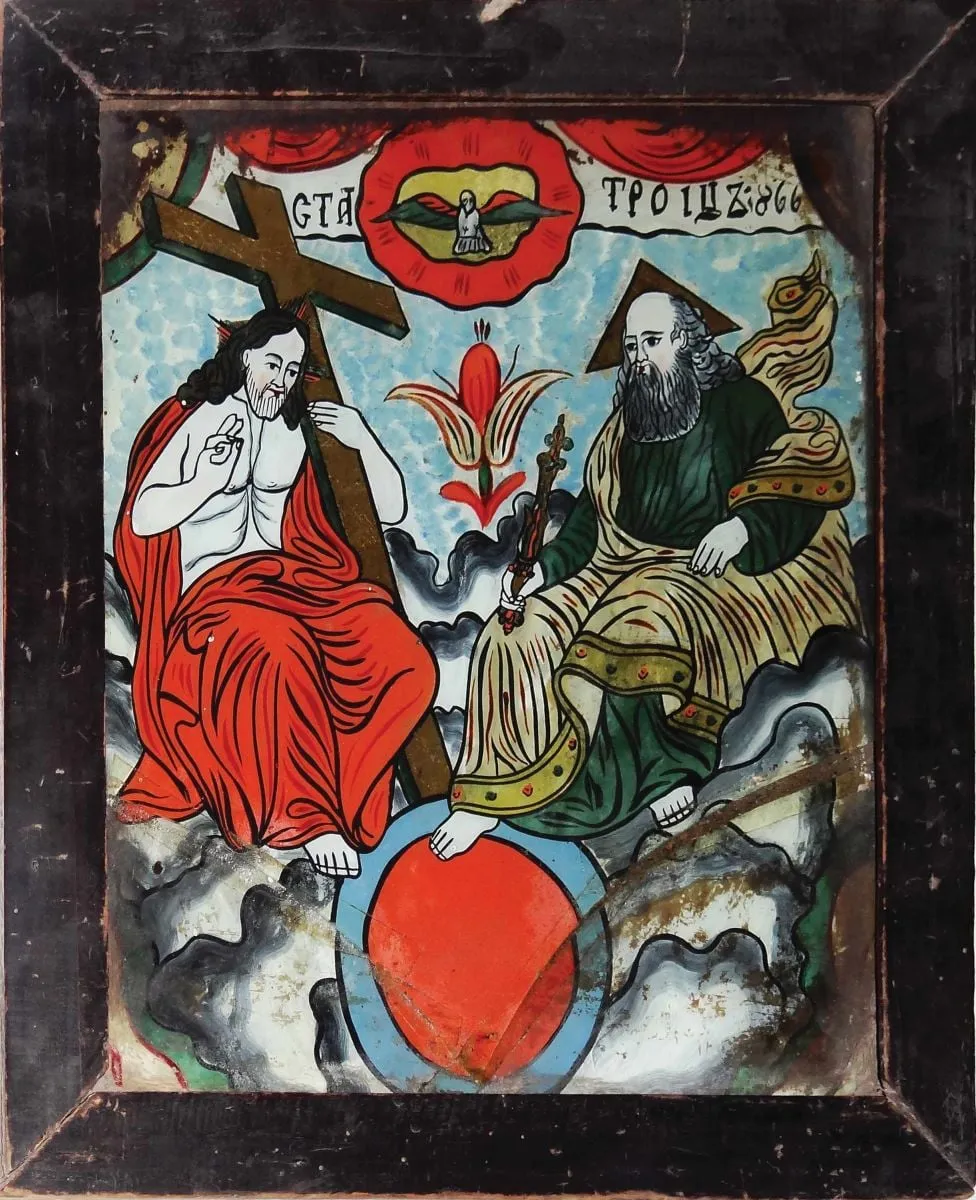
Sfânta Treime nou-testamentară is an unspecified painting by the Byzantine icon painting artist Unknown. It dates from 1866 and is held in the collection of the Alba Iulia Unification National Museum. This religious image depicts the Holy Trinity as described in the New Testament, rendered in a stylized, non-naturalistic manner.
About this work
Overview
This religious image depicts the Holy Trinity as described in the New Testament, rendered in a stylized, non-naturalistic manner. Three figures are arranged hierarchically against a pale blue sky dotted with gold stars and clouds. The composition emphasizes symbolic presence over physical realism, using flat areas of color and strong outlines to define form and meaning.
Subject & Meaning
The painting illustrates the Trinity through three distinct figures: a standing man holding a cross, representing Christ; a seated, bearded figure in gold and green, symbolizing God the Father; and a dove encircled in red, signifying the Holy Spirit. Each element follows established Christian iconography, conveying theological unity through visual hierarchy and traditional attributes rather than narrative action.
Technique & Style
The background’s pale blue and gold stars suggest a celestial realm, reinforcing the sacred nature of the scene.
The work employs a flat, decorative style with minimal shading and bold, clear outlines. Colors are saturated and unmodulated—red, gold, and green dominate—creating visual emphasis without depth. The background’s pale blue and gold stars suggest a celestial realm, reinforcing the sacred nature of the scene. The figures appear static, prioritizing symbolic clarity over anatomical or spatial realism.
History & Provenance
Though specific origins are unrecorded, the style aligns with Eastern Orthodox icon traditions from the late medieval or early modern period. Such images were typically produced for devotional use in churches or private chapels, following established models passed through artisan workshops. The lack of individual artistic signature reflects its function as a liturgical object rather than a personal expression.
Context
In Orthodox Christian practice, images of the Trinity were rare and carefully regulated due to theological concerns about depicting the divine. When rendered, they often used symbolic figures rather than literal representations. This painting reflects a cautious adherence to doctrine, using established symbols to express mystery without anthropomorphizing the divine essence.
Legacy
This image remains an example of how religious traditions translated complex theological concepts into accessible visual forms. Its enduring structure—three figures, dove, celestial backdrop—has influenced later devotional art in Eastern Europe. Though stylistically archaic, its symbolic language continues to inform liturgical imagery in communities that maintain traditional iconography.
Artist & collection
Museum
Alba Iulia Unification National Museum
Continue through works from the same source collection.
 Domestic Scene
 Giacomo and Cardinal Marco, investing Andrea, Abbot of San Zeno, with his Benefice
 The Nymph of Fontainebleau
 Portrait of a Woman
 Madonna and Child with Saints in the Enclosed Garden
 Venus and Minerva
 Family Group of Four on Sofa
 Wall painting from Room H of the Villa of P. Fannius Synistor at Boscoreale
 Sf. Treime nou-testamentară
 Învierea lui IS XS
 Sf. Treime
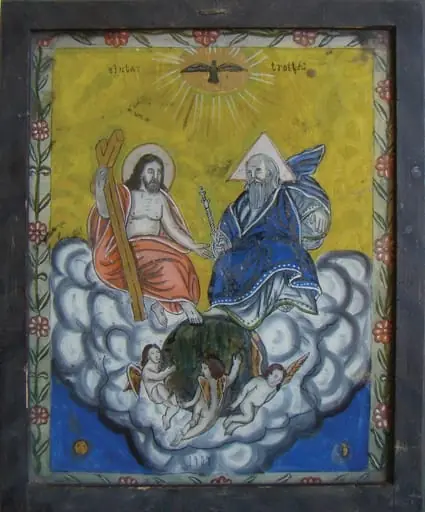
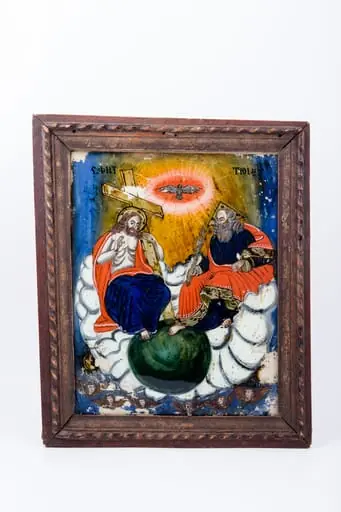 Dumnezeu-Fiul ține Crucea pe umărul stâng, Dumnezeu-Tatăl are aureolă triunghiulară, reprezentând Sfânta Treime. Tatăl și Fiul sunt înveșmântați în roșu vermillon și albastru cobalt și se sprijină amândoi cu tălpile goale de sfera Pământului, de culoare verde smarald. În registrul îndepărtat superior este cerul albastru, cu o deschidere galbenă de lumină, de unde se pogoară Sfântul Duh, sub forma porumbelului, pe un mănunchi de raze luminoase. În registrul inferior este o mandorlă mare de nouri albi, pe care se sprijină întreaga compoziție treimic-iconografică. Inscripția din româno-chirilică se traduce Sfânta Treime. Cromatica este vie și puternică: roșu vermillon, galben-ocru, orange, albastru cobalt, alb, negru. Este o icoană greco-catolică, din Mărginimea Sibiului, necanonică.
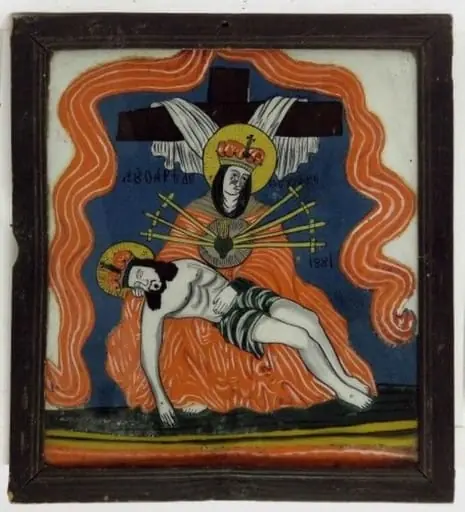 Coborârea de pe cruce
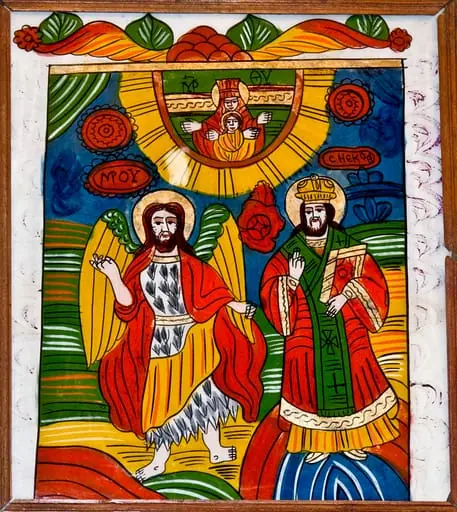 Sfinții Ioan și Nicolae
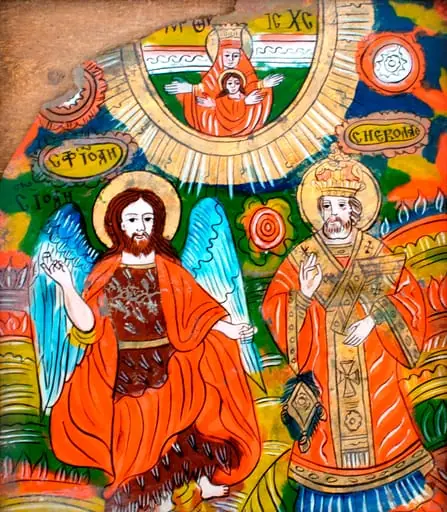 Asociere mai rar întâlnită, probabil comandată special. Icoana îi reprezintă pe în prim plan Sfinții Ioan Botezătorul și Sfântul Nicolae(1/1), deasupra lor Maica Domnului Platytera într-un medalion aurit,înconjurat de raze. Maica are coroană împărătească și îl ține pe Isus copil în poală, ambii avînd brațele desfăcute. Sfântul Ioan este în ipostaza îngerească, înaripat, desculț, binecuvântând cu dreapta, înveșmântat cu haina de păr de cămilă, deasupra mantie roșie. Sfântul Nicolae este prezentat în ipostaza de mare ierarh, cu însemnele episcopale(mitră pe cap, sacos, epitrahil decorat cu cruci și motive florale, bedernița cu franjuri și motive geometrice) Relief stilizat, alternanță de benzi ondulate multicolore, și registre cu elemente fitomorfe. Inscripțiile în chenare, numele sfântului Ioan dublat în afara chenarului. Câmp albastru ultramarin, decorat cu pete de culoare și motive astrale stilizate. Medalionul este împărțit în două zone de culoare(galben și verde) printr-o bandă albă cu motiv spiralat(funia răsucită). Cromatica este foarte variată:alb, albastru, verde, roșu, galben, ocru,culori intense. Icoana are colțul stâng lipsă.
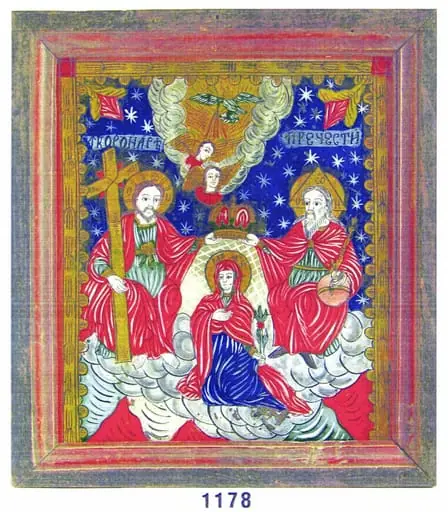 Încoronarea Maicii Domnului
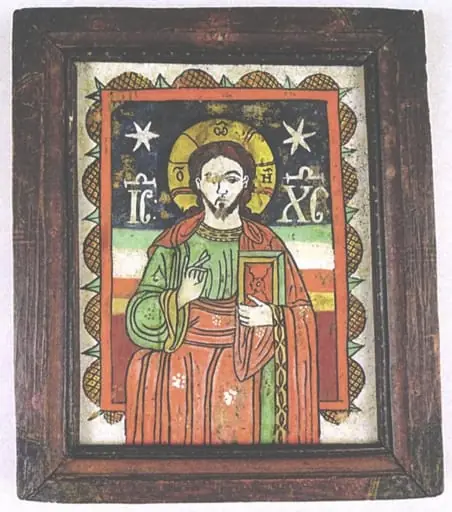 Iisus Hristos binecuvântând
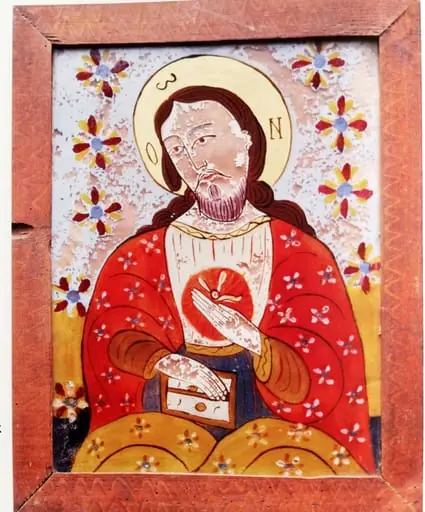 Iisus cu inima