Artwork
Sikh marriage procession
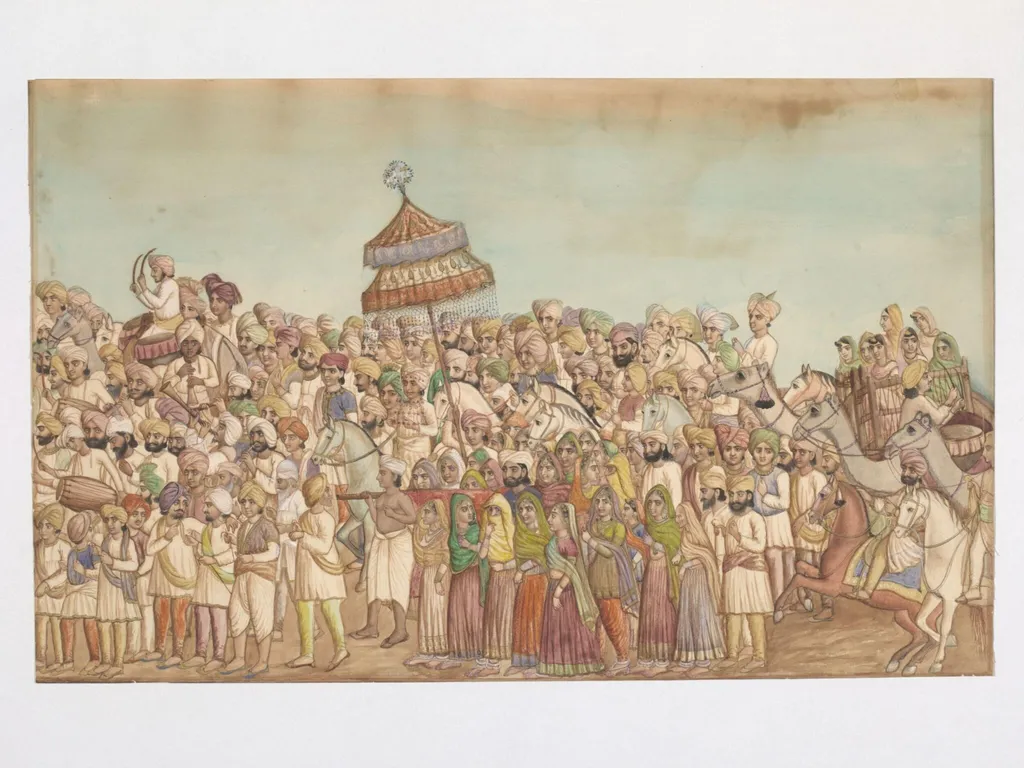
Sikh marriage procession is a paint painting by the Patna School of Painting artist Unknown. It dates from 1860 and is held in the collection of the Victoria and Albert Museum. This painting belongs to the genre known as Company painting, created by Indian artists for European patrons during the colonial period.
About this work
Overview
This painting belongs to the genre known as Company painting, created by Indian artists for European patrons during the colonial period.
This painting belongs to the genre known as Company painting, created by Indian artists for European patrons during the colonial period. Produced in the Punjab around 1860, it reflects a transitional phase in regional art following British annexation in 1849. Unlike more established centers of Company painting, the Punjab had limited exposure to European artistic conventions prior to this time, making this work a relatively uncommon example from the region.
Subject & Meaning
The scene captures a Sikh wedding procession, with the groom mounted on horseback, accompanied by a parasol-bearer and a dense crowd of attendees. The event is rendered with attention to social detail and ceremonial dress, suggesting a celebration of community and status. While rooted in local tradition, the composition’s clarity and spatial organization reflect the expectations of a European viewer seeking ethnographic documentation rather than spiritual symbolism.
Technique & Style
The artist blends Indian miniature traditions with Western naturalism, employing linear perspective and subtle shading to suggest depth. Figures are rendered with individualized features, and the use of chiaroscuro enhances volume without fully abandoning flat decorative elements typical of Punjabi painting. Color remains vivid and localized, preserving regional aesthetics even as compositional structure leans toward European conventions of observation and order.
History & Provenance
Created shortly after the British annexation of the Punjab in 1849, the painting emerged under the influence of Henry Lawrence, the British Resident in Lahore, who encouraged local artists to produce visual records for colonial audiences. Unlike in Bengal or Madras, where Company painting flourished commercially, Punjab’s output remained limited due to recent political upheaval and slower cultural integration, making this work a rare surviving example from the area.
Context
Prior to British rule, the Punjab had little tradition of secular painting for external consumption. Artistic production was largely religious or courtly, and European styles were virtually absent. The arrival of colonial administrators introduced new demands for imagery documenting local customs, prompting a brief, localized shift in artistic practice. This painting is part of that fleeting adaptation, occurring in a region still adjusting to new political and cultural realities.
Legacy
As one of the few surviving Company paintings from the Punjab, it serves as a material record of early colonial cultural exchange. It illustrates how local artists navigated new patronage systems without fully abandoning indigenous visual languages. Though the genre faded with the rise of photography and changing colonial attitudes, such works remain important for understanding the complex negotiations of identity and representation in 19th-century India.
Artist & collection

 Domestic Scene
 Giacomo and Cardinal Marco, investing Andrea, Abbot of San Zeno, with his Benefice
 The Nymph of Fontainebleau
 Portrait of a Woman
 Madonna and Child with Saints in the Enclosed Garden
 Venus and Minerva
 Family Group of Four on Sofa
 Wall painting from Room H of the Villa of P. Fannius Synistor at Boscoreale
 A Muharram scene
 Captain James Tod riding an elephant with his companions and escort
 Portrait of Maharaja Ali Jah Daulat Rao Sindhia of Gwalior
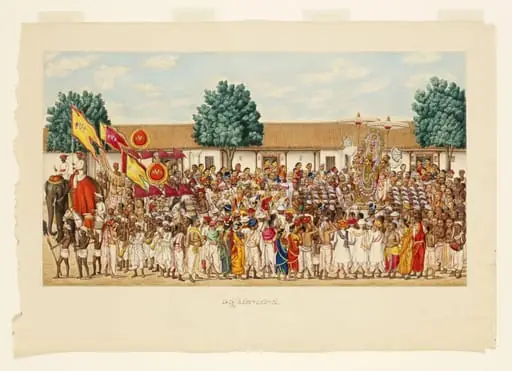 Vishnu on Garuda
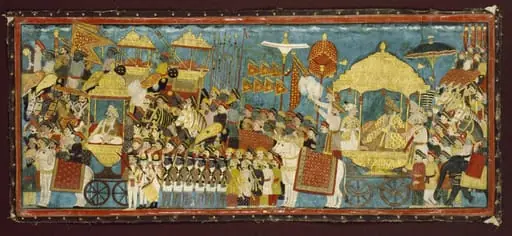 Processional scene with Amar Singh, ruler of Thanjavur (Tanjore), and Sarabhoji
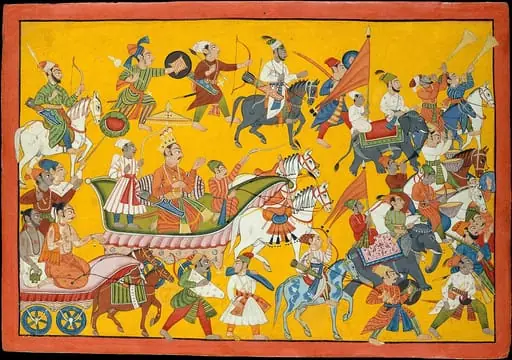 Untitled
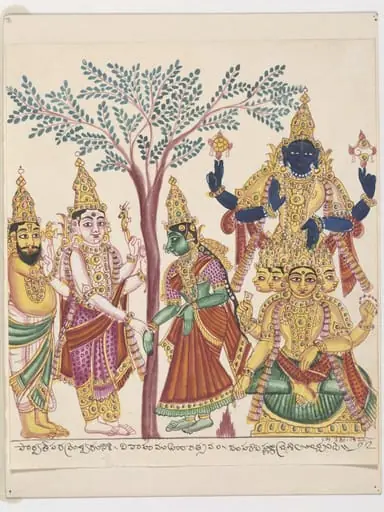 The marriage of Shiva and Parvati (Kalyanasundaramurti).