Artwork
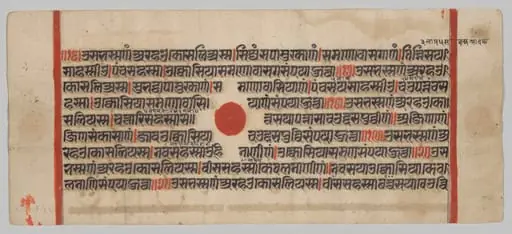
Text, Folio 26 (recto), from a Kalpa-sutra
Text, Folio 26 (recto), from a Kalpa-sutra is an unspecified painting by the Mughal Painting artist Unknown. It dates from 1488 and is held in the collection of the Cleveland Museum of Art. This folio originates from a Kalpa-sutra manuscript, a Jain religious text written in Sanskrit.
About this work
Overview
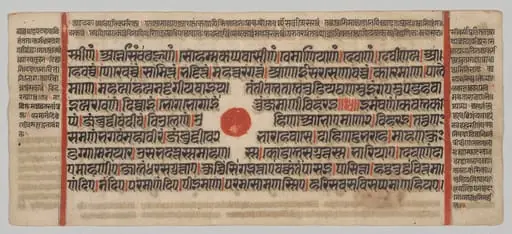
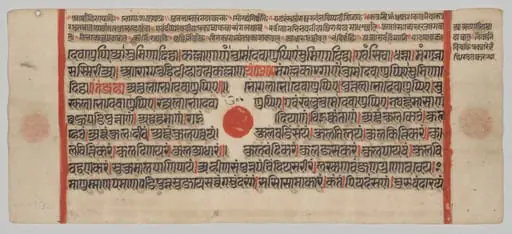
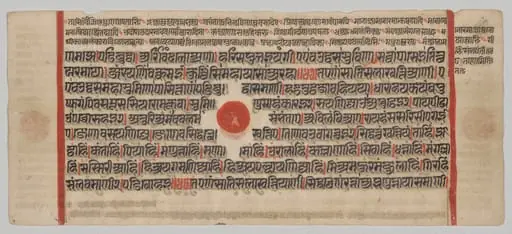
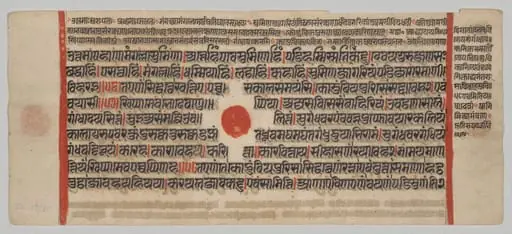
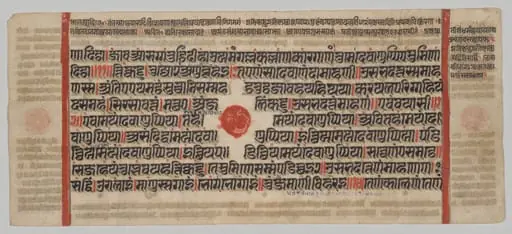
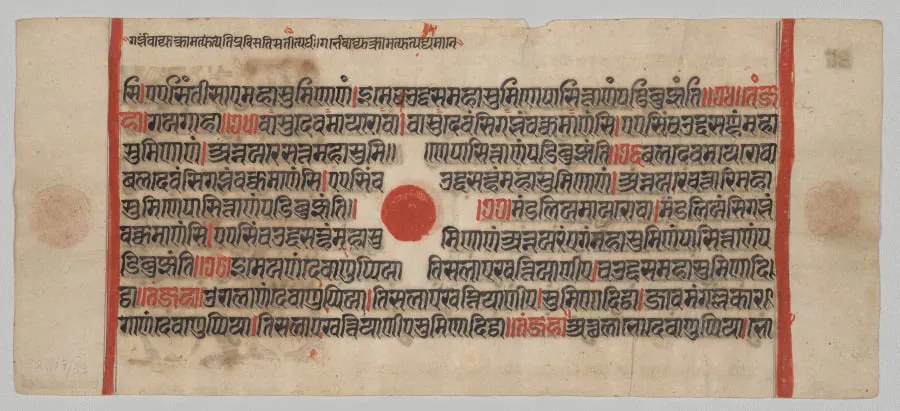
The page is densely covered in small, black ink script arranged in orderly lines, with selective red highlights and a central red circle containing a dot.
This folio originates from a Kalpa-sutra manuscript, a Jain religious text written in Sanskrit. The page is densely covered in small, black ink script arranged in orderly lines, with selective red highlights and a central red circle containing a dot. The paper shows signs of age—faded edges and surface wear—indicating prolonged use. The formatting suggests a liturgical or instructional function, guiding readers through sacred passages.
Subject & Meaning
The text likely contains passages from the Kalpa-sutra, detailing the lives and teachings of Jain Tirthankaras. Red markings may denote key doctrinal phrases, ritual instructions, or liturgical pauses. The central red circle with a dot could symbolize the Jain concept of the soul (jiva) or serve as a visual anchor for meditative reading. These features reflect a tradition where script itself carries spiritual weight.
Technique & Style
The script is executed in a precise, minuscule hand typical of Jain scribal practices. Red ink, derived from vermilion or cinnabar, was used sparingly for emphasis, contrasting with the dominant black iron-gall ink. The uniformity of lettering and minimal ornamentation align with ascetic aesthetic values, prioritizing clarity and reverence over decorative excess. The paper’s texture and wear suggest hand-produced, locally sourced materials.
History & Provenance
This folio likely dates to the late medieval period, between the 14th and 16th centuries, produced in western India, possibly Gujarat or Rajasthan. Jain monastic communities commissioned such manuscripts for ritual recitation and study. Its survival indicates careful preservation within temple or monastery libraries, though its current condition reflects centuries of handling and environmental exposure.
Context
Contemporary to late medieval India, this manuscript exists outside the European Renaissance tradition. While Western manuscripts of the same era emphasized illumination and gold leaf, Jain texts favored textual purity and symbolic minimalism. The use of color for functional emphasis, rather than ornament, reflects a distinct devotional culture where the word itself was sacred, not the image.
Legacy
Folios like this preserve the continuity of Jain scholarly and liturgical traditions. They represent a non-Western model of textual authority, where precision and restraint in presentation reinforce doctrinal integrity. Modern scholars rely on such manuscripts to reconstruct Jain history, linguistic evolution, and monastic pedagogy, offering insight into a sustained tradition of handwritten sacred literature.
Artist & collection

 Domestic Scene
 Giacomo and Cardinal Marco, investing Andrea, Abbot of San Zeno, with his Benefice
 The Nymph of Fontainebleau
 Portrait of a Woman
 Madonna and Child with Saints in the Enclosed Garden
 Venus and Minerva
 Family Group of Four on Sofa
 Wall painting from Room H of the Villa of P. Fannius Synistor at Boscoreale