Artwork
The Crucifixion
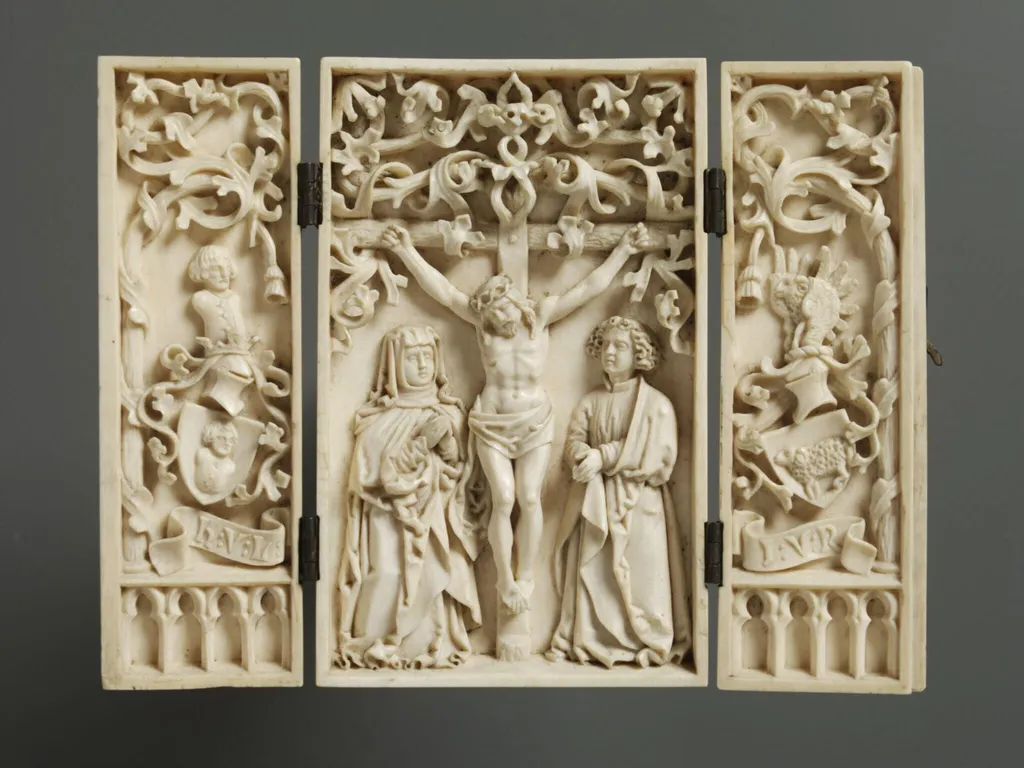
The Crucifixion is a work on paper by the Romanticist artist Unknown. It dates from 1845 and is held in the collection of the Victoria and Albert Museum.
About this work
Overview
Though styled to resemble late medieval German or French religious carvings, its materials, execution, and heraldic details reveal it as a deliberate pastiche.
This ivory triptych portrays the Crucifixion in a portable devotional format, likely crafted in the mid-nineteenth century. Though styled to resemble late medieval German or French religious carvings, its materials, execution, and heraldic details reveal it as a deliberate pastiche. The work combines carved ivory panels with ornate silver mounts, suggesting it was made for collectors rather than liturgical use.
Subject & Meaning
The central panel depicts Christ on the cross, flanked by the Virgin Mary and John the Evangelist, following traditional Passion iconography. The side panels feature heraldic shields bearing the initials H.V.I and I.V.R., possibly invented to evoke noble patronage. These symbols, though styled after fifteenth-century heraldry, lack historical accuracy, indicating a romanticized rather than devotional intent.
Technique & Style
The carving is precise but lacks the subtle wear and organic imperfections of medieval ivory work. The architectural framing shows anachronistic arcading, and the silver mounts are mechanically crafted, inconsistent with pre-modern metalwork. The composition draws from German woodcut traditions, particularly in its linear clarity and flattened space, but the overall effect is overly refined and artificial.
History & Provenance
A closely related triptych resides in the Kestner Museum, Hanover, documented in a 1923 study of ivory carvings. Both works are now understood as nineteenth-century productions, likely made to satisfy the Gothic Revival market. Their pristine condition, absence of documented provenance before the 1800s, and stylistic inconsistencies mark them as revivalist fabrications rather than medieval relics.
Context
During the early to mid-1800s, there was renewed interest in medieval religious art among collectors and museums. Artisans responded by producing small devotional objects in archaic styles, often blending authentic motifs with modern techniques. Portable triptychs, once used by travelers for private prayer, were reimagined as decorative curiosities, divorced from their original spiritual function.
Legacy
This triptych exemplifies the nineteenth-century trend of reviving medieval forms for aesthetic rather than religious purposes. While it reflects genuine engagement with historical styles, its inaccuracies serve as a reminder of how revivalism can distort cultural memory. Today, it is studied not as a medieval artifact but as a product of its own time’s fascination with the past.
Artist & collection

 Domestic Scene
 Giacomo and Cardinal Marco, investing Andrea, Abbot of San Zeno, with his Benefice
 The Nymph of Fontainebleau
 Portrait of a Woman
 Madonna and Child with Saints in the Enclosed Garden
 Venus and Minerva
 Family Group of Four on Sofa
 Wall painting from Room H of the Villa of P. Fannius Synistor at Boscoreale
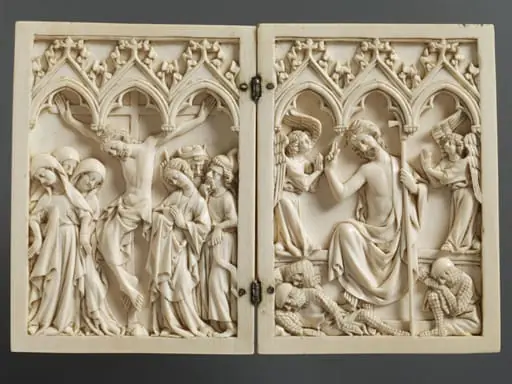 Diptych
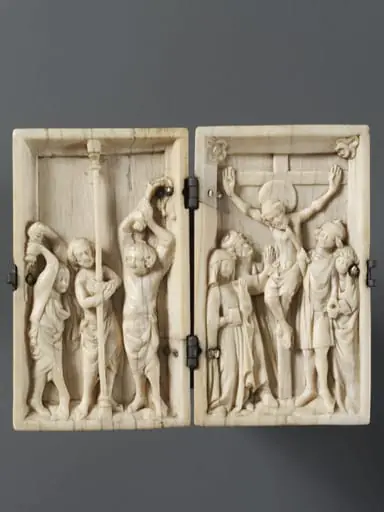 Scourging of Christ and the Crucifixion
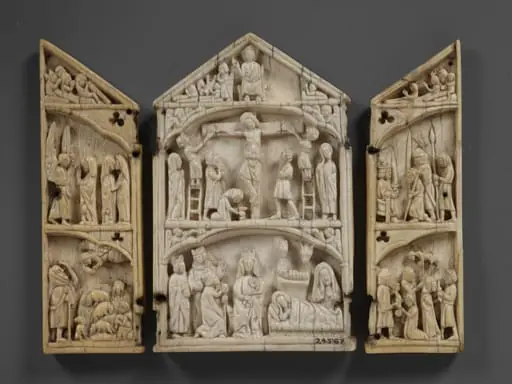 The Nativity with the Adoration of the Magi, the Crucifixion and the Last Judgement
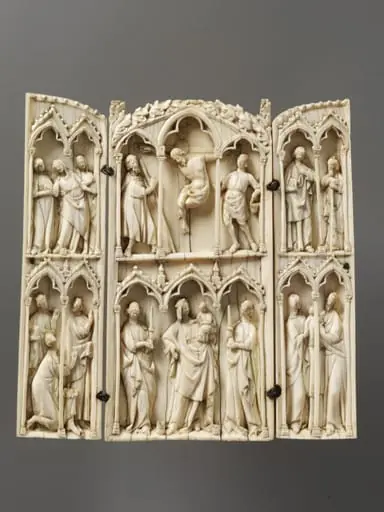 The Crucifixion, the Virgin and Child and Scenes from the Life of Christ
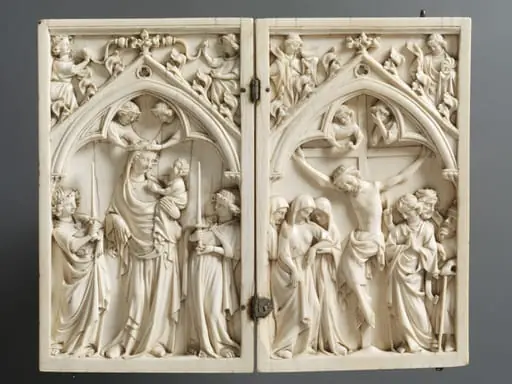 The Virgin and Child and the Crucifixion
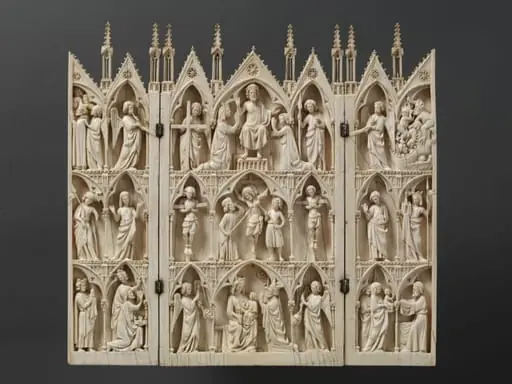 The Virgin and Child, the Crucifixion and the Last Judgement
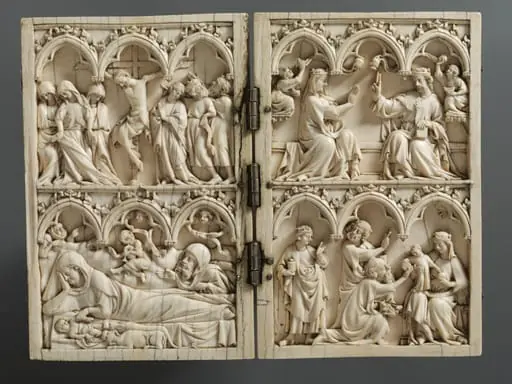 The Nativity, the Adoration of the Magi, the Crucifixion and the Coronation of the Virgin
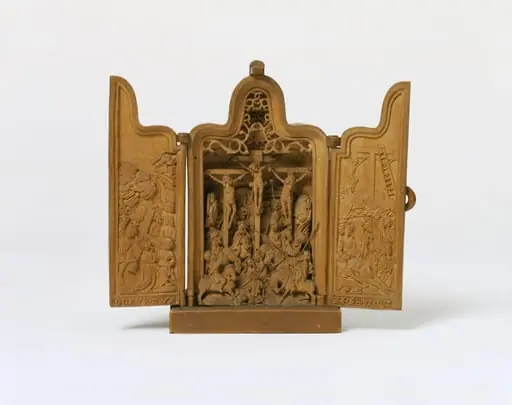 The Crucifixion of Christ
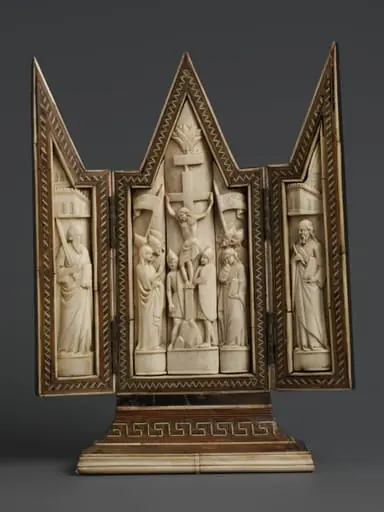 The Crucifixion
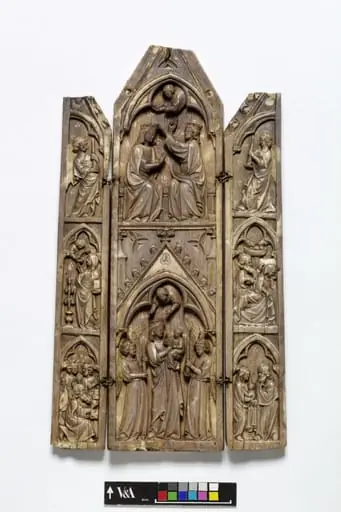 Virgin and Child, the Coronation of the Virgin and scenes from the Nativity
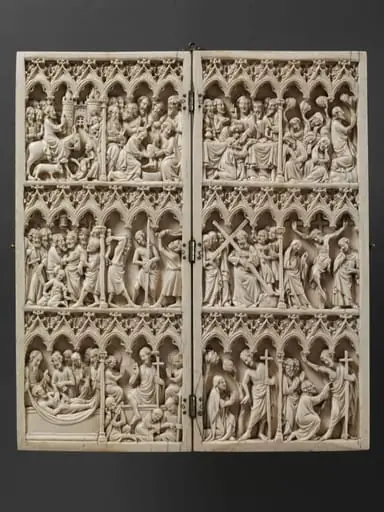 Scenes from the Passion of Christ
 Christ in Majesty and the Coronation of the Virgin