Artwork
The gardener seizes and beats a donkey who insisted on braying, while the deer, its companion flees to safety, from a Tuti-nama (Tales of a Parrot): Forty-first Night
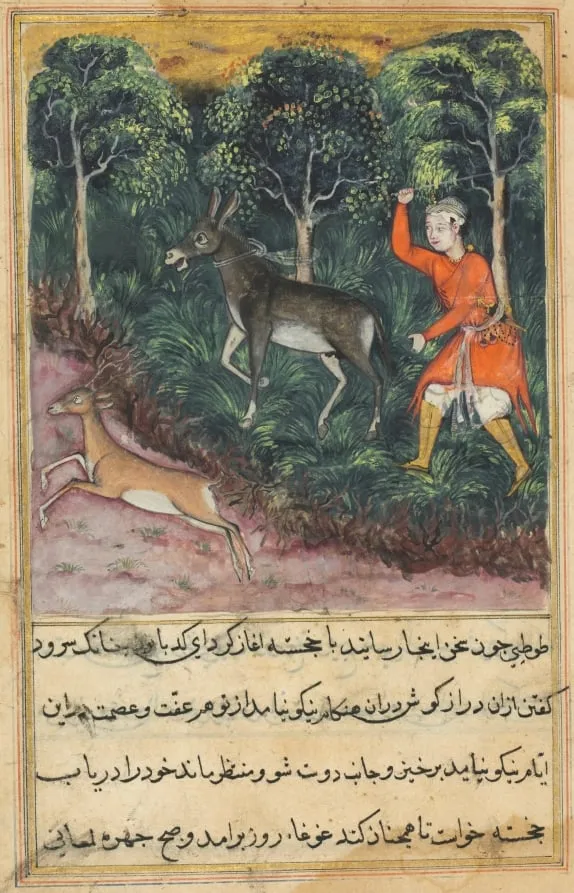
The gardener seizes and beats a donkey who insisted on braying, while the deer, its companion flees to safety, from a Tuti-nama (Tales of a Parrot): Forty-first Night is an unspecified painting by the Mughal Painting artist Unknown. It dates from 1560 and is held in the collection of the Cleveland Museum of Art.
About this work
To see more paintings like this, look up Mughal India, court of Akbar (reigned 1556–1605).
A gardener swings a stick at a tied-up donkey while a deer bolts away. The donkey’s mouth is open—mid-bray—its legs tangled in rope.
This painting comes from a book of parrot tales made for Emperor Akbar’s court. The story warns against ignoring good advice. The deer tried to stop the donkey’s loud singing, but the donkey wouldn’t listen. Now it’s paying the price.
To see more paintings like this, look up Mughal India, court of Akbar (reigned 1556–1605).
Overview
The painting depicts a scene from the forty‑first night of the *Tuti‑nama* (Tales of a Parrot), a manuscript created for the court of the Mughal emperor Akbar (r. 1556–1605). In the composition a gardener, brandishing a staff, prepares to strike a donkey that is bound by rope, while a deer flees from the disturbance. The donkey’s mouth is open in the act of braying, its limbs tangled in the cords.
Subject & Meaning
The narrative illustrates a moral lesson: the donkey, warned by the deer that its noisy, abrasive braying would bring trouble, ignores the counsel and suffers the gardener’s punishment. The fleeing deer symbolizes the ignored voice of reason, emphasizing the consequences of obstinacy and the value of heeding prudent advice.
Technique & Style
Rendered in the Mughal miniature tradition, the work combines precise line work with a limited but vivid palette typical of courtly manuscripts. The figures are stylized, the gardener’s gesture exaggerated, and the animal forms are delineated with careful attention to movement, creating a dynamic tableau within the confined space of the page.
Context
The scene originates from a collection of parrot tales compiled for Akbar’s imperial library, reflecting the emperor’s patronage of illustrated literature. Such manuscripts were produced in workshops attached to the royal atelier, where artists blended Persian influences with indigenous Indian elements, documenting moral stories for elite audiences.
Artist & collection

 Domestic Scene
 Giacomo and Cardinal Marco, investing Andrea, Abbot of San Zeno, with his Benefice
 The Nymph of Fontainebleau
 Portrait of a Woman
 Madonna and Child with Saints in the Enclosed Garden
 Venus and Minerva
 Family Group of Four on Sofa
 Wall painting from Room H of the Villa of P. Fannius Synistor at Boscoreale
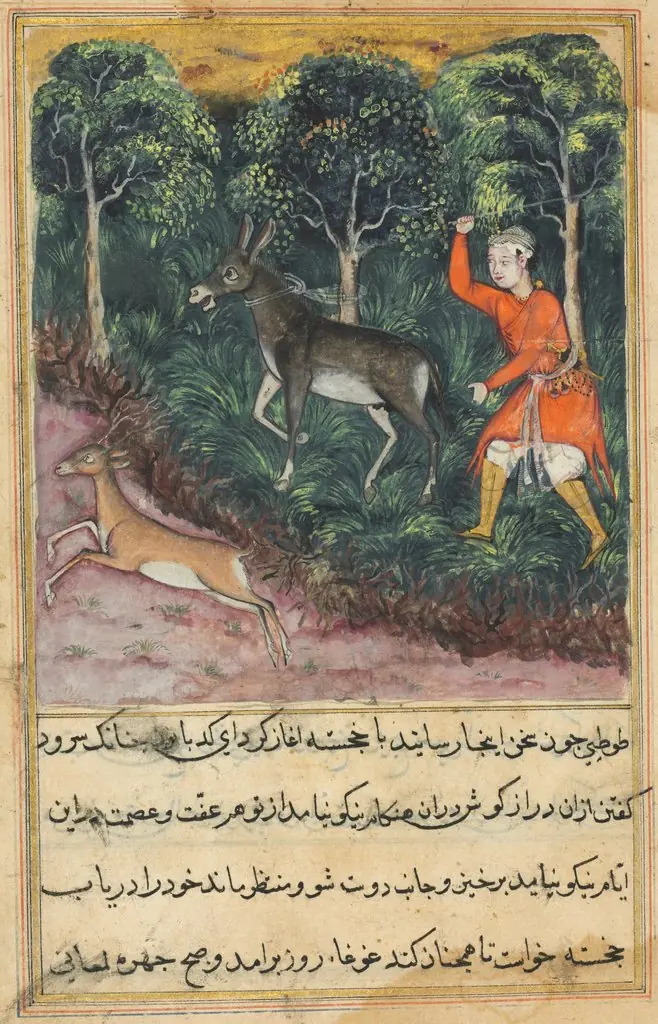 The gardener seizes and beats a donkey who insisted on braying, while the deer, its companion flees to safety, from a Tuti-nama (Tales of a Parrot): Forty-first Night
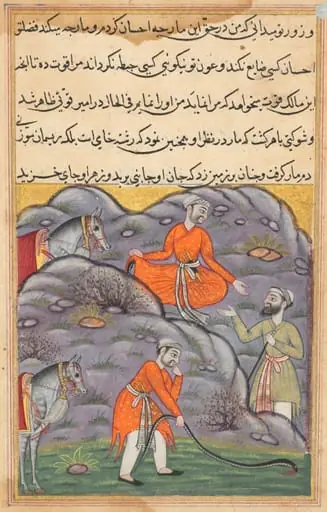 The emir slays the snake after giving it shelter, from a Tuti-nama (Tales of a Parrot): Forty-fifth Night
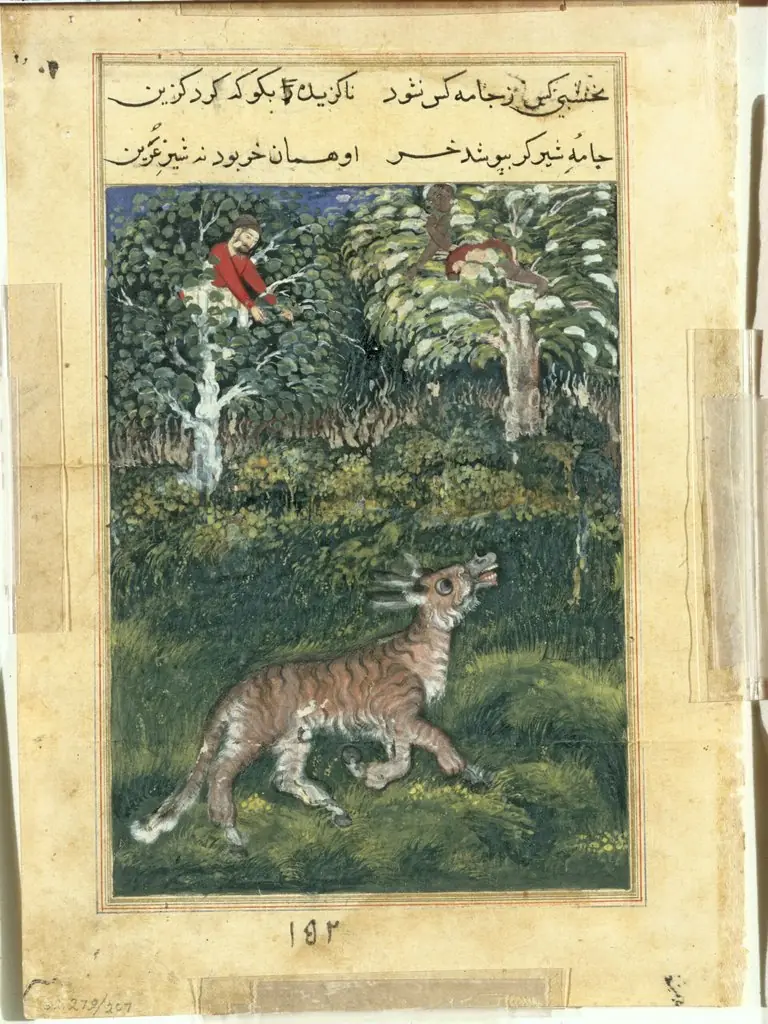 The donkey, in a tiger’s skin, reveals his identity by braying aloud, from a Tuti-nama (Tales of a Parrot): Thirty-first Night
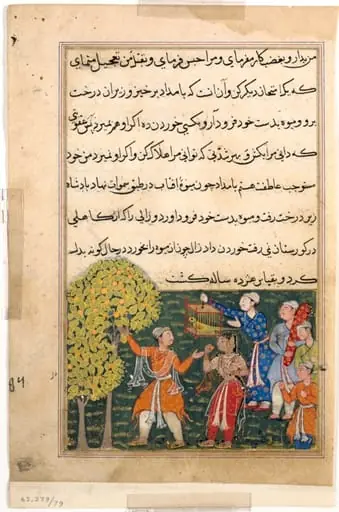 The king plucks fruit from the Tree of Life with his own hands and feeds it to a lady, from a Tuti-nama (Tales of a Parrot): Ninth Night
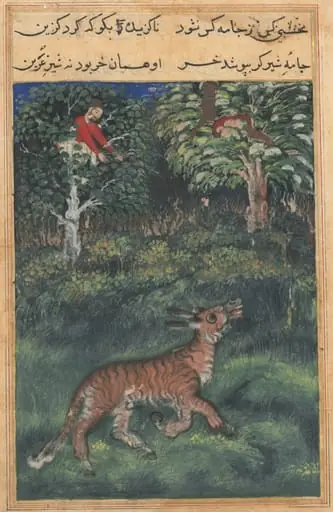 The donkey, in a tiger’s skin, reveals his identity by braying aloud, from a Tuti-nama (Tales of a Parrot): Thirty-first Night
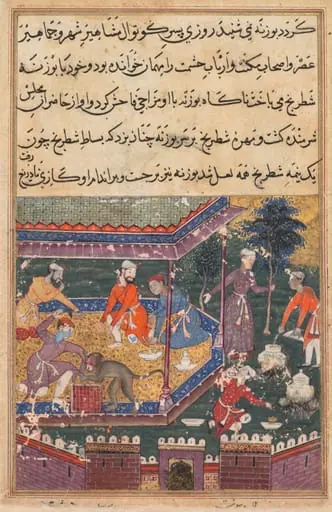 The wounded monkey bites the hand of the prince, his chessmate, in the presence of guests, from a Tuti-nama (Tales of a Parrot): Fifth Night
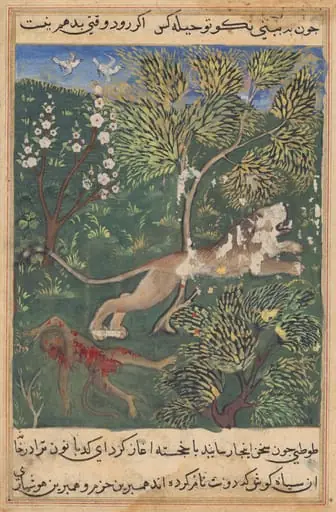 The lion, suspecting treachery on the part of the monkey, slays him and flees, from a Tuti-nama (Tales of a Parrot): Twenty-ninth Night
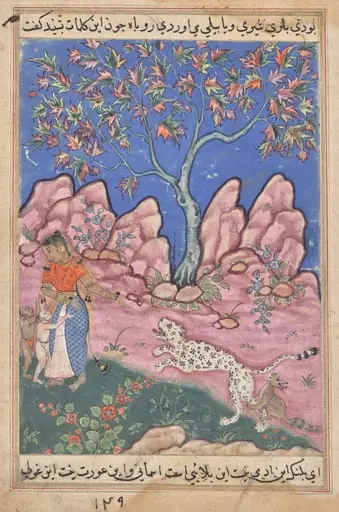 The woman conversing with her children, as the leopard returns, egged on by a fox who is tied to his leg, from a Tuti-nama (Tales of a Parrot): Thirtieth Night