Artwork
The emir slays the snake after giving it shelter, from a Tuti-nama (Tales of a Parrot): Forty-fifth Night
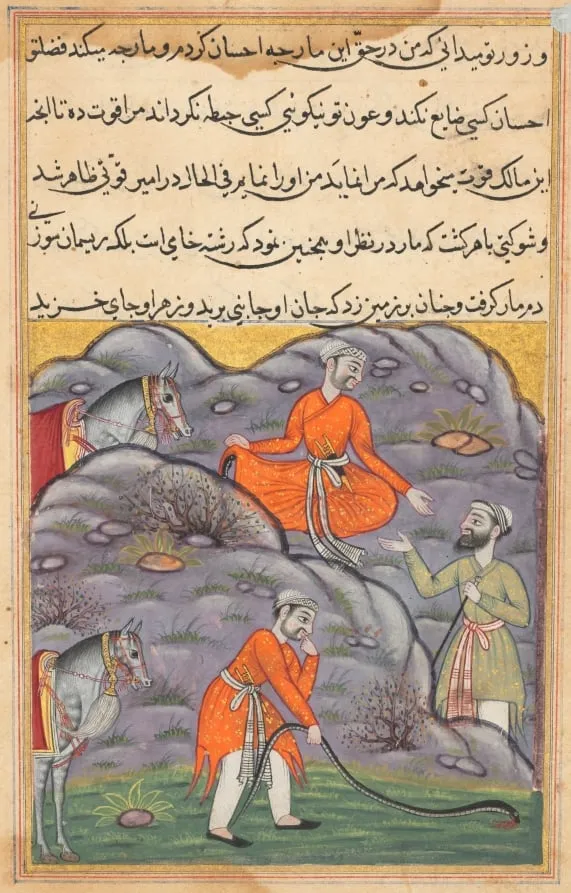
The emir slays the snake after giving it shelter, from a Tuti-nama (Tales of a Parrot): Forty-fifth Night is an unspecified painting by the Mughal Painting artist Unknown. It dates from 1560 and is held in the collection of the Cleveland Museum of Art. This painting is one of forty-eight illustrations from the Tuti-nama, a manuscript commissioned by the Mughal emperor Akbar.
About this work
To see more work from this time, look up *Mughal India, court of Akbar (reigned 1556–1605)*.
You see a small painting split into two scenes: in the top, a man in orange talks to another man while a snake hides under his robe; in the bottom, the same man smashes the snake on the ground.
This is from a book of parrot tales made for Emperor Akbar’s court. The story warns about trusting the untrustworthy—even when you’ve shown kindness. The snake is tiny, almost missed, but it changes everything.
To see more work from this time, look up *Mughal India, court of Akbar (reigned 1556–1605)*.
Overview
This painting is one of forty-eight illustrations from the Tuti-nama, a manuscript commissioned by the Mughal emperor Akbar. It depicts a single fable across two sequential scenes, illustrating the consequences of misplaced trust. The narrative unfolds vertically: first, the emir offers shelter to a snake; later, he destroys it after discovering its intent to harm him. The work exemplifies the Mughal court’s interest in moral storytelling through visual art.
Subject & Meaning
The tale warns against extending kindness to those whose nature is inherently deceitful. The emir’s act of mercy is met with betrayal, and his swift retaliation underscores the moral that danger can lurk beneath apparent vulnerability. The snake’s near-invisibility in the upper scene heightens the tension, suggesting that threats are often concealed until it is too late to act.
Technique & Style
Executed in opaque watercolor and gold on paper, the painting uses fine brushwork to distinguish figures and subtle details. The two scenes are arranged vertically within a single frame, a common Mughal convention for sequential storytelling. The emir’s orange robe dominates the composition, framing the hidden snake and later serving as the stage for its destruction, guiding the viewer’s eye through the narrative.
History & Provenance
Created in the 1560s at Akbar’s imperial atelier, the Tuti-nama was among the earliest illustrated manuscripts produced under his patronage. It drew from a Persian literary tradition but was reimagined with Indian visual conventions. The manuscript was likely assembled by a team of artists, with this scene attributed to a master painter working in the imperial workshop, possibly under the supervision of Mir Sayyid Ali or Abd al-Samad.
Context
Akbar’s court fostered a vibrant culture of illustrated manuscripts that blended Persian, Indian, and Central Asian influences. The Tuti-nama, based on a 12th-century Arabic collection, was adapted to reflect Mughal values of governance and moral discernment. These stories served not only as entertainment but also as tools for instructing courtiers and heirs in the complexities of power and human nature.
Legacy
The Tuti-nama set a precedent for narrative illustration in Mughal art, influencing later imperial manuscripts such as the Akbarnama. Its integration of moral allegory with precise visual storytelling became a hallmark of the court’s artistic identity. Though the original manuscript is now dispersed, surviving folios remain key to understanding the development of early Mughal painting and its engagement with ethical themes.
Artist & collection

 Domestic Scene
 Giacomo and Cardinal Marco, investing Andrea, Abbot of San Zeno, with his Benefice
 The Nymph of Fontainebleau
 Portrait of a Woman
 Madonna and Child with Saints in the Enclosed Garden
 Venus and Minerva
 Family Group of Four on Sofa
 Wall painting from Room H of the Villa of P. Fannius Synistor at Boscoreale
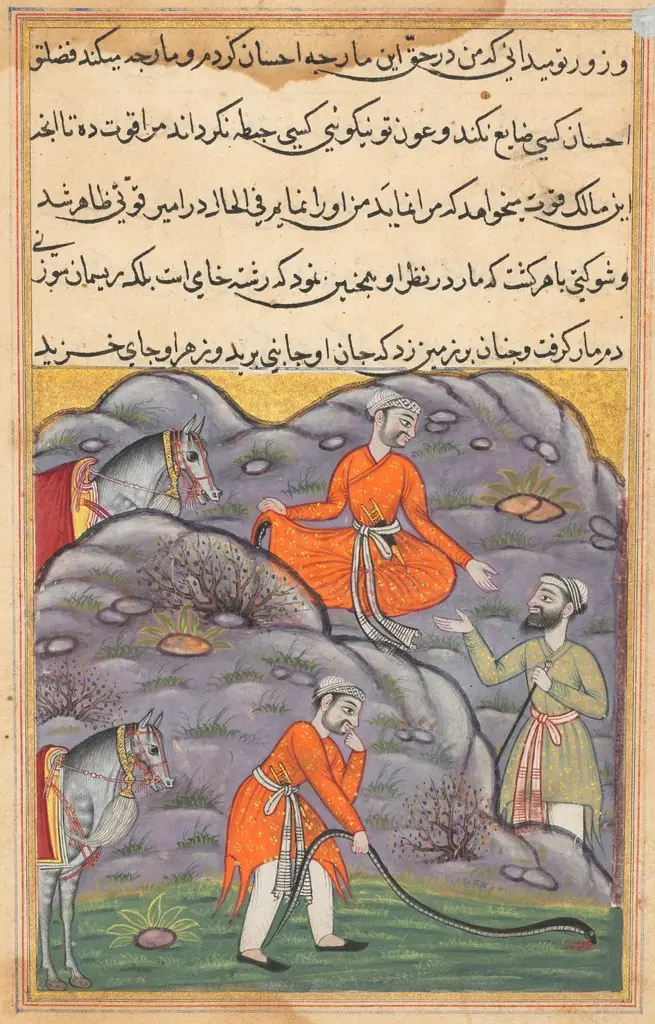 The Emir slays the snake after giving it shelter, from a Tuti-nama (Tales of a Parrot): Forty-fifth Night
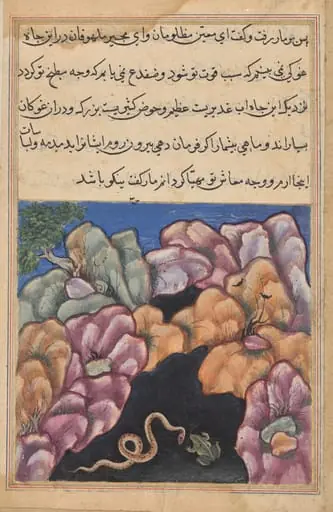 The snake enters into an argument with the frog, from a Tuti-nama (Tales of a Parrot): Twenty-sixth Night
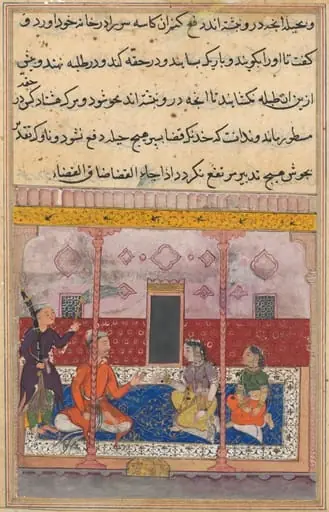 The merchant has the hateful skull ground and put into a box, from a Tuti-nama (Tales of a Parrot): Twenty-third Night
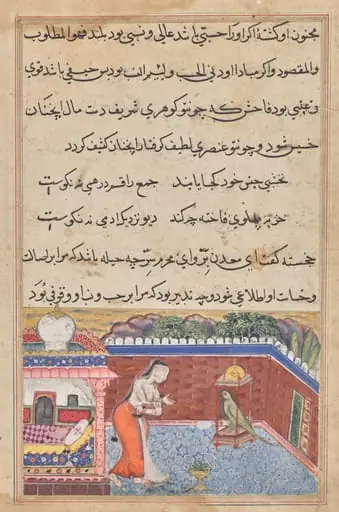 The parrot addresses Khujasta at the beginning of the thirty-first night, from a Tuti-nama (Tales of a Parrot)
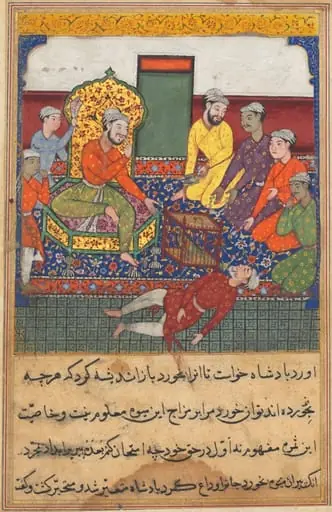 The old man eats of the fruit of the Tree of Life, but drops dead, from a Tuti-nama (Tales of a Parrot): Ninth Night
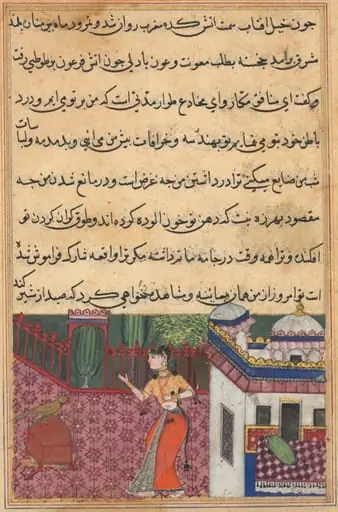 The parrot addresses Khujasta at the beginning of the thirty-third night, from a Tuti-nama (Tales of a Parrot)