Artwork
The son of the pious man slays the dragon, from a Tuti-nama (Tales of a Parrot): Fifty-second Night
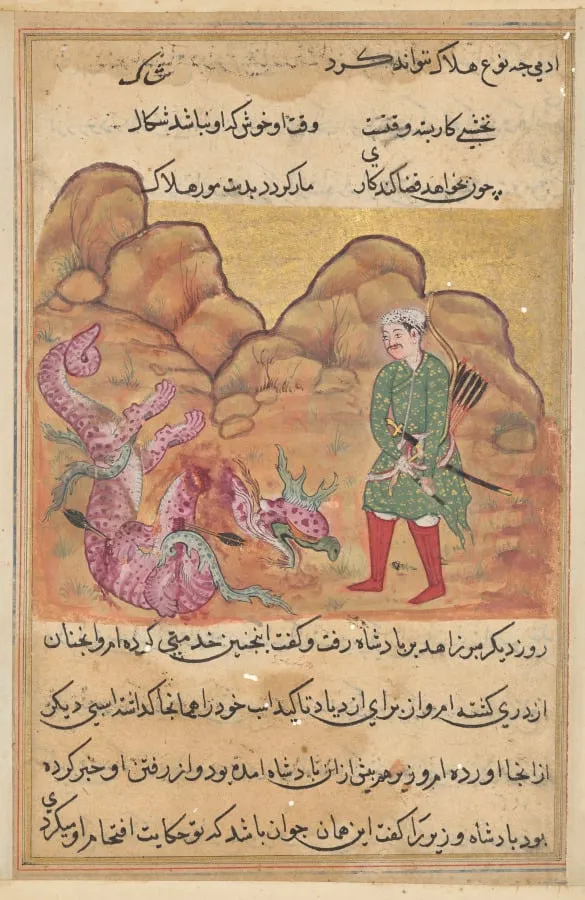
The son of the pious man slays the dragon, from a Tuti-nama (Tales of a Parrot): Fifty-second Night is an unspecified painting by the Mughal Painting artist Unknown. It dates from 1560 and is held in the collection of the Cleveland Museum of Art. The painting illustrates a youthful hero standing triumphantly over a slain dragon, its contorted form pierced by two arrows.
About this work
To see more paintings like this, look up Mughal India, court of Akbar (reigned 1556–1605).
A young man stands over a dead dragon, its body twisted and arrows sticking out. The king’s daughter watches from a balcony above, her face calm.
This painting comes from a book of parrot tales made for Emperor Akbar’s court. The stories were told night after night, and each one got its own picture. The dragon’s death isn’t the end—it’s just one step in a longer tale.
To see more paintings like this, look up Mughal India, court of Akbar (reigned 1556–1605).
Overview
The painting illustrates a youthful hero standing triumphantly over a slain dragon, its contorted form pierced by two arrows. Above the scene, a princess observes from a balcony, her expression composed. The composition captures the moment of victory that enables the hero to pursue marriage with the king’s daughter.
Subject & Meaning
The narrative depicts a young man who has slain a fearsome dragon, a feat traditionally required to win the hand of the monarch’s daughter. By succeeding where other warriors have failed, the hero demonstrates both bravery and destiny, underscoring themes of valor and royal alliance.
Technique & Style
Executed in the Mughal miniature tradition, the work combines delicate brushwork with vivid pigments, rendering the dragon’s twisted body and the figures’ fine details. The use of perspective places the hero at the foreground while the princess is positioned higher, creating a visual hierarchy that emphasizes the hero’s achievement.
History & Provenance
The image originates from a Tuti‑nama, a collection of illustrated parrot tales compiled for Emperor Akbar’s court in the late 16th century. Each night a new story was recited, and a corresponding miniature was produced, linking the artwork to the courtly practice of storytelling.
Context
The painting belongs to the broader corpus of Mughal court art under Akbar (1556–1605), a period noted for its synthesis of Persian, Indian, and Central Asian artistic influences. The narrative reflects the era’s fascination with heroic quests and royal patronage of literary illustration.
Artist & collection

 Domestic Scene
 Giacomo and Cardinal Marco, investing Andrea, Abbot of San Zeno, with his Benefice
 The Nymph of Fontainebleau
 Portrait of a Woman
 Madonna and Child with Saints in the Enclosed Garden
 Venus and Minerva
 Family Group of Four on Sofa
 Wall painting from Room H of the Villa of P. Fannius Synistor at Boscoreale
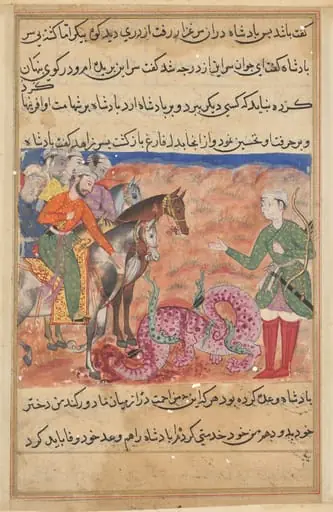 The pious man’s son presents the slain dragon to the king, from a Tuti-nama (Tales of a Parrot): Fifty-second Night
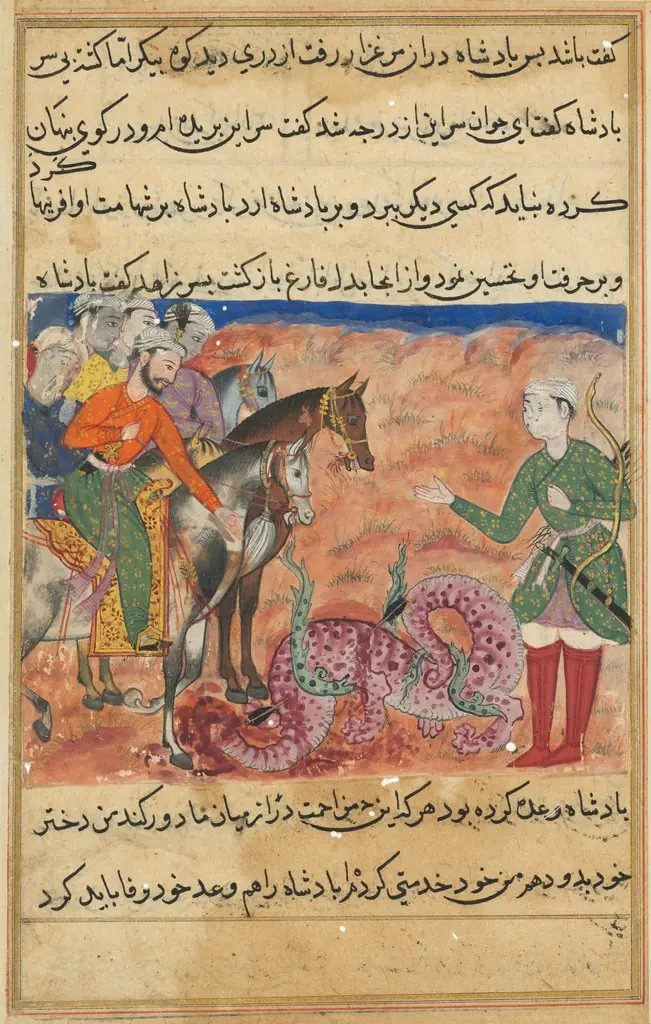 The pious man’s son presents the slain dragon to the king, from a Tuti-nama (Tales of a Parrot): Fifty-second Night
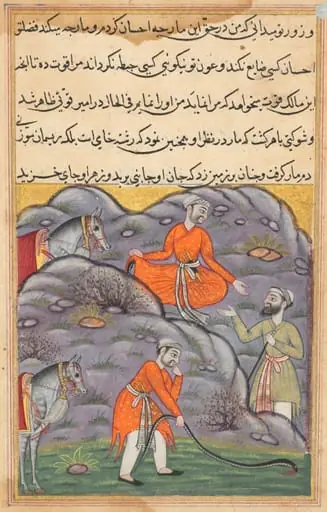 The emir slays the snake after giving it shelter, from a Tuti-nama (Tales of a Parrot): Forty-fifth Night
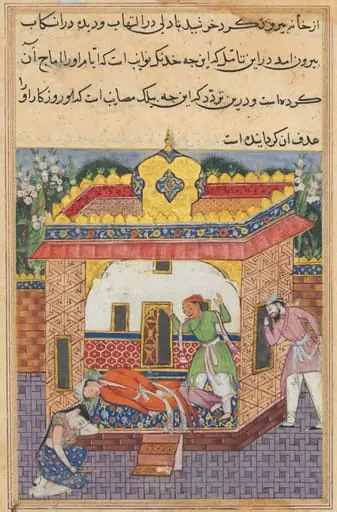 Latif, who has murdered his brother, falsely accuses Khurshid of the deed, from a Tuti-nama (Tales of a Parrot): Thirty-second Night
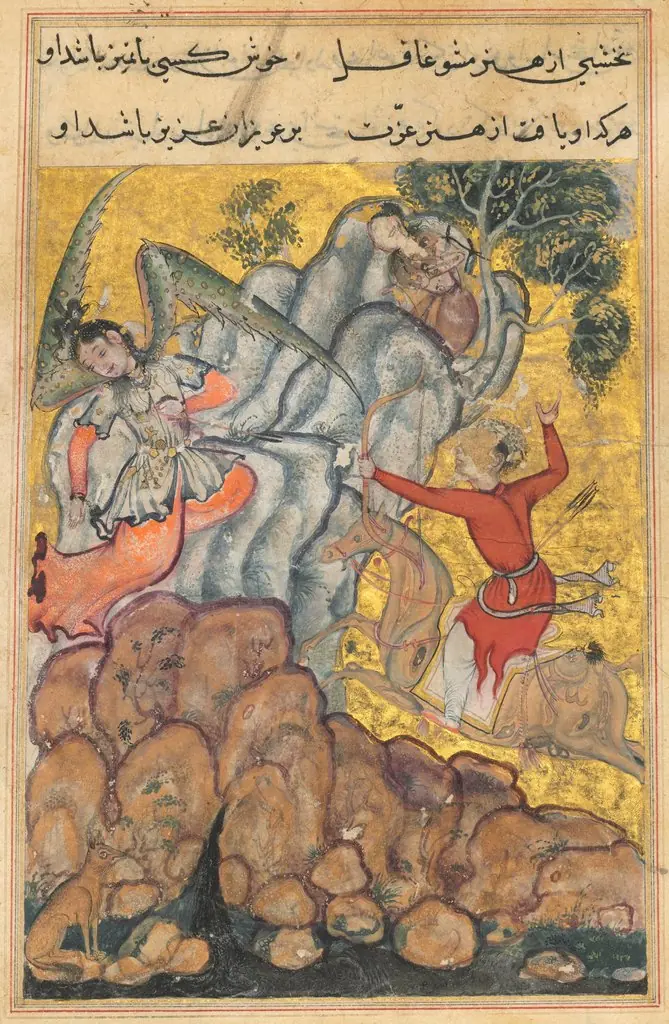 The third suitor, who is an archer, shoots the wicked fairy who has imprisoned Zuhra. He rides on a magic horse prepared by the second suitor and is led to the spot by the divining prowess of the first, from a Tuti-nama (Tales of a Parrot): Thirty-fo
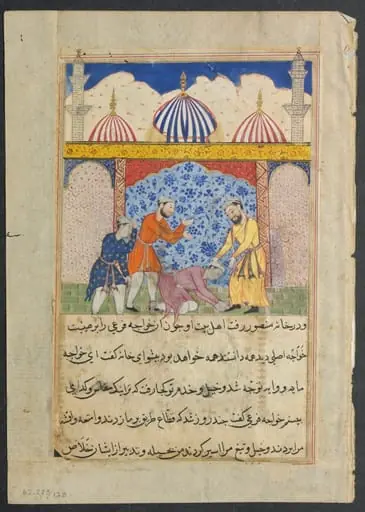 The young man, who has magically taken on the appearance of Mansur the merchant, arrives at his home, from a Tuti-nama (Tales of a Parrot): Seventeenth Night