Artwork
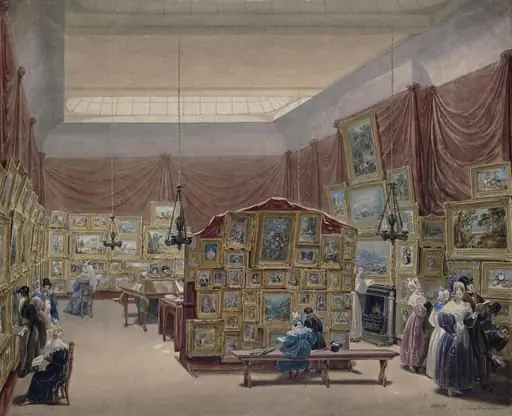
View of Mary Linwood's gallery
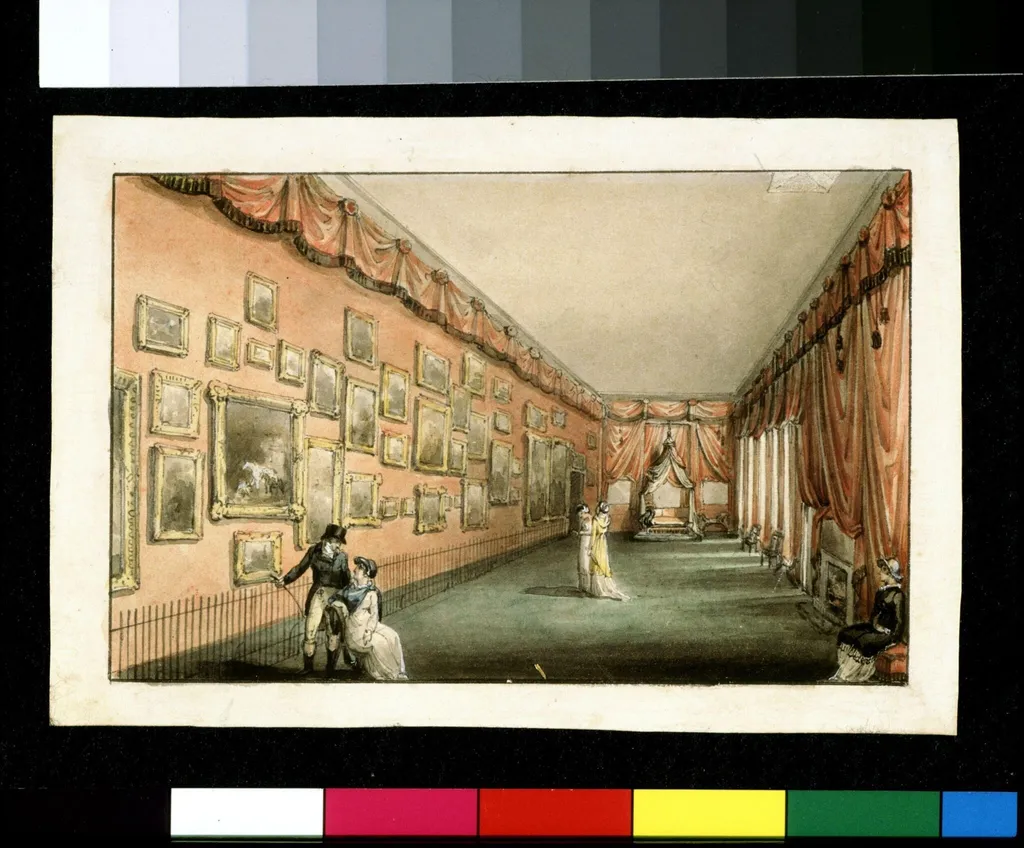
View of Mary Linwood's gallery is a watercolor work on paper by the British Romanticist artist Unknown. It dates from 1810 and is held in the collection of the Victoria and Albert Museum.
About this work
Overview
Created as a preparatory study, it likely served as a reference for an aquatint reproduction in a luxury publication.
This watercolour depicts the interior of Mary Linwood’s exhibition space in Leicester Square, capturing the arrangement of her embroidered copies of Old Master paintings. Created as a preparatory study, it likely served as a reference for an aquatint reproduction in a luxury publication. The scene includes Linwood herself at work, surrounded by framed needlework pieces and art supplies, reflecting the intersection of fine art and domestic craft in late 18th-century Britain.
Subject & Meaning
The painting documents Linwood’s unique artistic practice: translating oil paintings into intricate wool embroidery. Her gallery, filled with meticulously stitched reproductions, functioned as both a commercial exhibition and a statement on the legitimacy of needlework as fine art. The presence of the artist at her table underscores her role as both creator and curator, challenging gendered hierarchies in art production during a time when women’s artistic labor was often undervalued.
Technique & Style
Executed in watercolour with vivid, non-naturalistic hues, the sketch prioritizes clarity and composition over realism. Bright tones were applied despite the likely eventual reproduction in monochrome aquatint, suggesting the artist valued visual impact over technical constraints. The careful rendering of light on framed works reveals an awareness of spatial depth and display, typical of preparatory studies meant to guide printmakers in capturing the gallery’s atmosphere.
History & Provenance
The watercolour was bequeathed to the Victoria and Albert Museum alongside Linwood’s portrait of Napoleon, believed to be based on direct observation. It is linked to her Leicester Square gallery, the first art exhibition in Britain lit by gaslight, which opened in 1802. The piece may have been commissioned by a publisher or used by Linwood herself to promote her work, possibly as a prototype for an illustrated catalogue of her collection.
Context
Linwood’s work emerged during a period when women artists navigated limited public recognition. Her embroidered copies, praised for their fidelity and craftsmanship, attracted elite patrons and even outperformed original paintings in auction. The involvement of John Constable in painting the backgrounds of her works highlights the collaborative nature of artistic production and the blurred lines between fine art and decorative practice in early 19th-century London.
Legacy
Linwood’s gallery and its documentation in watercolour offer insight into the commercialization of art and the elevation of needlework to a public art form. Her success challenged conventional boundaries between male and female artistic domains. Though her embroidery is now less widely known, this sketch preserves the spatial and cultural context of her influential exhibition, serving as a rare visual record of a pioneering female artist’s professional environment.
Artist & collection

 Domestic Scene
 Giacomo and Cardinal Marco, investing Andrea, Abbot of San Zeno, with his Benefice
 The Nymph of Fontainebleau
 Portrait of a Woman
 Madonna and Child with Saints in the Enclosed Garden
 Venus and Minerva
 Family Group of Four on Sofa
 Wall painting from Room H of the Villa of P. Fannius Synistor at Boscoreale
 The Gallery at the Browsholme, near Clitheroe
 Stuedekoration
 View of Queen Caroline's Drawing Room
 View of the King's Great Drawing Room
 The gallery at Knole House, near Sevenoaks
 Interior View
 Tanzgesellschaft
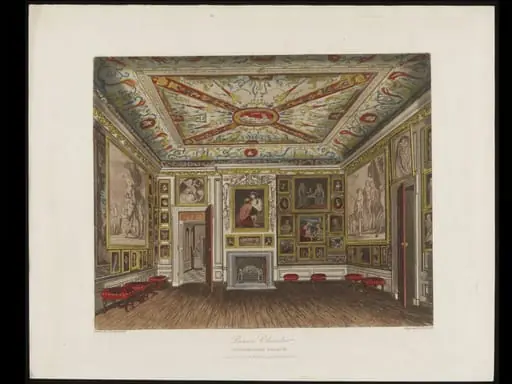 View of the Presence Chamber
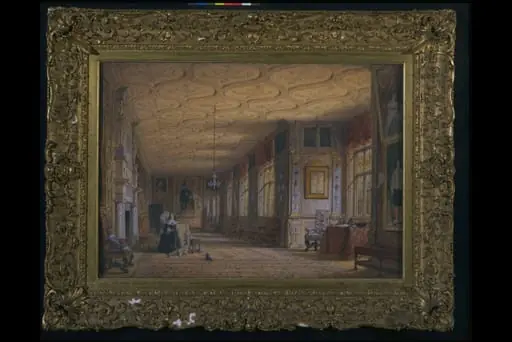 The Cartoon Gallery at Knole
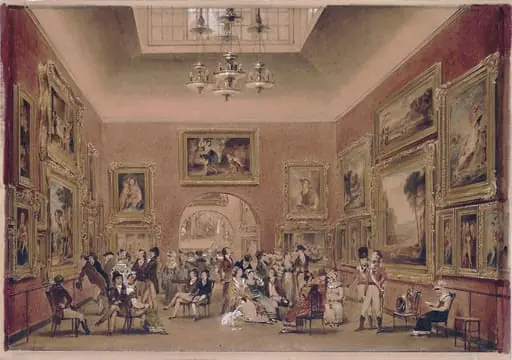 The Interior of the British Institution
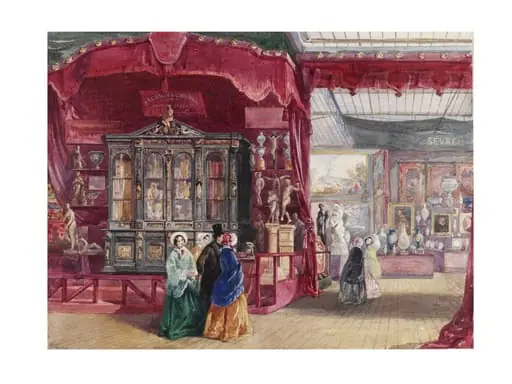 Part of the French Court, no. 1 (Sevres)
 Interior of the Gallery of the New Society of Painters in Watercolours, Old Bond Street