Artwork
Yudhisthira
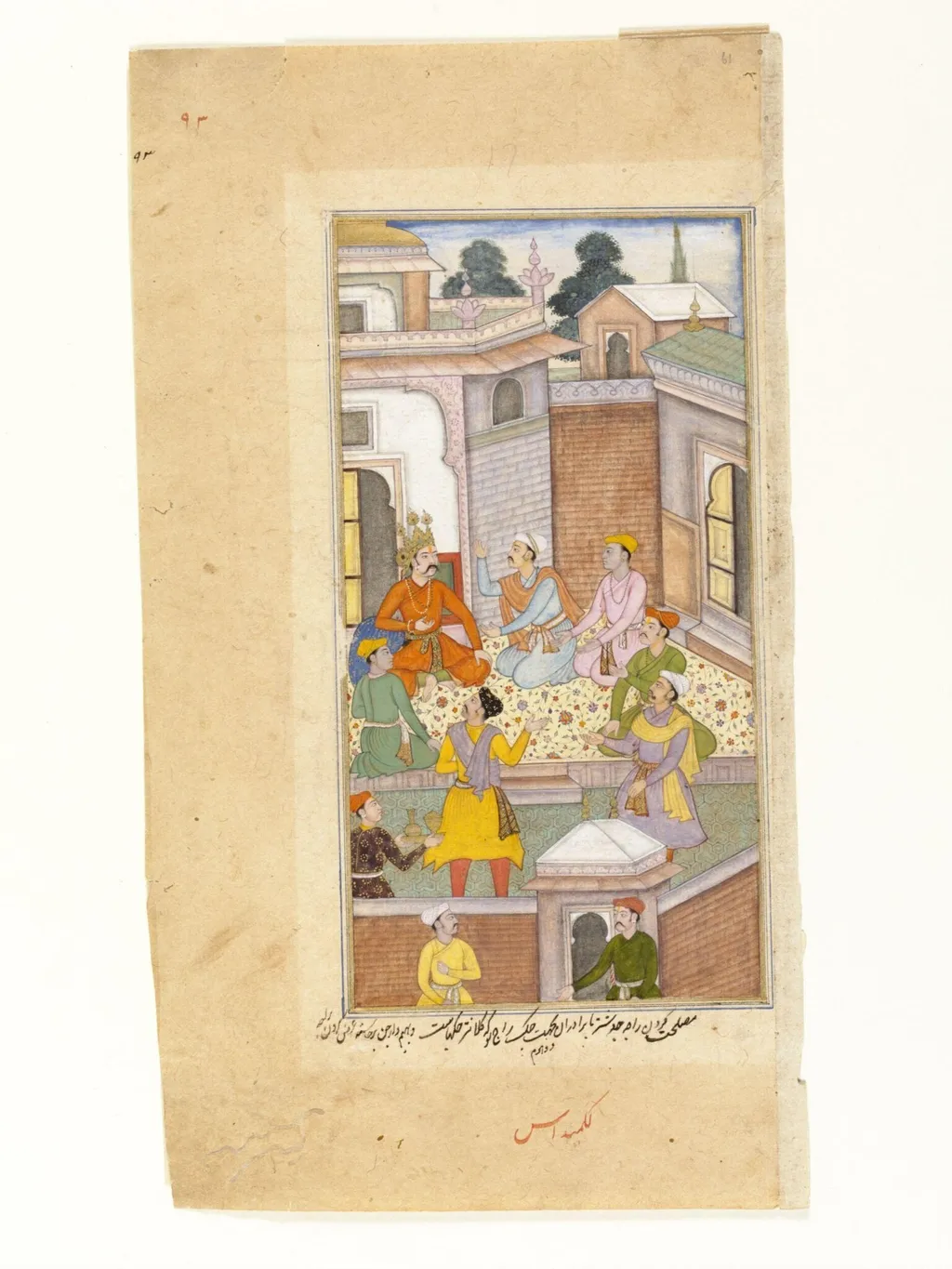
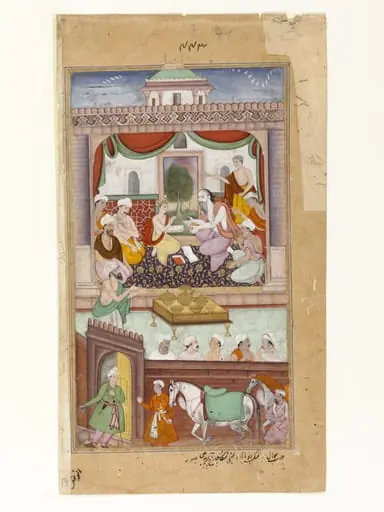
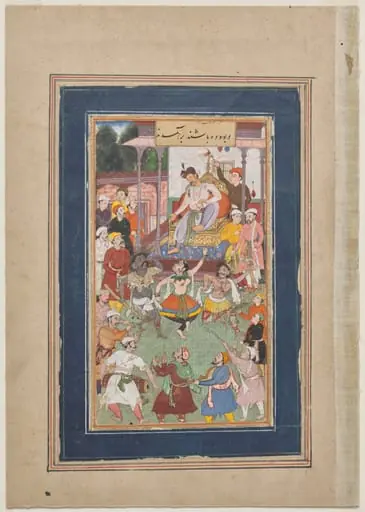
Yudhisthira is a paint painting by Unknown. It dates from 1550 and is held in the collection of the Victoria and Albert Museum. Created in 1550, this painting is an illustrated page from the Razm-nama, a Persian-language adaptation of the Indian epic Mahabharata.
About this work
Overview
The work reflects the fusion of Indian storytelling traditions with Persian artistic conventions, characteristic of early Mughal manuscript illumination.
Created in 1550, this painting is an illustrated page from the Razm-nama, a Persian-language adaptation of the Indian epic Mahabharata. Executed in opaque watercolour and gold on paper, it belongs to a series commissioned to translate and visually interpret Hindu narratives for a Mughal court audience. The work reflects the fusion of Indian storytelling traditions with Persian artistic conventions, characteristic of early Mughal manuscript illumination.
Subject & Meaning
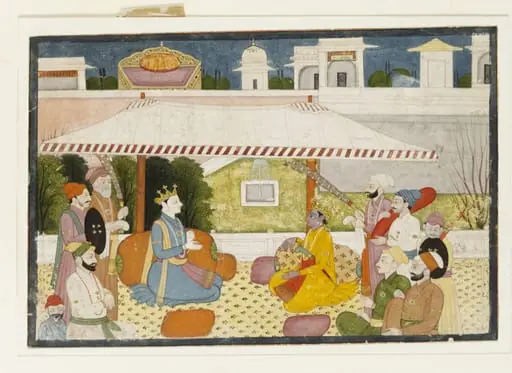
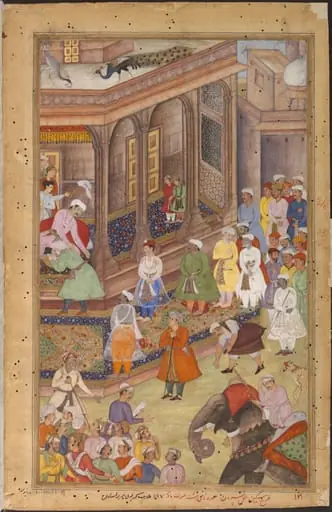
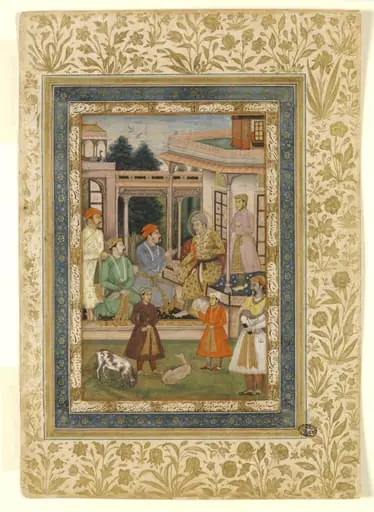
The scene portrays Yudhisthira, the eldest Pandava brother, seated on a raised platform as his siblings and advisors gather around him in deliberation. The gesture of one figure pointing toward him suggests a moment of solemn decision-making before the Kurukshetra War. The composition emphasizes hierarchy and unity among the brothers, underscoring themes of duty, leadership, and moral responsibility central to the Mahabharata’s philosophical core.
Technique & Style
The painting employs fine brushwork and layered opaque watercolours to achieve rich, saturated hues—deep reds, emerald greens, and golden yellows—accented with metallic gold detailing on textiles and architecture. The architectural elements, including arched portals and tiled roofs, reflect Persianate design, while the figures’ poses and facial expressions retain Indian stylistic traits. The use of gold enhances the ceremonial tone without overwhelming the narrative clarity.
History & Provenance
The painting was part of a manuscript collection later held by Messrs L. Chaundy of Oxford, Lea., at 2 Albemarle Street, London. Its documented history was formally reviewed in 2023 as part of a provenance research initiative under reference R.P. 22/3859. The acquisition trail confirms its passage through private British collections before entering institutional care, though earlier ownership prior to the 19th century remains unverified.
Context
Commissioned during Akbar’s reign, the Razm-nama project aimed to bridge cultural and religious traditions within the Mughal Empire. Translating the Mahabharata into Persian allowed Hindu epics to be accessible to the court’s Muslim elite. Artists from diverse regional backgrounds collaborated, blending Deccani, Rajasthani, and Persian styles, resulting in a unique visual language that reflected imperial pluralism.
Legacy
This painting exemplifies the Mughal court’s engagement with indigenous literary traditions through art. Though the full Razm-nama manuscript is dispersed across collections, individual folios like this one continue to inform scholarly understanding of cross-cultural exchange in 16th-century South Asia. Its preservation and study contribute to broader efforts to recognize non-Western artistic systems within global art history.
Artist & collection

 Domestic Scene
 Giacomo and Cardinal Marco, investing Andrea, Abbot of San Zeno, with his Benefice
 The Nymph of Fontainebleau
 Portrait of a Woman
 Madonna and Child with Saints in the Enclosed Garden
 Venus and Minerva
 Family Group of Four on Sofa
 Wall painting from Room H of the Villa of P. Fannius Synistor at Boscoreale