Artwork
東海道五十三次之内 府中 安部川|Travellers Fording the Abe River at Fuchu
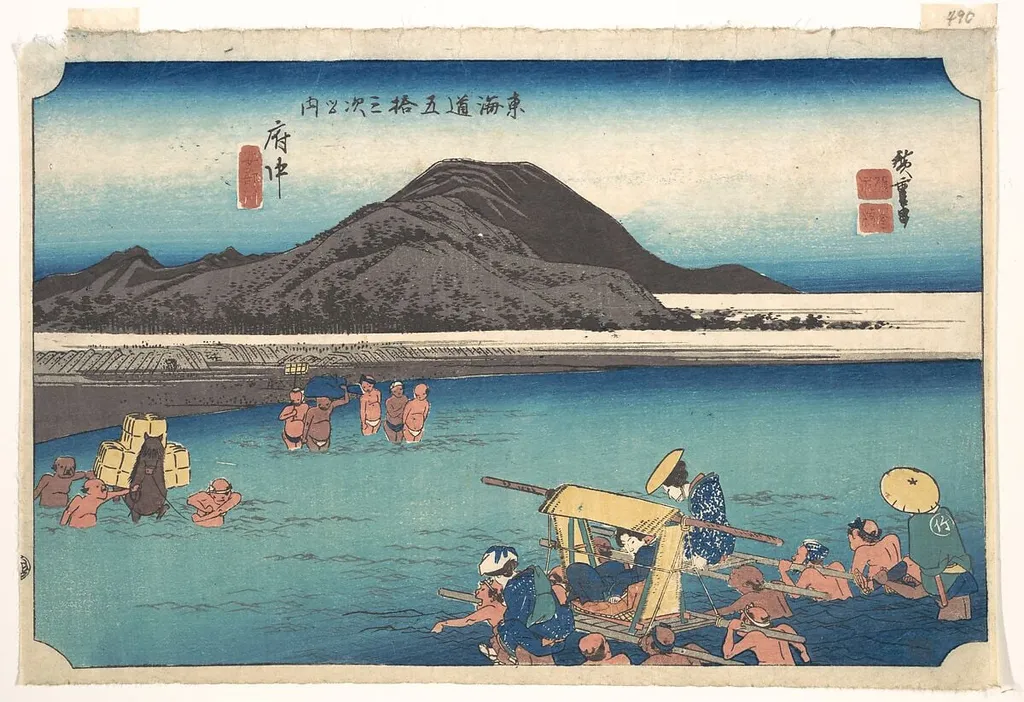
東海道五十三次之内 府中 安部川|Travellers Fording the Abe River at Fuchu is an ink print by the Romanticist artist Utagawa Hiroshige. It dates from 1834 and is held in the collection of the Metropolitan Museum of Art.
About this work
Overview
Created around 1834 by Utagawa Hiroshige, this woodblock print is one of fifty-three scenes in the series *The Fifty-three Stations of the Tōkaidō*.
Created around 1834 by Utagawa Hiroshige, this woodblock print is one of fifty-three scenes in the series *The Fifty-three Stations of the Tōkaidō*. It depicts a quiet moment along the historic highway connecting Edo and Kyoto. Unlike many ukiyo-e works centered on city life, Hiroshige focused on rural landscapes and the rhythms of travel, using subtle color and composition to evoke mood rather than spectacle.
Subject & Meaning
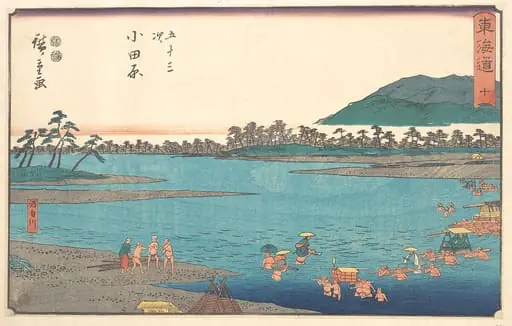
The scene shows travelers crossing the Abe River at Fuchu, some wading through shallow water, others crossing on a pole-propelled raft. Figures carry bundles and goods, suggesting daily commerce or pilgrimage. The quiet activity reflects the ordinary yet essential journeys that sustained the Tōkaidō’s function as a vital artery of movement and communication in Edo-period Japan.
Technique & Style
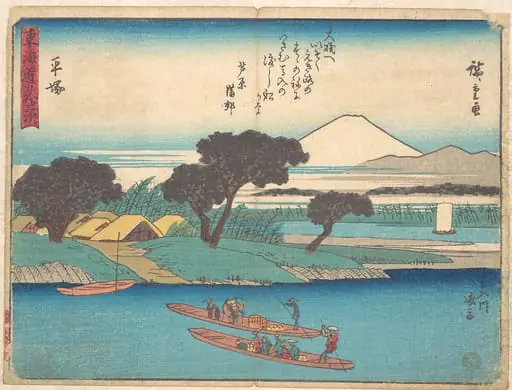
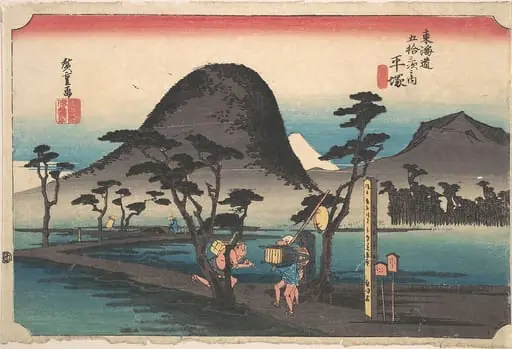
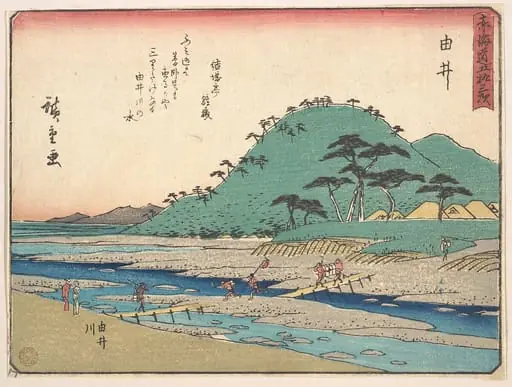
Hiroshige employed fine woodblock carving and layered ink and color to render the river in gradations of blue, suggesting depth and movement. The sky is softly washed, and distant mountains fade into haze, enhancing atmospheric perspective. Figures are rendered with minimal detail, emphasizing their integration into the landscape rather than individual identity, a hallmark of his poetic realism.
History & Provenance
Produced during the Edo period, the print was part of a commercially successful series commissioned for a broad public audience. Original impressions were widely distributed, often sold as souvenirs for travelers. Surviving examples are held in major museum collections, including the Metropolitan Museum of Art and the British Museum, attesting to its enduring presence in global print collections.
Context
The Tōkaidō road was a major route for merchants, pilgrims, and officials under the Tokugawa shogunate. Hiroshige’s series documented each station with geographic and cultural accuracy, aligning with a growing public interest in travel and regional identity. The inclusion of natural elements—river, sky, mountain—elevated the journey beyond mere transit into a contemplative experience.
Legacy
Hiroshige’s approach to landscape influenced later Western artists, including the Impressionists, who admired his compositional economy and sensitivity to light. While his prints were once mass-produced ephemera, they are now recognized as pivotal in the evolution of Japanese visual culture and the global appreciation of woodblock printing as a fine art form.
Artist & collection
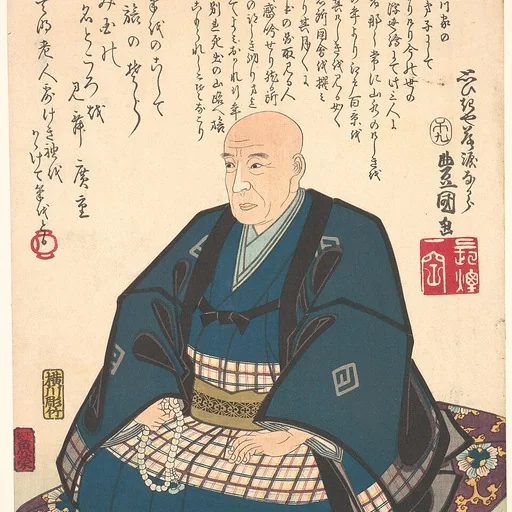
Artist
Utagawa Hiroshige (歌川 広重) or Andō Hiroshige (安藤 広重), born Andō Tokutarō (安藤 徳太郎; 1797 – 12 October 1858), was a Japanese ukiyo-e artist, considered the last great master of that tradition.