Artwork
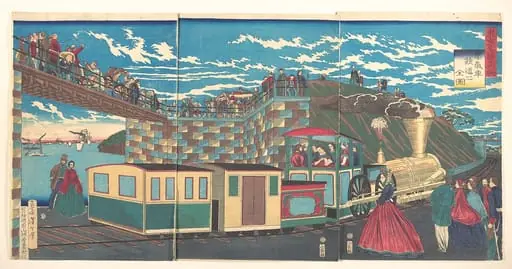
東京高輪鉄道蒸気車走行之全図|Tokyo /Takanawa Steam Railway
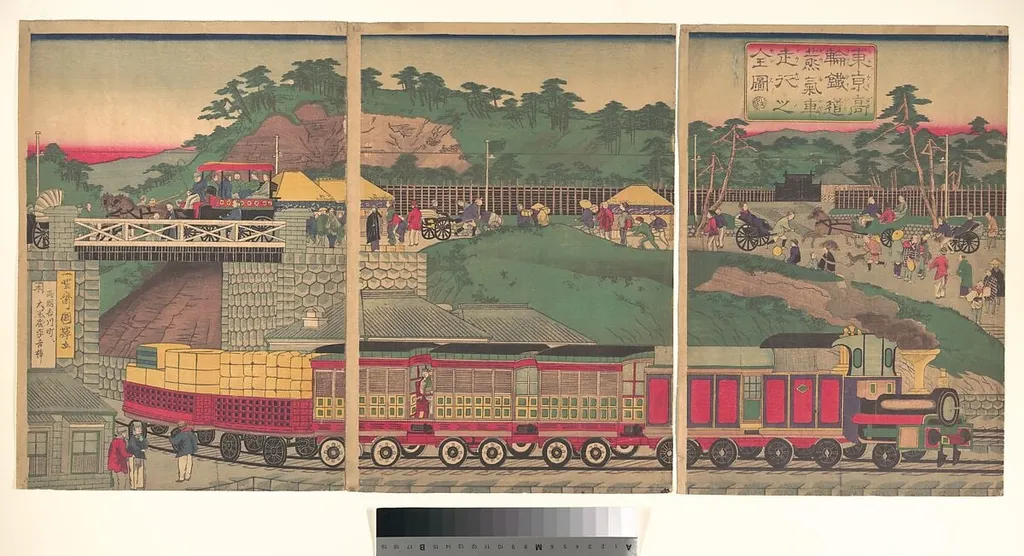
東京高輪鉄道蒸気車走行之全図|Tokyo /Takanawa Steam Railway is an ink print by the Impressionist artist Utagawa Kuniteru. It is held in the collection of the Metropolitan Museum of Art.
About this work
Overview
Composed of three horizontal panels, it captures a moment of transition as steam locomotion enters urban life.
This triptych woodblock print, created in 1879 by Utagawa Kuniteru, depicts the Takanawa railway station in Tokyo during the early years of Japan’s railroad expansion. Composed of three horizontal panels, it captures a moment of transition as steam locomotion enters urban life. Ink and color on paper convey both the mechanical novelty of the train and the human response to it, rendered with the precision typical of late Edo-period printmaking.
Subject & Meaning
The scene portrays the arrival and departure of a steam train at Takanawa Station, framed by bystanders of varying ages and social standing. The left panel shows the stationary locomotive beneath a bridge, the center captures pedestrians approaching a fence, and the right illustrates motion and smoke as the train departs. Together, they suggest the rhythm of modern transit and the quiet awe of ordinary citizens encountering industrial progress in their daily lives.
Technique & Style
Kuniteru employs bold outlines and vivid, flat areas of color characteristic of ukiyo-e traditions, adapting them to a modern subject. The train’s metallic surfaces and billowing smoke are rendered with sharp, controlled lines, contrasting with the softer, more fluid forms of the crowd and landscape. The triptych format, traditionally used for dramatic narratives, here frames a mundane yet transformative moment, blending classical composition with contemporary realism.
History & Provenance
Produced in 1879, the print emerged during Japan’s rapid modernization under the Meiji government, which actively promoted rail infrastructure. It was likely distributed as a commercial print, documenting a newly opened section of the Tokyo-Yokohama line. The work entered the collection of The Metropolitan Museum of Art in the 20th century, where it remains one of the few surviving visual records of early Japanese railway life from a native artist’s perspective.
Context
In the late 1870s, Japan was integrating Western technology into its society with deliberate speed. The Takanawa station, opened in 1872, was among the first in the country. This print reflects public fascination with trains, which symbolized progress but also disrupted traditional rhythms of life. Unlike Western depictions that often glorified industry, Kuniteru’s work observes the human scale of change, focusing on quiet observation rather than triumph.
Legacy
As one of the earliest Japanese woodblock prints to depict a steam train in daily operation, it stands as a document of cultural adaptation. While not widely known outside specialized collections, it offers insight into how traditional art forms responded to industrialization. Its preservation allows modern viewers to see the railway not as an abstract force, but as a lived experience—seen through the eyes of those who first watched it pass.
Artist & collection


 Untitled
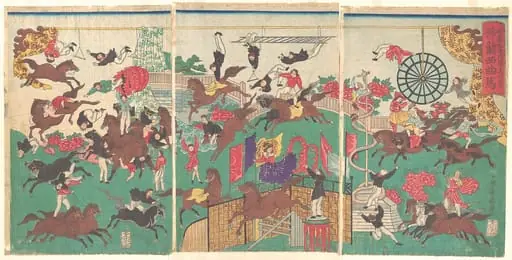 浅草観音境内ニ於イテ興行仕候 佛蘭西曲馬|French Equestrian Circus on the grounds of Asakusa Kannon temple (Asakusa kannon keidai ni oite kōgyō tsukawashi sōrō-Furansu kyokuba)
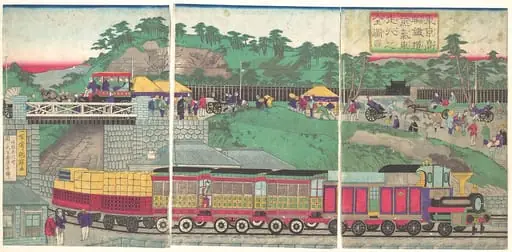 東京高輪鉄道蒸気車走行之図|Illustration of a Steam Locomotive Running on the Takanawa Railroad in Tokyo (Tōkyō takanawa tetsudō jōkisha sōkō no zu)
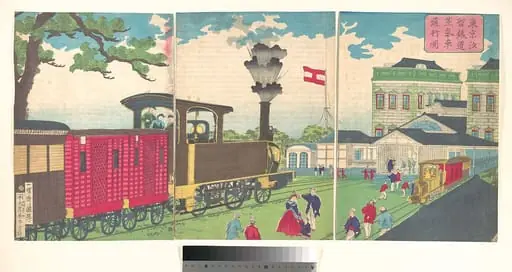 東京汐留鉄道蒸気車通行図|Illustration of a Steam Locomotive Passing Shiodome in Tokyo (Tōkyō Shiodome testudō jōkisha tsūkō zu)
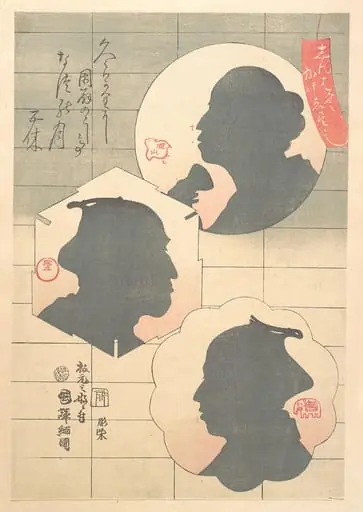 Untitled
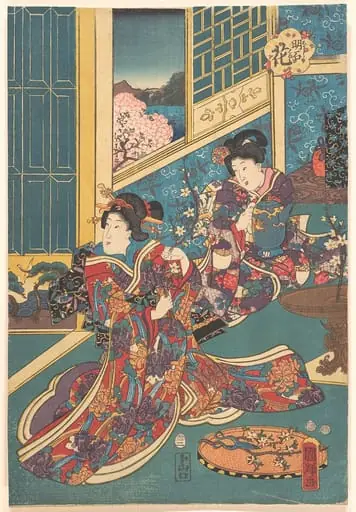 Untitled