Artwork
Tokaido Yotsuya Kaidan|Onoe Matsusuke as the Ghost of the Murdered Wife Oiwa, in "A Tale of Horror from the Yotsuya Station on the Tokaido Road"
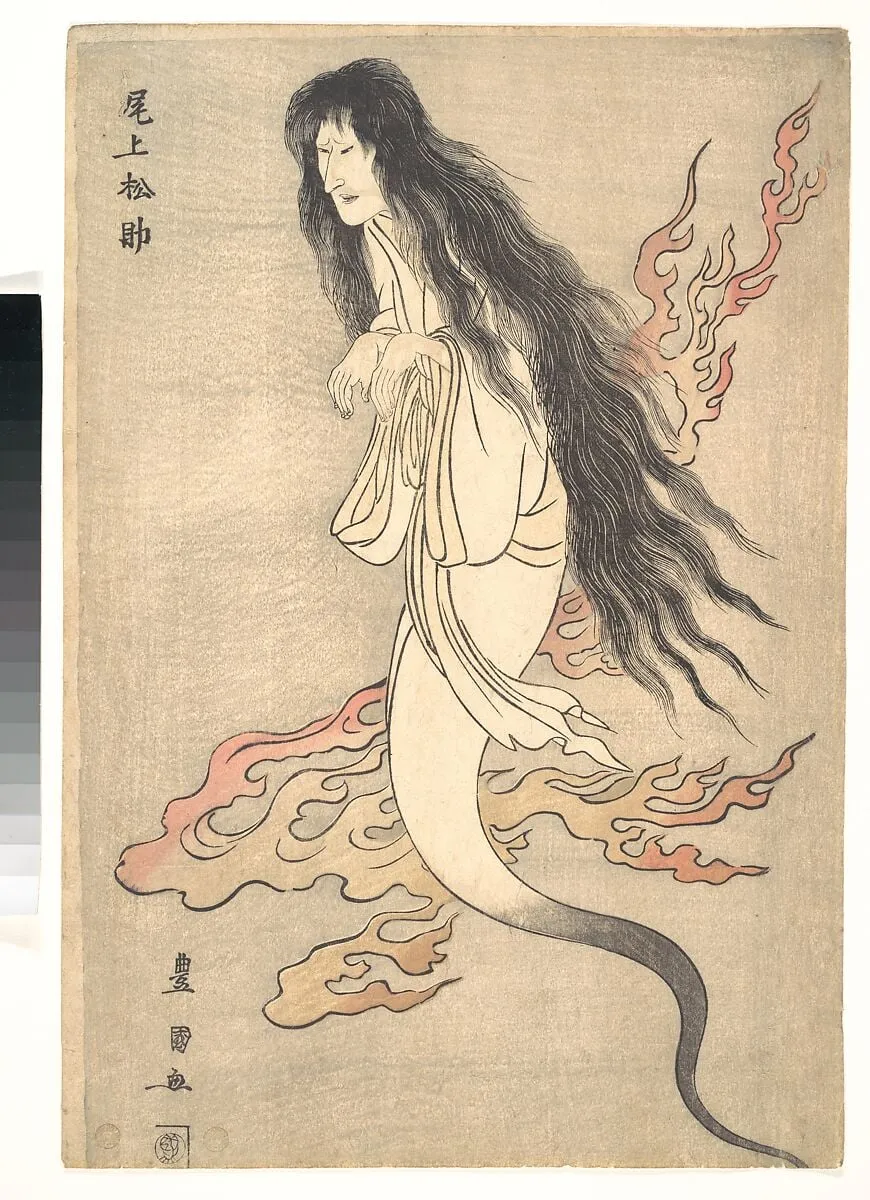
Tokaido Yotsuya Kaidan|Onoe Matsusuke as the Ghost of the Murdered Wife Oiwa, in "A Tale of Horror from the Yotsuya Station on the Tokaido Road" is an ink print by the Baroque artist Utagawa Toyokuni I. It dates from 1812 and is held in the collection of the Metropolitan Museum of Art.
About this work
Overview
This woodblock print, produced in 1812 by Utagawa Toyokuni I, depicts a scene from the popular Japanese ghost story known as 'Tokaido Yotsuya Kaidan.' Rendered in ink and color on paper, it captures a moment of supernatural retribution. The image was part of a series illustrating theatrical performances, translating stage drama into portable visual form for a broad audience.
Subject & Meaning
The figure represents Oiwa, a betrayed wife whose vengeful spirit returns after being poisoned by her husband. Her disfigured face, disheveled hair, and floating posture convey both tragedy and fury. The swirling red flames beneath her feet symbolize the infernal realm she now inhabits, while her outstretched sleeves suggest the lingering force of her unresolved anguish.
Technique & Style
Toyokuni employed bold outlines and flat areas of color typical of ukiyo-e, emphasizing dramatic contrast over naturalism. The ghost’s pale skin and dark hair are sharply delineated against a minimalist background, heightening emotional impact. The use of red for the flames adds intensity, while the absence of landscape focuses attention entirely on the spectral figure’s presence.
History & Provenance
Created during the Edo period, the print was likely distributed as a theater poster or collectible print for fans of kabuki drama. It entered the collection of The Metropolitan Museum of Art through documented acquisitions of Japanese prints in the early 20th century, where it remains part of their holdings of Edo-period visual culture.
Context
The story of Oiwa was a staple of kabuki theater, reflecting societal anxieties about betrayal, justice, and the supernatural. Such prints served not only as entertainment but also as cultural artifacts that reinforced moral narratives. The popularity of ghost tales in this era stemmed from their ability to explore hidden fears through familiar, dramatic forms.
Legacy
Toyokuni’s depiction of Oiwa became one of the most enduring visual representations of the ghost in Japanese art. Its influence extended beyond printmaking, shaping later illustrations, film, and theater portrayals of vengeful spirits. The image endures as a reference point for how horror was visually codified in Edo-period popular culture.
Artist & collection

Artist
Toyokuni was a born showman who made sure the energy of Edo’s kabuki stage never faded on paper.