Artwork
Henry VII and the Family of Henry VIII in Whitehall Palace
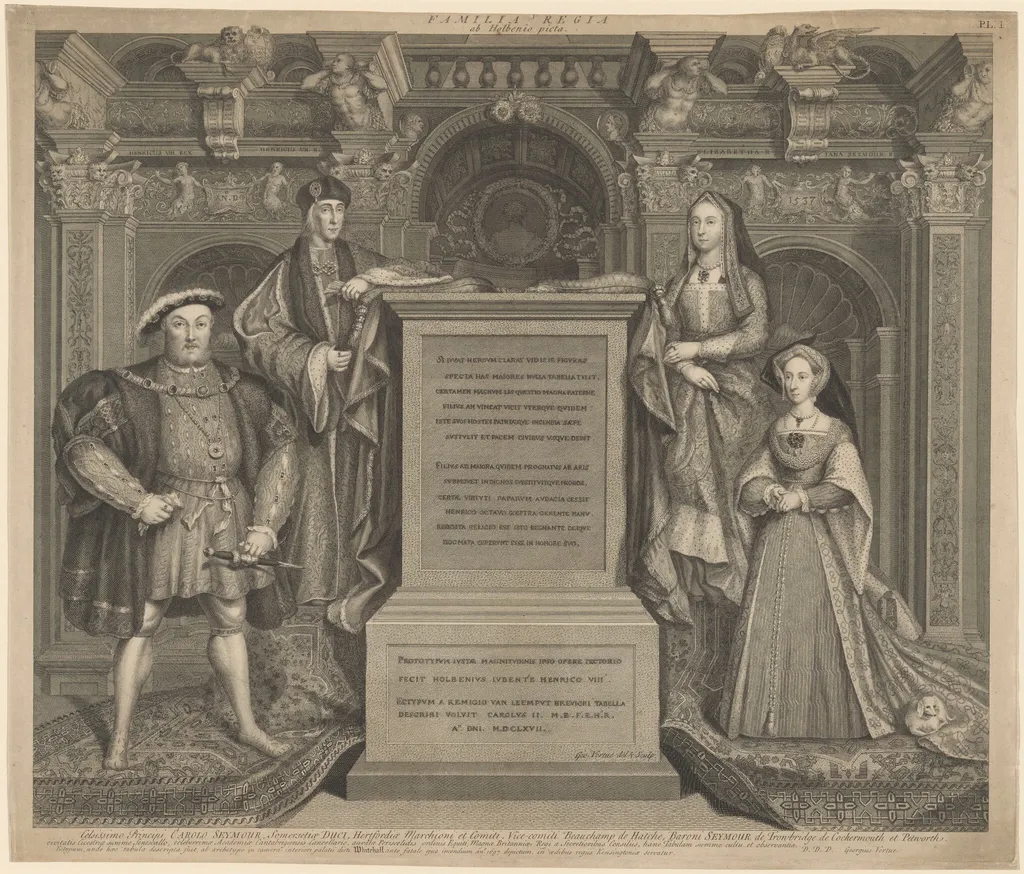
Henry VII and the Family of Henry VIII in Whitehall Palace is an ink print by the Baroque artist George Vertue. It dates from 1720 and is held in the collection of the National Gallery of Art.
About this work
Overview
This 1720 engraving by George Vertue depicts Henry VII and members of Henry VIII’s immediate family within the architectural setting of Whitehall Palace.
This 1720 engraving by George Vertue depicts Henry VII and members of Henry VIII’s immediate family within the architectural setting of Whitehall Palace. Rendered in monochrome, the composition presents four figures arranged formally before an ornate carved panel. The image was produced as a reproductive print, intended to circulate a visual record of royal lineage rather than serve as an original portrait.
Subject & Meaning
The figures include Henry VII, flanked by his son Henry VIII and two female relatives, likely Catherine of Aragon and Margaret Tudor. Their placement and attire emphasize dynastic continuity and authority. The Latin inscription reinforces the legitimacy of the Tudor line, while the elaborate background frame functions as a symbolic genealogical tree, linking rulership to divine and historical sanction.
Technique & Style
Vertue employed fine-line engraving to achieve sharp detail and tonal contrast, characteristic of 18th-century reproductive printmaking. The figures are rendered with restrained realism, while the background frame is densely populated with miniature carvings of faces, foliage, and heraldic motifs. The precision of the lines reflects the technical discipline required to translate monumental palace decoration into a small-scale printed format.
History & Provenance
Commissioned during the early Georgian period, the engraving was part of a broader antiquarian effort to document Tudor history through visual means. Vertue, a noted antiquary and engraver, worked from existing paintings and architectural records. The print was likely produced for scholarly or aristocratic audiences interested in royal heritage, rather than for public display.
Context
In the 1720s, interest in Tudor history was revived amid political debates over succession and legitimacy. Vertue’s engraving tapped into this cultural moment, offering a curated image of the Tudor dynasty that aligned with contemporary ideals of order and lineage. The choice of Whitehall Palace—a symbol of royal power since Henry VIII’s reign—anchored the image in a tangible historical space.
Legacy
The engraving became a key reference for later historians and artists depicting the Tudors, influencing how the family was visually imagined in the 18th and 19th centuries. Though not a contemporary portrait, it helped solidify a standardized iconography of Henry VII and his descendants, embedding their image in the collective memory of British royal history.
Artist & collection