Artwork
Untitled
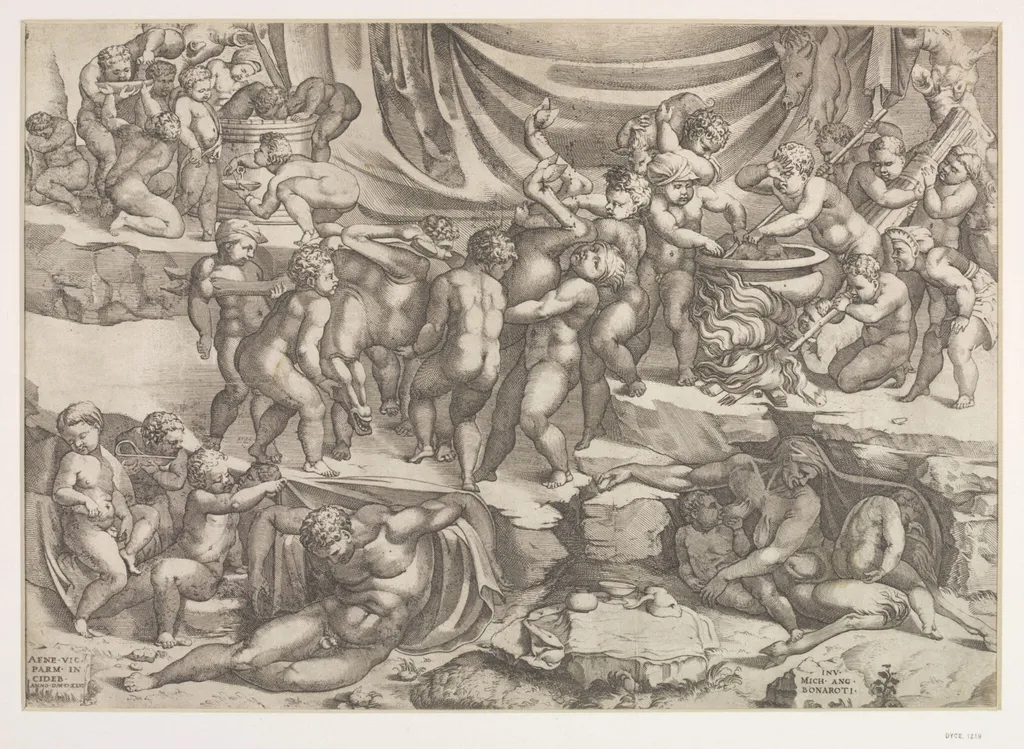
Untitled is a print by the Renaissance artist Enea Vico. It dates from 1540 and is held in the collection of the Victoria and Albert Museum.
About this work
Overview
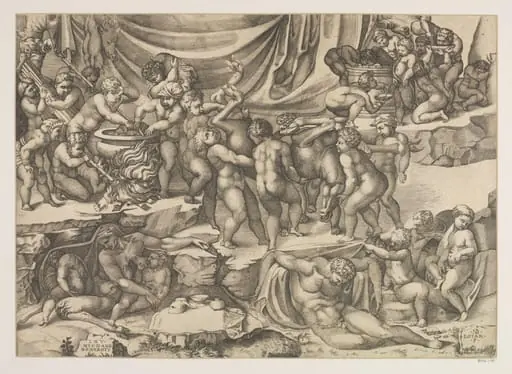
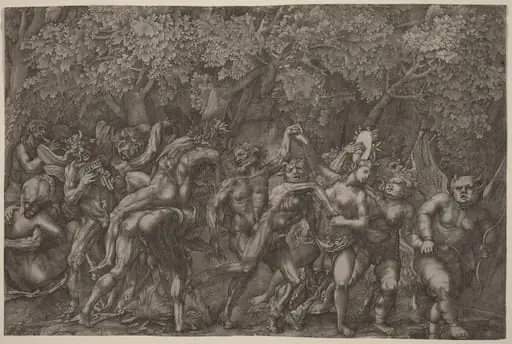
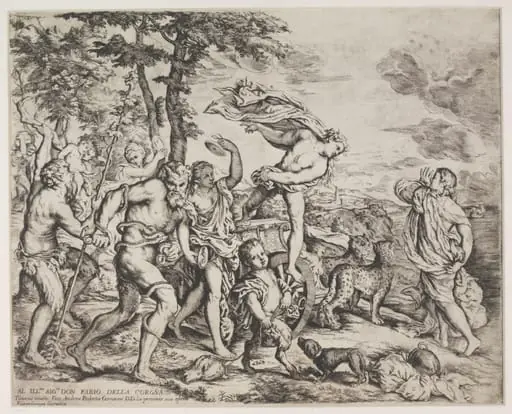
This engraving presents a mythological revelry centered on Silenus, the companion of Dionysus, though his donkey is the only visible remains of his presence.
This engraving presents a mythological revelry centered on Silenus, the companion of Dionysus, though his donkey is the only visible remains of his presence. The scene is densely populated with nude figures engaged in varied, vigorous activities—wrestling, cooking, playing music—creating a sense of unstructured frenzy. The composition draws from an earlier print by Nicolas Beatrizet, which itself was based on a design attributed to Michelangelo, though the present version reverses the original orientation.
Subject & Meaning
The imagery evokes a bacchanal, a ritual celebration associated with Dionysian excess and the blurring of human and animal boundaries. The lifeless donkey, traditionally Silenus’s mount, replaces its master as the central relic, suggesting decay amid revelry. Figures engaged in labor and play imply a world turned upside down—order dissolved into chaotic ritual. The absence of Silenus himself may hint at the fleeting nature of divine presence or the exhaustion following indulgence.
Technique & Style
The artist employs precise, incised lines to define muscular forms and dynamic poses, emphasizing physicality and motion. Deep chiaroscuro contrasts heighten the drama, with shadowed recesses isolating figures against lighter backgrounds. Musculature is exaggerated, recalling Mannerist ideals, while the crowded composition avoids spatial depth, pressing figures toward the picture plane. The precision of the engraving underscores a technical mastery rooted in Renaissance printmaking traditions.
History & Provenance
The print is a reversed adaptation of Nicolas Beatrizet’s 16th-century engraving, which was made after a lost drawing by Michelangelo. Beatrizet’s version was widely circulated, and this reinterpretation likely emerged in the same period, possibly by a Northern European engraver familiar with Italian models. The reversal suggests the artist worked directly from a printed example rather than the original design, a common practice among printmakers seeking to adapt popular imagery.
Context
In the mid-1500s, mythological scenes of revelry were popular among collectors of prints, especially those linked to Michelangelo’s designs. These works appealed to humanist tastes and the fascination with classical antiquity, even when their content was fantastical or grotesque. The engraving reflects a broader trend of disseminating Italian Renaissance imagery through Northern European printshops, where technical skill often surpassed originality in subject matter.
Legacy
Though not attributed to a major artist, this print exemplifies the transmission and transformation of Renaissance imagery through reproductive printmaking. Its dense, muscular figures and dramatic lighting influenced later depictions of mythological chaos in Northern European art. The work survives as evidence of how classical themes were reinterpreted across regions and generations, often detached from their original context yet retaining their visceral impact.
Artist & collection

Artist
Enea Vico (29 January 1523 – 18 August 1567) was an Italian engraver. Vico was born in Parma. He specialized in grotesque engravings based on antique paintings. Vico made engravings for Cosimo I de' Medici, Grand Duke…

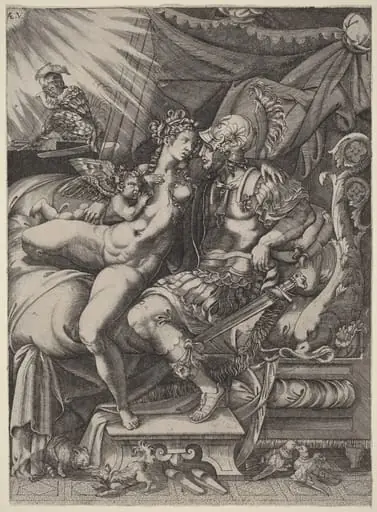 The Loves of Mars and Venus
![Fragments from Ancient Cameos in the Grimani Collection [Plate I], by Enea Vico](https://artifactworldgallery.com/img/enea-vico--fragments-from-ancient-cameos-in-the-grimani-collection-plat--1f564c058ab46ade-w320.webp) Fragments from Ancient Cameos in the Grimani Collection [Plate I]
Fragments from Ancient Cameos in the Grimani Collection [Plate I]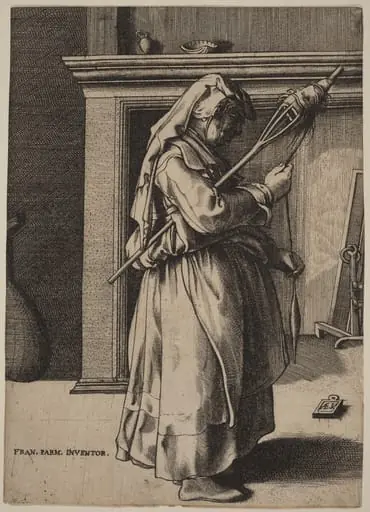 Old Woman with a Distaff
![Fragments from Ancient Cameos in the Grimani Collection [Plate II], by Enea Vico](https://artifactworldgallery.com/img/enea-vico--fragments-from-ancient-cameos-in-the-grimani-collection-plat--6333de7ba7491db7-w320.webp) Fragments from Ancient Cameos in the Grimani Collection [Plate II]
Fragments from Ancient Cameos in the Grimani Collection [Plate II]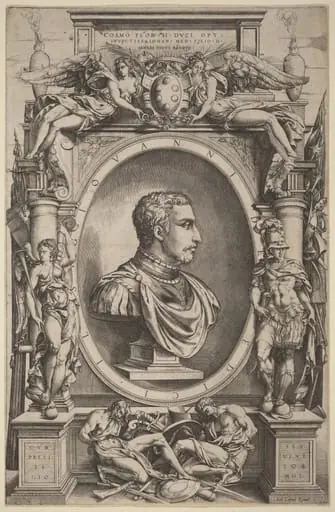 Giovanni de' Medici
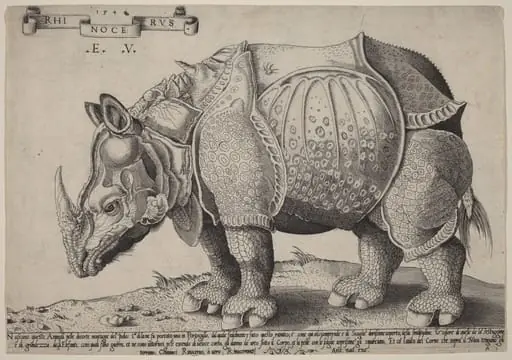 Rhinoceros
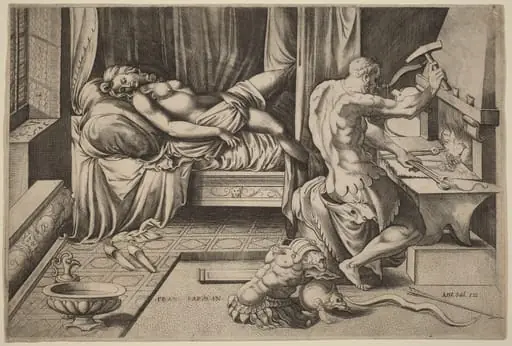 Venus Reclining with Vulcan at His Forge
![Fragments from Ancient Cameos in the Grimani Collection [Plate III], by Enea Vico](https://artifactworldgallery.com/img/enea-vico--fragments-from-ancient-cameos-in-the-grimani-collection-plat--bf2c0f15852500f8-w320.webp) Fragments from Ancient Cameos in the Grimani Collection [Plate III]
Fragments from Ancient Cameos in the Grimani Collection [Plate III]