Artwork
Trebizond
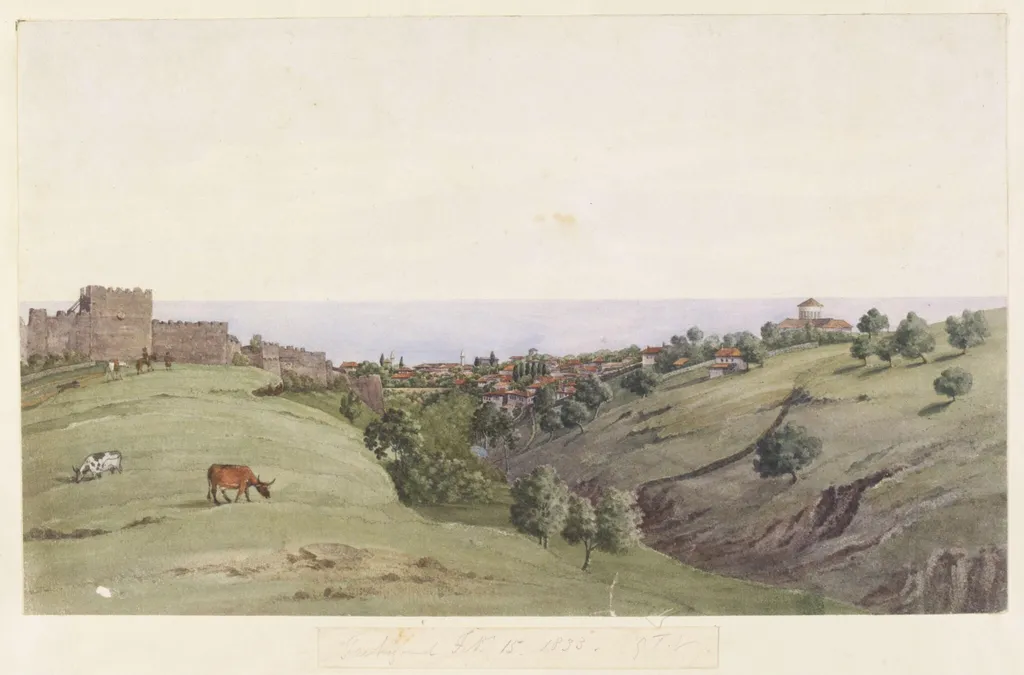
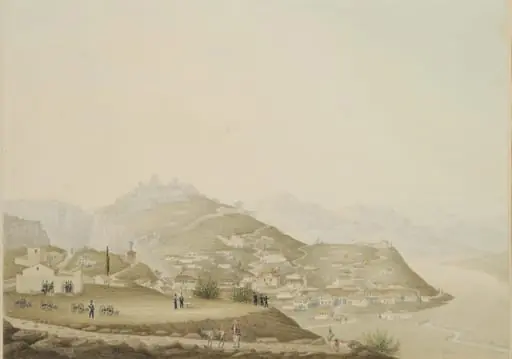
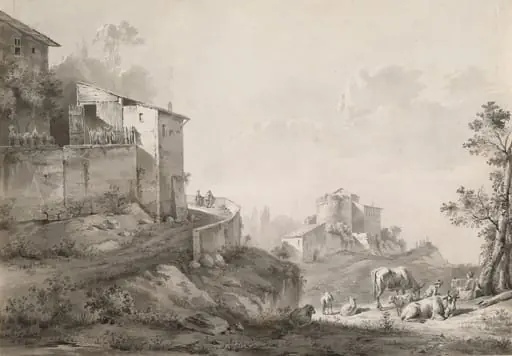
Trebizond is a watercolor work on paper by the Romanticist artist Godfrey Thomas Vigne. It dates from 1833 and is held in the collection of the Victoria and Albert Museum.
About this work
Overview
Vigne’s focus on subtle naturalism and daily life reflects his approach as a traveler-observer rather than a romanticized chronicler of grand events.
This watercolour by Godfrey Thomas Vigne captures a quiet landscape view of Trebizond, rendered in soft tones of green, brown, and muted blue. The scene emphasizes the town’s topography—its stone walls climbing a hillside, clustered dwellings, and a distant fortress—without dramatic action. Vigne’s focus on subtle naturalism and daily life reflects his approach as a traveler-observer rather than a romanticized chronicler of grand events.
Subject & Meaning
The painting presents Trebizond as a fortified settlement integrated into its rugged terrain, with the Yeni Cuma Camii visible above the town and defensive walls tracing the hill’s contour. Two grazing cows in the foreground anchor the scene in ordinary life, suggesting a community shaped by geography and time rather than conflict. The absence of human figures heightens the sense of quiet endurance, conveying the town’s quiet resilience.
Technique & Style
Vigne employed delicate watercolour washes to build layered, atmospheric effects, using translucent glazes to suggest distance and haze. The lines of walls and paths are softly defined, avoiding sharp detail in favor of tonal gradations. This restrained technique aligns with topographical drawing traditions of the early 19th century, prioritizing observational accuracy over expressive flourish.
History & Provenance
Created during Vigne’s travels in the 1830s, the work was later included in his published accounts of journeys through the region. It remained in the collection of the Royal Geographical Society until its sale at Christie’s in January 1974. The piece entered a private collection following the auction, eventually becoming part of the Victoria and Albert Museum’s holdings through subsequent acquisition.
Context
Vigne’s watercolour emerged during a period of heightened European interest in the geography and architecture of the eastern Ottoman Empire. His work contributed to a growing body of visual documentation by amateur travelers, offering ethnographic insight beyond military or political narratives. The image reflects a scholarly, rather than imperial, engagement with the region’s landscapes.
Legacy
The watercolour endures as a quiet record of Trebizond’s physical and social fabric in the early 19th century. Its preservation in a major museum collection underscores its value as a primary source for understanding regional topography and domestic life. Vigne’s restrained style continues to inform how travel sketches are evaluated for historical and visual authenticity.
Artist & collection


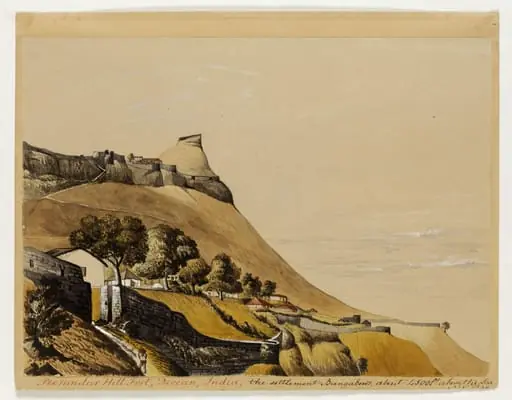 Poorundur Hill Fort
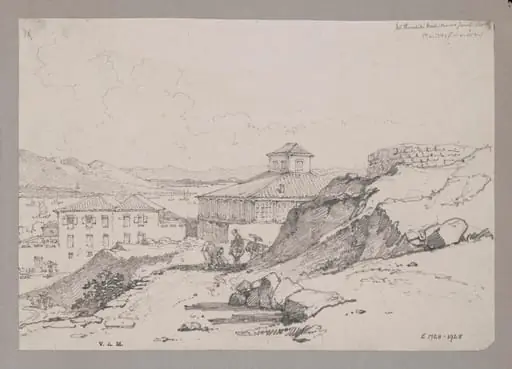 The Rev. Mr. Vatchell's house (formerly Mr. Thornhill's), Macao
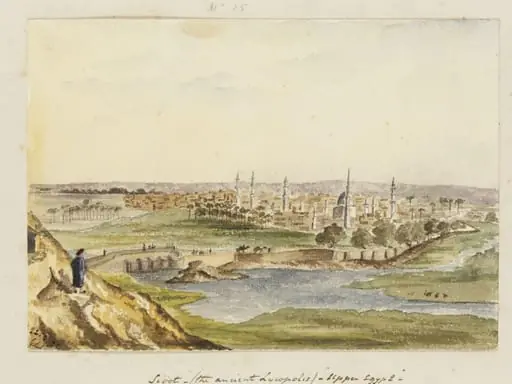 `Sioot - (the ancient Lycopolis.) - "Upper Egypt." from the Stabl-Antar Hill'
 Η Λιβαδειά το 1833
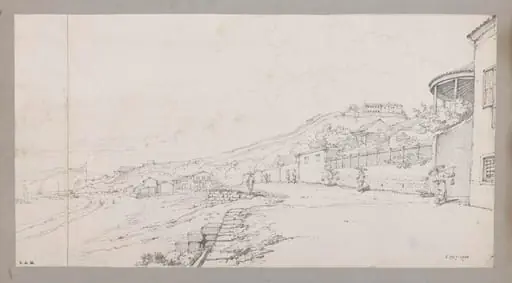 Part of Macao Bay, looking west
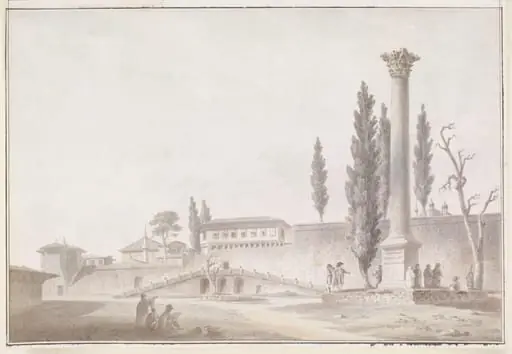 The Gardens of the Seraglio with European visitors inspecting the Column of the Goths, Constantinople
 Hampstead Heath, Evening Light
 Dr. Colledge's original Hospital at Macao
 Untitled
 Italian villa
 Lake and Town of Nemi
 A Sunlit Landscape with Hilltop Houses