Artwork
Sehzade Camii, Constantinople
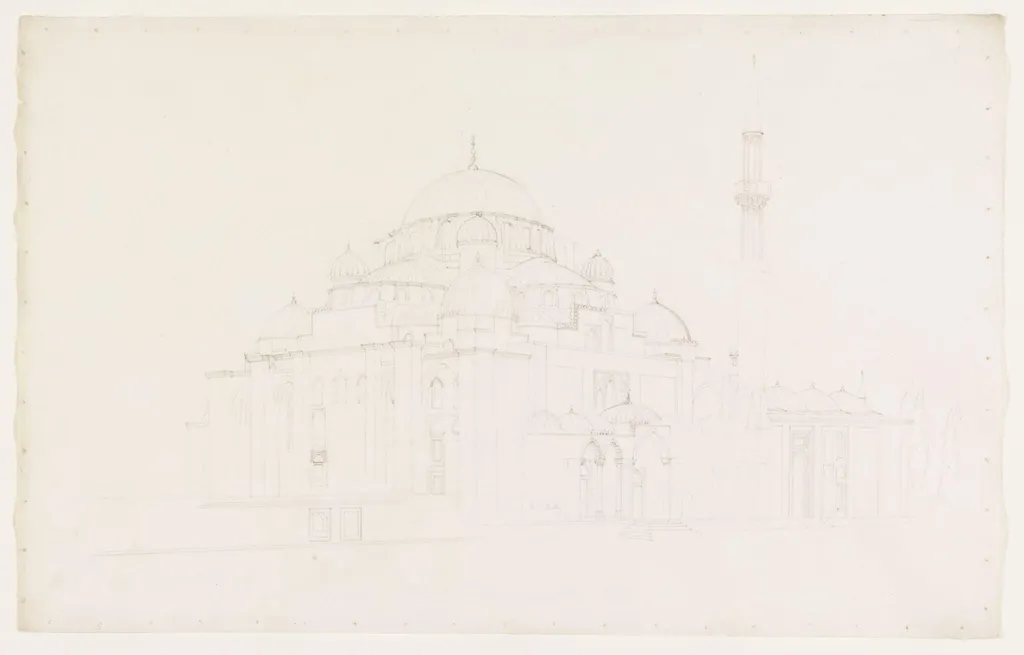
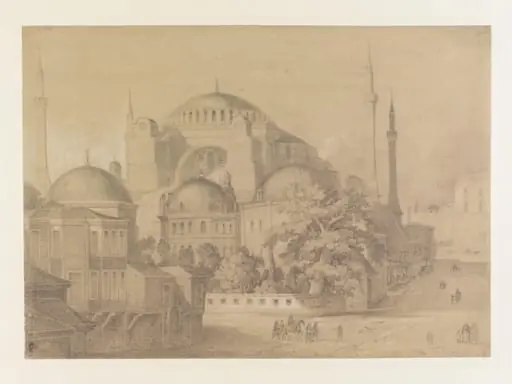
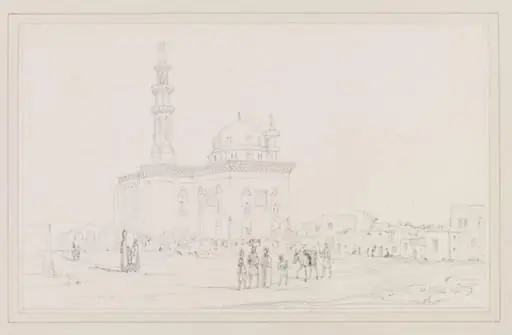
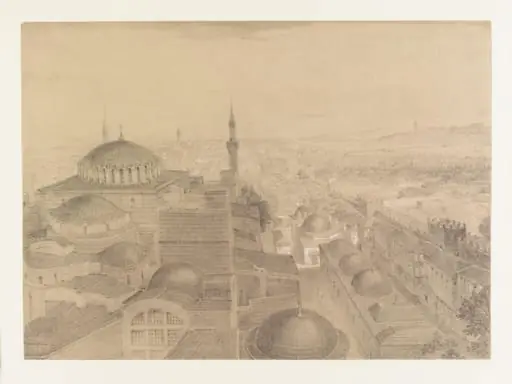
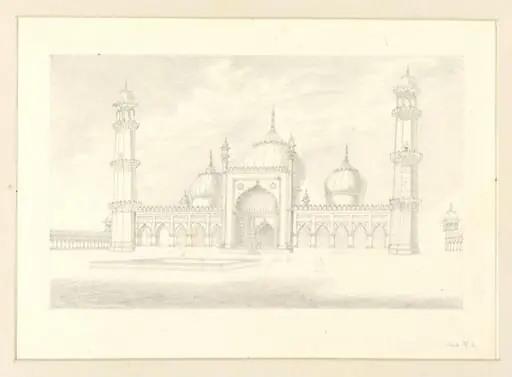
Sehzade Camii, Constantinople is a drawing by the Romanticist artist Lewis Vulliamy. It dates from 1818 and is held in the collection of the Victoria and Albert Museum.
About this work
Vulliamy was a British architect who sketched nine mosques in Istanbul and Bursa.
This is a drawing of a historic Ottoman mosque built by Sinan. Made around 1818, it shows careful lines and a light, dreamy feel. The paper has small holes along the edges, hinting at an old tracing tool.
Vulliamy was a British architect who sketched nine mosques in Istanbul and Bursa. His work stands out because it mixes sharp accuracy with a soft, airy look.
Check out the Victoria and Albert Museum.
Overview
This drawing depicts the Şehzade Mosque in Constantinople, commissioned by Sultan Süleyman I and completed between 1544 and 1548 under the direction of the Ottoman architect Sinan. Executed around 1818, the work belongs to a series of nine studies of mosques in Istanbul and Bursa. Its precision and delicate execution distinguish it from contemporaneous architectural sketches.
Subject & Meaning
The drawing captures the Şehzade Mosque, a structure built to honor Süleyman’s deceased son, Prince Mehmed. Though primarily a record of architectural form, the image also reflects an early 19th-century European engagement with Islamic design. The attention to detail suggests an intent to document rather than idealize, preserving the mosque’s proportions and decorative elements.
Technique & Style
The sheet combines meticulous draftsmanship with an almost translucent quality, achieved through fine, controlled lines. A row of evenly spaced pin-holes along the edges indicates the use of a mechanical aid, possibly a camera lucida or a similar optical device, to project and trace the scene. This method allowed for both accuracy and a softened, atmospheric effect.
History & Provenance
Created by British architect Lewis Vulliamy during his travels as a Royal Academy travelling student, the drawing was produced between 1818 and 1822. Vulliamy, trained under Sir Robert Smirke, visited Italy, Greece, and Turkey, documenting architectural landmarks. The series of mosque drawings remained outside his later professional practice, which favored classical revival styles.
Context
At the time of its creation, European interest in Islamic architecture was limited, with most architects focusing on classical or Gothic revival styles. Vulliamy’s use of an optical tracing device reflects the period’s experimentation with scientific instruments to enhance artistic precision. His sketches predate the broader 19th-century fascination with Islamic art and design.
Legacy
Though Vulliamy did not incorporate Islamic motifs into his built work, his mosque drawings offer an early example of European architectural documentation of Ottoman structures. The series stands as a rare visual record of these buildings before the advent of widespread photography, preserving details of form and ornament that might otherwise have been overlooked.
Artist & collection
Artist
Lewis Vulliamy was an English architect descended from the Vulliamy family of clockmakers.