Artwork
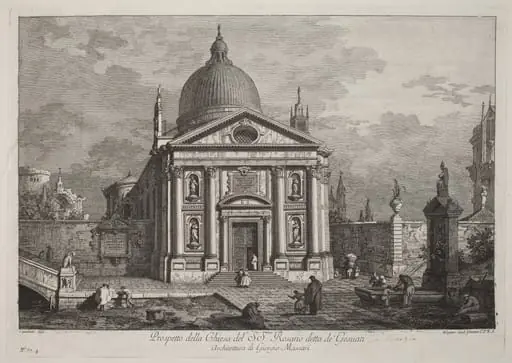
Prospetto della Chiesa di S. Simeone Appostolo
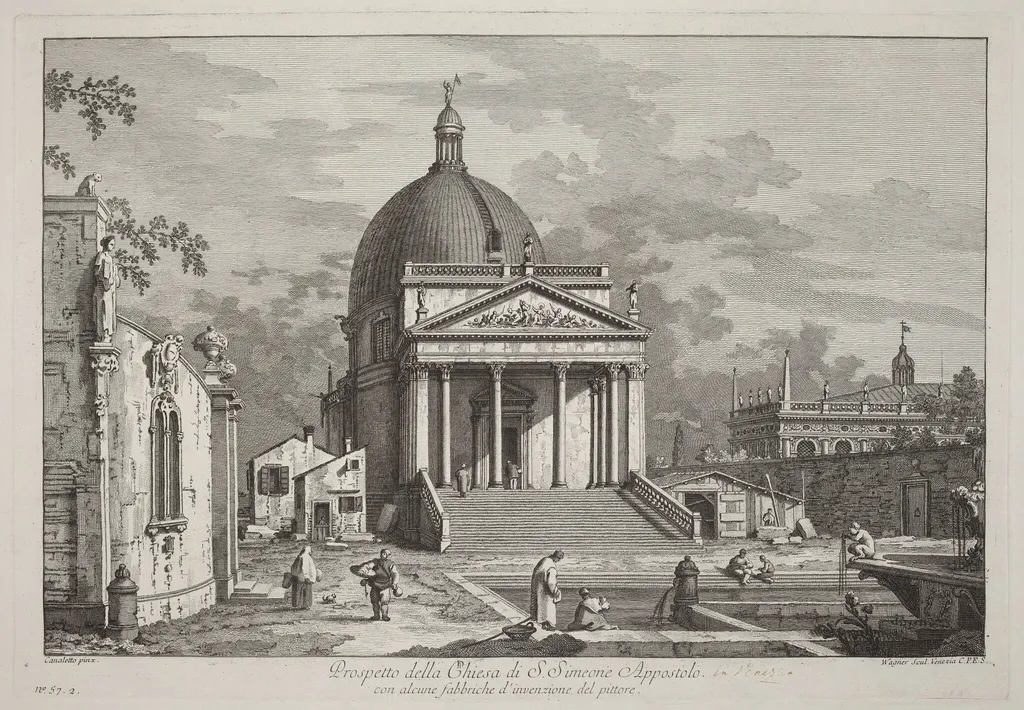
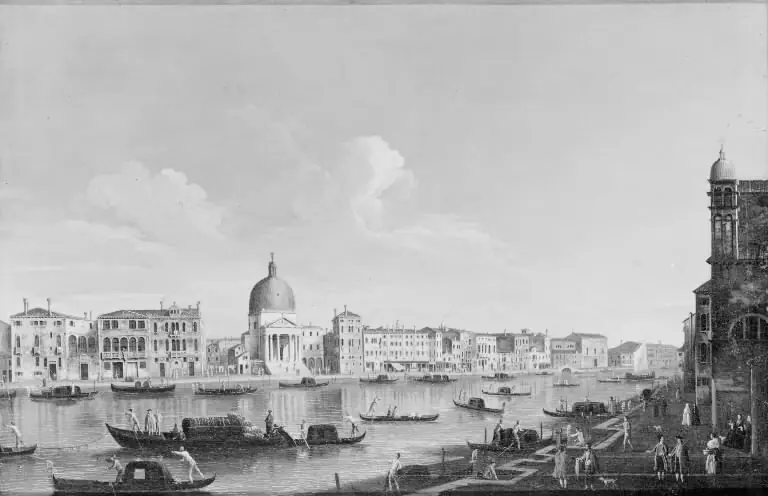
Prospetto della Chiesa di S. Simeone Appostolo is an ink print by the Baroque artist Joseph Wagner. It dates from 1742 and is held in the collection of the National Gallery of Art.
About this work
Overview
The composition balances structural grandeur with everyday life, capturing the church as both a religious landmark and a node in the city’s daily rhythm.
Created in 1742 by Joseph Wagner, this print depicts the facade of the Church of San Simeone Profeta in Venice. Executed in engraving and etching on laid paper, it presents an architectural view with careful attention to spatial depth and urban context. The composition balances structural grandeur with everyday life, capturing the church as both a religious landmark and a node in the city’s daily rhythm.
Subject & Meaning
The church, dedicated to Saint Simeon the Apostle, is shown in idealized form, emphasizing its monumental dome and classical columns. Surrounding figures—pedestrians, laborers, and animals—anchor the structure in lived experience. The inclusion of a bridge, canal, and adjacent buildings situates the church within Venice’s urban fabric, suggesting its role not only as a place of worship but as a central feature of public life.
Technique & Style
Wagner employed etching for delicate linework and engraving for precise, bold contours, combining both to render texture and light. The rendering of stone, fabric, and water varies in line weight and density, enhancing realism. Small incidental details—a bird perched on a column, a dog near the steps—add spontaneity without disrupting the architectural harmony, reflecting a tradition of topographical precision infused with human observation.
History & Provenance
The print was produced during a period of heightened interest in Venetian architecture among European travelers and collectors. Wagner, an Austrian artist active in Venice, specialized in architectural views. This work likely served as a souvenir or study for patrons drawn to the city’s visual culture. Its survival in multiple institutional collections suggests it was widely circulated and valued for its accuracy and detail.
Context
In mid-18th century Venice, architectural prints were both artistic records and commercial products. Wagner’s depiction aligns with the tradition of vedute, or cityscapes, popularized by Canaletto and others. Unlike pure fantasy views, this engraving reflects actual urban features, including the bridge and canal, offering a reliable visual document of the church’s setting before later renovations altered the landscape.
Legacy
The print remains a reference for scholars studying Venetian ecclesiastical architecture and 18th-century print culture. Its blend of topographical fidelity and subtle human activity influenced later artists documenting urban environments. Though not widely exhibited today, it endures in academic and museum archives as a quiet testament to the intersection of art, architecture, and daily life in Enlightenment Venice.
Artist & collection