Artwork
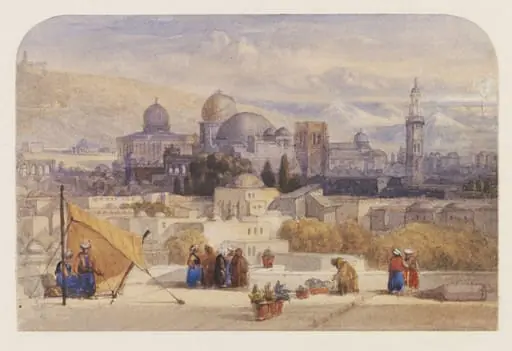
Jerusalem. Mount Moriah The Site Of The Temple now occupied by the Mosque of Omar
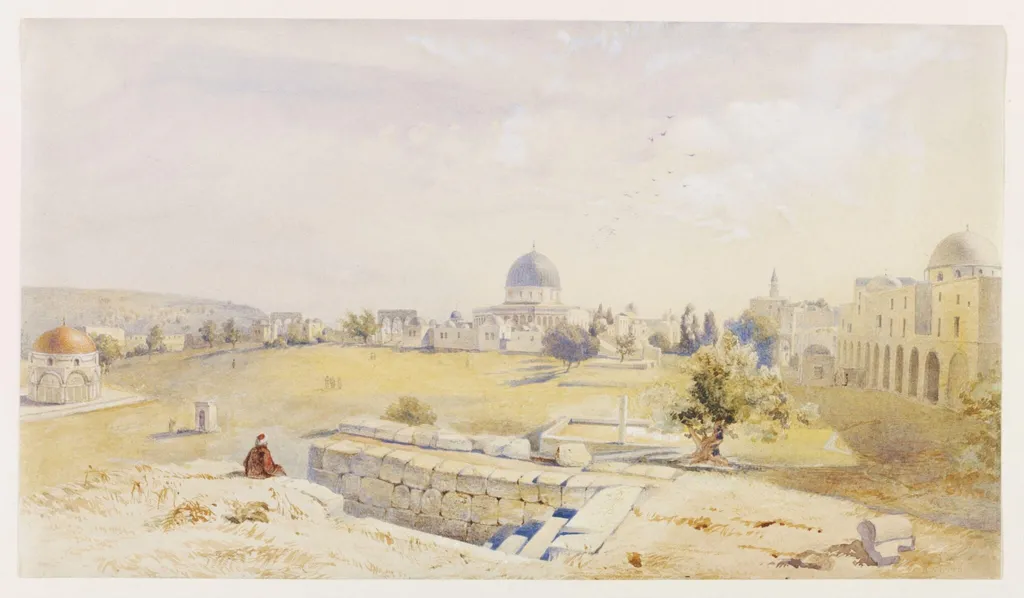
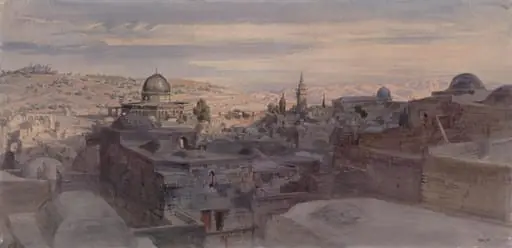
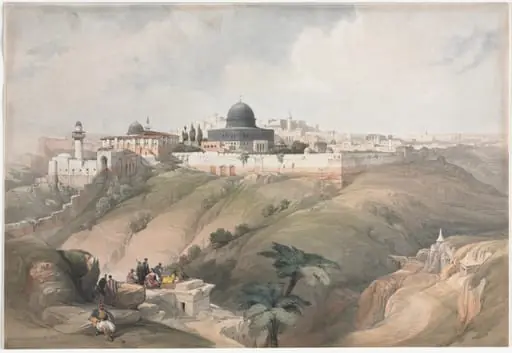
Jerusalem. Mount Moriah The Site Of The Temple now occupied by the Mosque of Omar is a watercolor work on paper by the Impressionist artist Henry Warren. It dates from 1853 and is held in the collection of the Victoria and Albert Museum.
About this work
This watercolor shows Jerusalem’s Mount Moriah from the 1850s. Henry Warren painted it without ever visiting the city, using a sketch by Joseph Bonomi from 1833.
The view centers on the Dome of the Rock, sacred to both Muslims and Jews. It was later engraved for a 1854 book about Jesus Christ’s life.
See more of Warren’s detailed biblical scenes at the Victoria and Albert Museum.
Overview
This watercolour by Henry Warren depicts Mount Moriah in Jerusalem, focusing on the Dome of the Rock as the central architectural feature.
This watercolour by Henry Warren depicts Mount Moriah in Jerusalem, focusing on the Dome of the Rock as the central architectural feature. Created in the 1850s, the work was based on a sketch made by Joseph Bonomi during his 1833 visit to the city. Warren, who never traveled to the Near East, relied on such sources to produce his detailed biblical landscapes, which were widely exhibited and appreciated for their precision and atmospheric rendering.
Subject & Meaning
The site portrayed holds deep religious significance for Judaism, Christianity, and Islam. For Jews, it is the location of the ancient Temples; for Muslims, it is the Dome of the Rock, a sacred shrine tied to the Prophet Muhammad’s night journey. Christians also revere it as part of the biblical landscape of Jesus’ life. Warren’s composition reflects this layered sanctity, presenting the site not as a mere topographical record but as a symbol of shared spiritual heritage.
Technique & Style
Warren employed fine watercolour techniques to achieve intricate detail and subtle tonal gradations, characteristic of mid-19th-century British watercolour practice. His rendering of architecture, foliage, and atmospheric perspective demonstrates careful study of Bonomi’s original sketch. The composition is orderly and balanced, with the Dome of the Rock dominating the center, framed by surrounding structures and distant hills, enhancing the sense of historical weight and spatial depth.
History & Provenance
The watercolour was produced as a preparatory study for an engraving included in Revd John Fleetwood’s 1854 publication, The Life of Our Lord and Saviour Jesus Christ. It derives from Joseph Bonomi’s 1833 sketch, made during his travels in the Levant. Warren’s version, completed decades later, was part of a broader trend among British artists to illustrate biblical sites using second-hand visual sources, often commissioned for religious or educational publications.
Context
In the mid-19th century, European interest in the Holy Land intensified due to religious revivalism and archaeological exploration. Artists like Warren, though never visiting the region, contributed to a visual culture that sought to authenticate biblical narratives through detailed imagery. His work aligned with institutional efforts to educate the public about sacred geography, supported by societies such as the New Society of Painters in Water-Colours, of which he was long president.
Legacy
Warren’s watercolours, including this depiction of Mount Moriah, remain part of institutional collections such as the Victoria and Albert Museum, where they serve as examples of Victorian interpretive landscape art. Though his reliance on others’ sketches has been noted, his ability to translate observational data into compelling, reverent compositions influenced the visual representation of biblical sites in British art for decades.
Artist & collection
Artist
Henry Warren kept a diary with tiny pencil sketches in the corners, but he never let anyone read the words—only the pictures.