Artwork
He Bids Me Dry the Last...
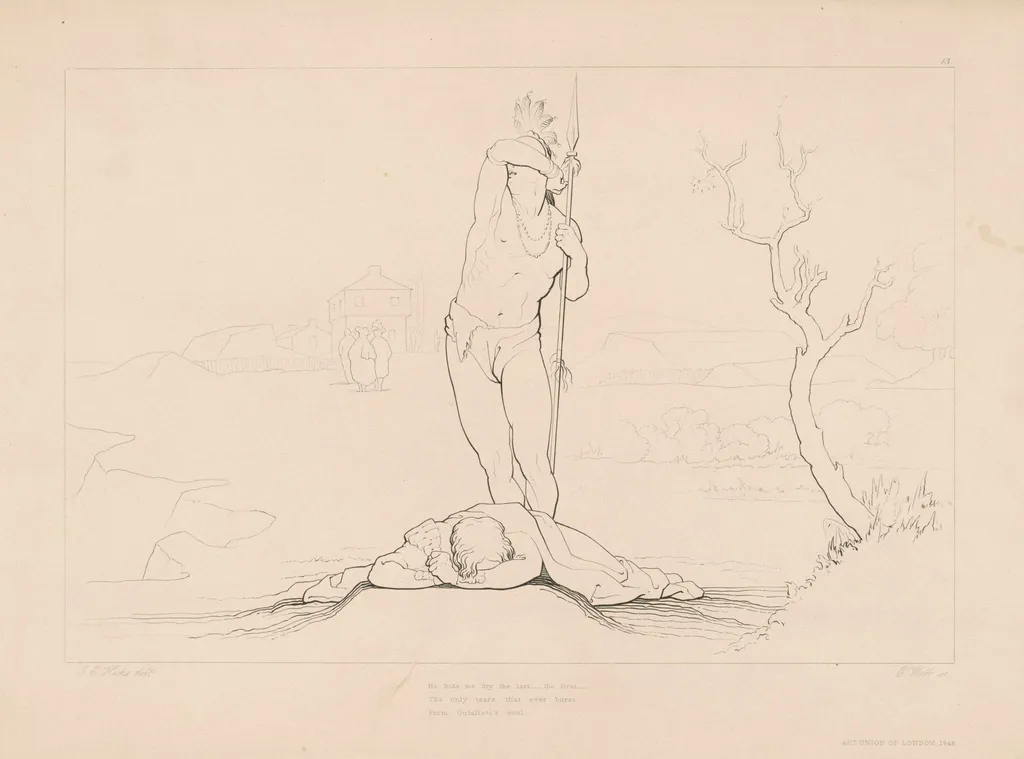
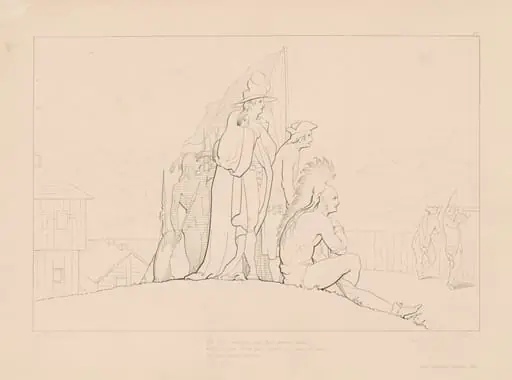
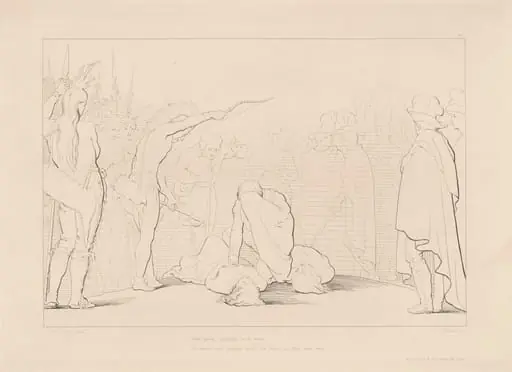
He Bids Me Dry the Last... is an ink print by the Romanticist artist Edward Webb. It dates from 1846 and is held in the collection of the National Gallery of Art.
About this work
Overview
A sparse landscape of trees and a distant house frames the scene, emphasizing its rural, wilderness setting.
Edward Webb’s 1846 engraving, titled He Bids Me Dry the Last..., presents a stark, somber tableau rendered in black on wove paper. The composition centers on a standing figure, armed with a spear and adorned with a feathered headdress, confronting a prone figure swathed in cloth, suggesting death or injury. A sparse landscape of trees and a distant house frames the scene, emphasizing its rural, wilderness setting.
Subject & Meaning
The work depicts a confrontation between two men, one dominant and armed, the other vulnerable and covered, evoking themes of violence, loss, and perhaps ritual sacrifice. The somber atmosphere, reinforced by the muted background, invites contemplation of mortality and the harshness of frontier life.
Technique & Style
Webb employs bold, decisive lines and careful cross‑hatching to model forms and suggest depth, a hallmark of Romantic engraving. The stark contrast between dark silhouettes and lighter spaces creates texture and a dramatic chiaroscuro that heightens the emotional intensity of the scene.
History & Provenance
Created in 1846, the print belongs to the mid‑nineteenth‑century surge of Romantic prints that explored dramatic narratives through the medium of engraving. It was produced on wove paper, a common support for fine prints of the period, and has since been catalogued among Webb’s lesser‑known works.
Context
During the 1840s, Romantic artists often turned to exotic or wilderness subjects to convey emotional extremes. Webb’s choice of a solitary, violent encounter aligns with contemporary interests in the untamed frontier and the moral complexities of human conflict.
Artist & collection