Artwork
New Palace Yard with the Augmentation Office as in 1793 and the Offices of the Exchequer
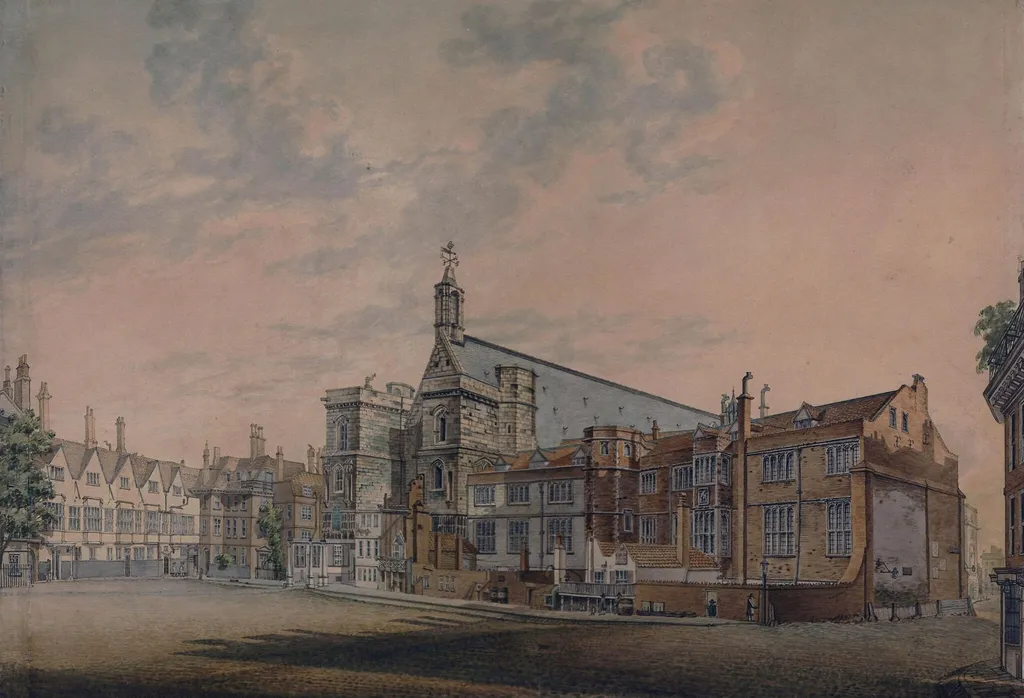
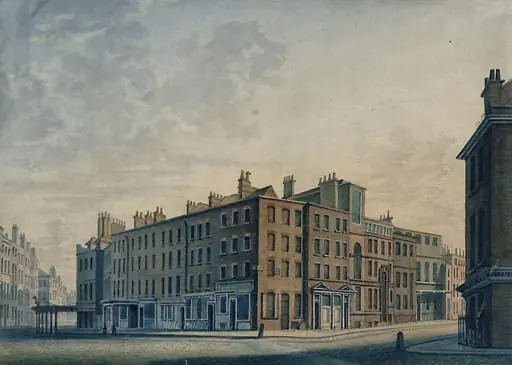
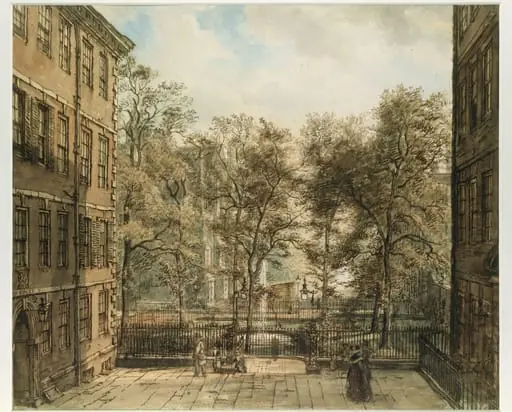
New Palace Yard with the Augmentation Office as in 1793 and the Offices of the Exchequer is a watercolor work on paper by the Romanticist artist William Capon. It dates from 1793 and is held in the collection of the Victoria and Albert Museum.
About this work
The artist focused on how light hits the buildings, making some parts look warm and others cool.
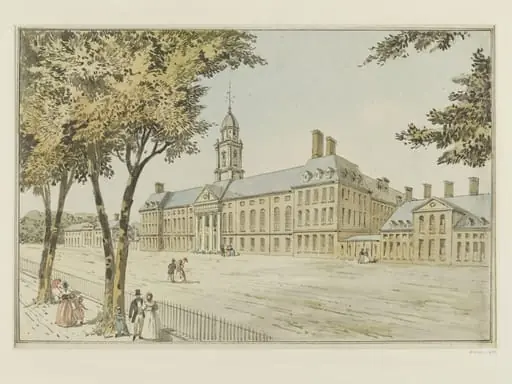
This painting shows a row of old stone buildings with tall windows and steep roofs. A church with a pointed tower sits in the middle, and smaller houses line the street. The sky is soft pink with wispy clouds, and the ground looks damp, like after rain.
The artist focused on how light hits the buildings, making some parts look warm and others cool. This was a busy area in 1793, with offices for taxes and government work.
Check out the Victoria and Albert Museum to see this painting in person.
Overview
The work is a watercolour and ink drawing on laid paper, reinforced with a wove backing, portraying New Palace Yard in Westminster as it appeared in 1793. It records the south and east facades of the yard, including the Tudor Augmentation Office opposite Westminster Hall, which was demolished later that year.
Subject & Meaning
The composition captures a bustling civic space framed by stone buildings with tall mullioned windows and steeply pitched roofs. Central to the view is a church with a pointed tower, while adjacent structures house the offices of the Exchequer and other governmental functions, reflecting the administrative heart of late‑18th‑century Westminster.
Technique & Style
The artist employs a delicate wash of watercolour to render atmospheric effects, contrasting warm illuminated surfaces with cooler shadowed areas. Ink outlines define architectural details, and the soft pink sky with wispy clouds suggests a recent rain, enhancing the sense of depth and light across the scene.
History & Provenance
Inscribed on the backing sheet are the artist’s name, the date 1793, and the title, confirming its contemporaneity. An architectural historian has cited the piece as an important visual record of the palace’s layout before the demolition of the Augmentation Office. The drawing is currently held by the Victoria and Albert Museum.
Artist & collection