Artwork
Hampton Court Palace
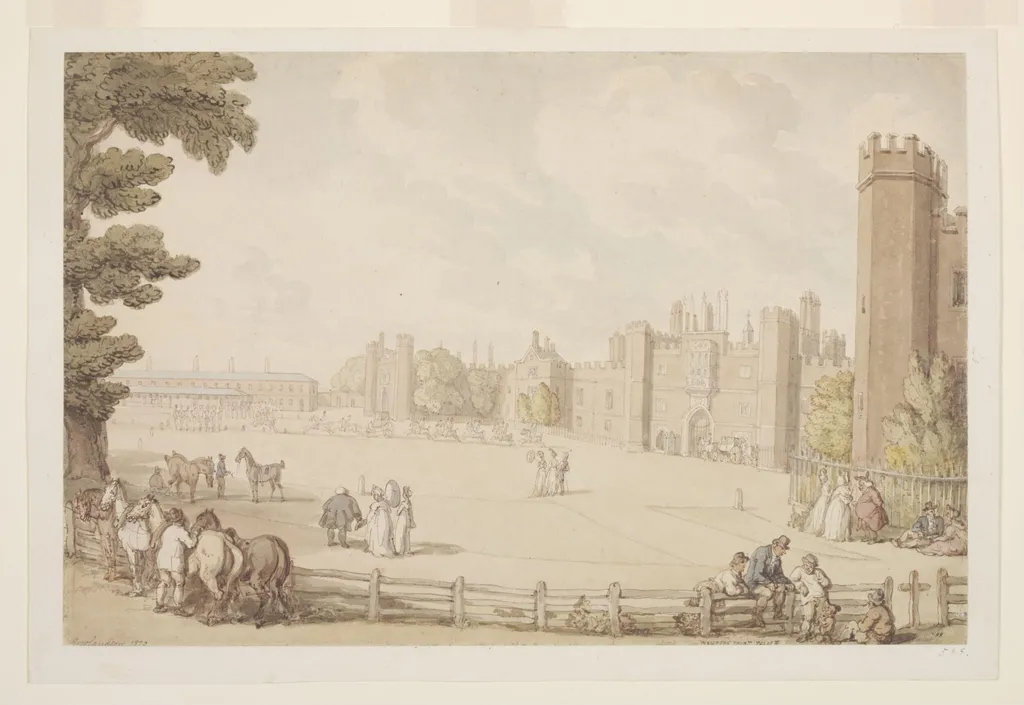
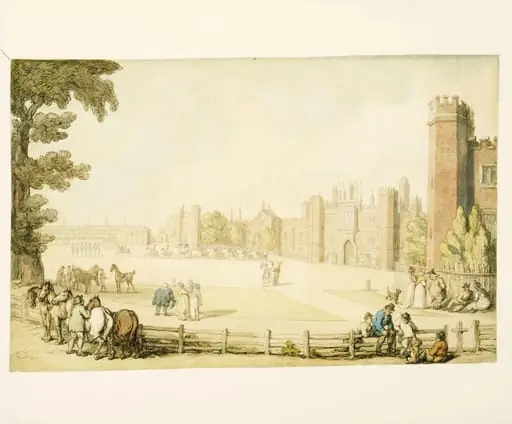
Hampton Court Palace is a watercolor work on paper by the Romanticist artist Thomas Rowlandson. It dates from 1820 and is held in the collection of the Victoria and Albert Museum.
About this work
Overview
The scene is rendered in delicate, translucent washes that suggest rather than define forms, giving the composition a gentle, atmospheric quality.
Created in 1820, this watercolour by Thomas Rowlandson captures a quiet moment in the courtyard of Hampton Court Palace. The scene is rendered in delicate, translucent washes that suggest rather than define forms, giving the composition a gentle, atmospheric quality. Rowlandson signed and dated the work, anchoring it firmly in the final years of his career as a keen observer of everyday British life.
Subject & Meaning
The painting portrays a routine yet layered moment: a carriage with four horses and a military escort departs through the palace gate, while a carter tends to his animals on the left. On the right, four men amuse themselves by training a dog to beg. These incidental activities, neither grand nor dramatic, reflect the ordinary rhythms of palace life, suggesting a world where duty and leisure coexist without ceremony.
Technique & Style
Rowlandson employed loose, light watercolour washes to suggest architecture, figures, and foliage without rigid detail. Forms are implied through tone and suggestion rather than precise line, creating a soft, almost hazy effect. The palette is restrained—pale blues, greys, and earth tones—enhancing the sense of calm and quiet observation. The brushwork is economical, prioritizing mood over precision.
History & Provenance
The watercolour was completed in 1820, near the end of Rowlandson’s active career. It entered the collection of the Victoria and Albert Museum, where it remains accessible to the public. Its survival in good condition reflects its status as a personal, observational work rather than a commissioned piece, likely made for private appreciation or as a study of contemporary life.
Context
In the early 19th century, Hampton Court Palace had lost its role as a royal residence but retained symbolic and ceremonial importance. Rowlandson’s depiction aligns with a broader trend among artists to document the transition of historic sites into public spaces. His focus on mundane activity, rather than architecture alone, reflects a growing interest in social realism during the period.
Legacy
Rowlandson’s watercolour contributes to a visual record of post-monarchical England, where historic sites became stages for civilian life. Its understated quality distinguishes it from more formal topographical works of the era. Though not widely exhibited, it endures as a quiet testament to the artist’s skill in capturing fleeting, unremarkable moments with sensitivity and clarity.
Artist & collection
Artist
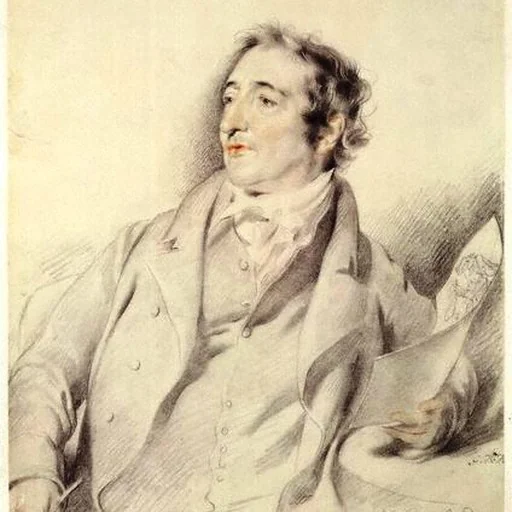
Thomas Rowlandson (; 13 July 1757 – 21 April 1827) was an English artist and caricaturist of the Georgian Era, noted for his political satire and social observation.

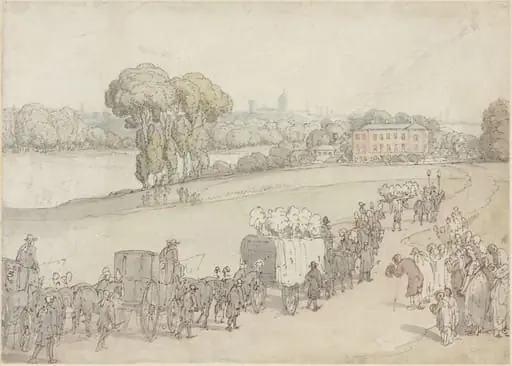
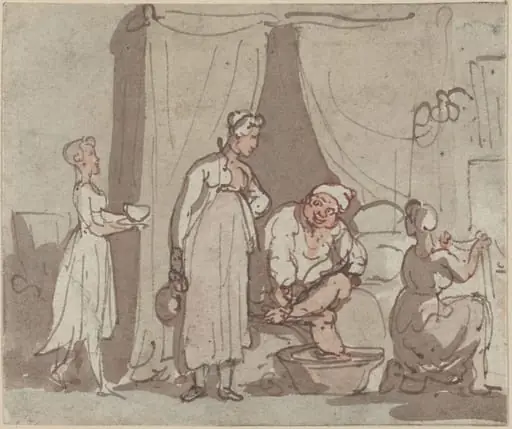
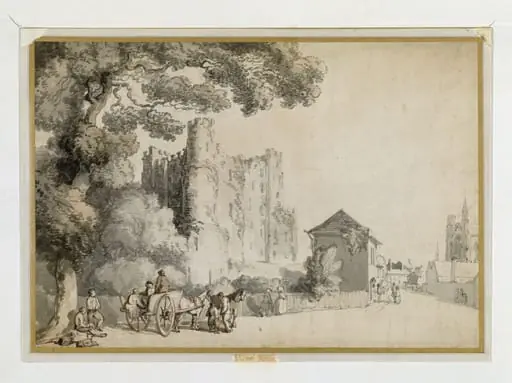 Boley Hill and Castle, Rochester, with the "Justice Tree"
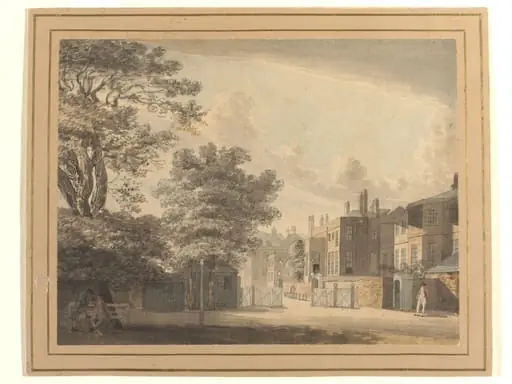 Birdcage Walk, London
 Windsor Castle from the Great Park, near the End of the Long Walk
 Kew Palace
 The Archbishop's Palace at Lambeth
 A Country House and Park, probably Norton Hall, near Sheffield
 New Palace Yard with the Augmentation Office as in 1793 and the Offices of the Exchequer
 Untitled
 Peterborough House, Millbank, Westminster
 Sandbeck Park, Yorkshire
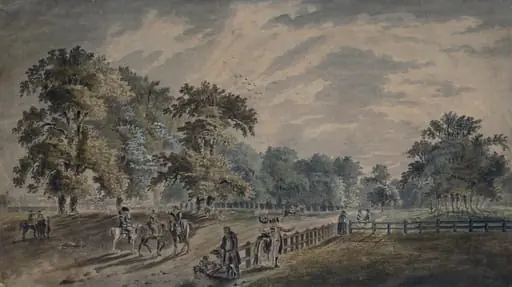 St. James's Park
 Hampton Court