Artwork
Portraits of Sir Walter Raleigh, Lord Bacon, Algernon Sidney, and Sir Matthew Hale
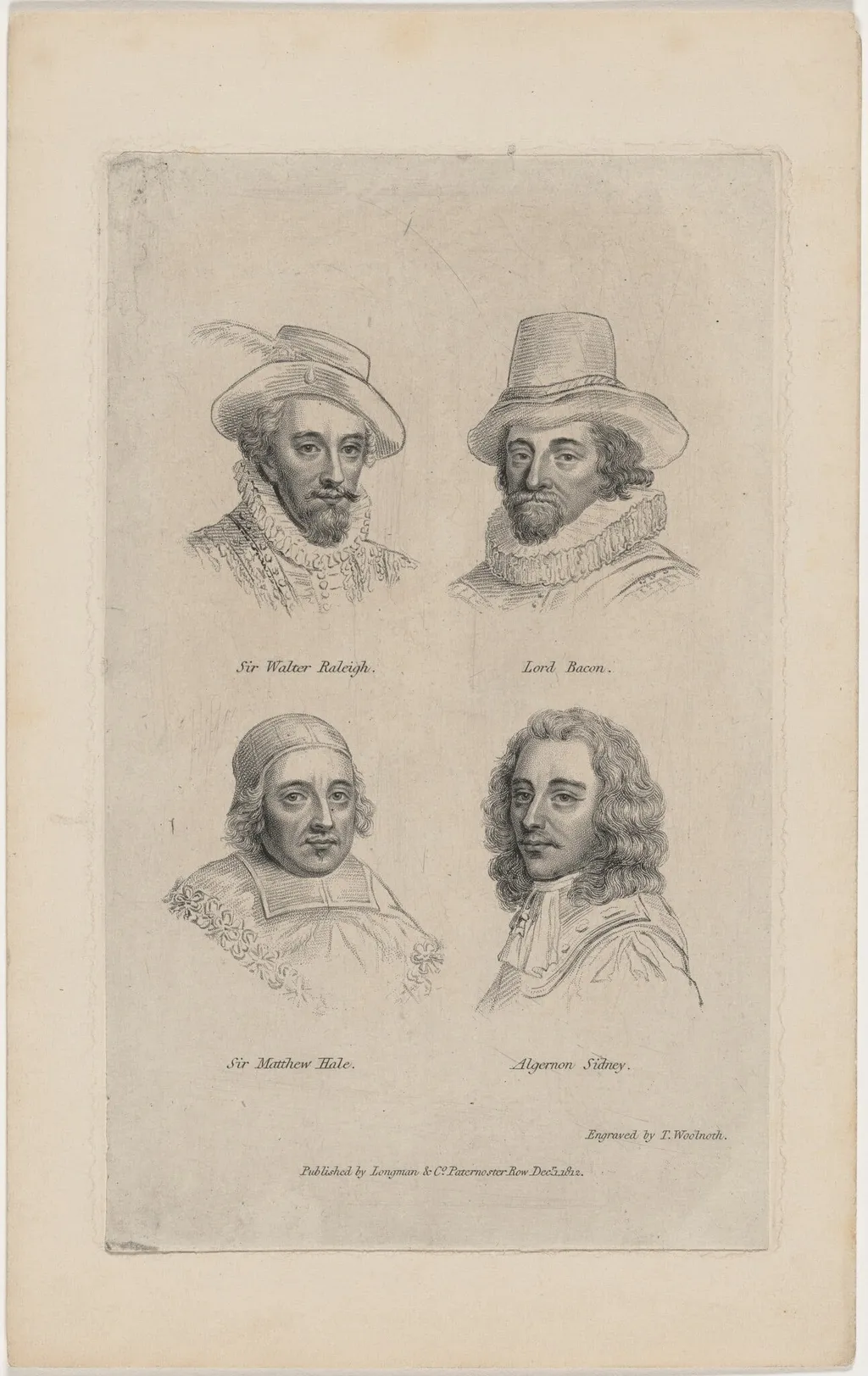
Portraits of Sir Walter Raleigh, Lord Bacon, Algernon Sidney, and Sir Matthew Hale is a print by the Romanticist artist Thomas Woolnoth. It dates from 1821 and is held in the collection of the National Gallery of Art.
About this work
Overview
Rendered as a facsimile, it reproduces earlier likenesses rather than originating new imagery.
This 1821 print by Thomas Woolnoth presents four prominent English figures—Sir Walter Raleigh, Lord Bacon, Algernon Sidney, and Sir Matthew Hale—in a single composition. Rendered as a facsimile, it reproduces earlier likenesses rather than originating new imagery. The work is executed in monochrome, using fine linear shading to define features against a pale ground, reflecting its function as a historical record rather than an artistic innovation.
Subject & Meaning
The four men depicted were influential in law, politics, and intellectual life during the 16th and 17th centuries. Each is identified by name beneath their portrait, emphasizing their historical significance. Their formal attire and solemn expressions convey authority and gravitas, aligning the print with a tradition of honoring public figures through visual commemoration, particularly in the context of England’s evolving constitutional identity.
Technique & Style
Woolnoth employed a linear, tonal approach typical of engraved facsimiles of the period. The portraits lack color, relying on subtle gradations of ink to suggest volume and expression. Ruffled collars and varied headwear are rendered with precise, restrained lines, suggesting adherence to original source material. The style prioritizes clarity and fidelity over embellishment, consistent with the reproduction practices of historical portraiture in early 19th-century print culture.
History & Provenance
The print was produced in 1821 as part of a broader effort to preserve and disseminate images of notable historical figures. Woolnoth, known for his work in reproductive engraving, likely based the portraits on earlier drawings or engravings, though the original sources remain unconfirmed. Its creation reflects a growing public interest in national heritage during the post-Enlightenment era, when printed collections of historical figures became common in libraries and private collections.
Context
In the early 1800s, Britain experienced a surge in interest in its political and legal past, particularly figures associated with parliamentary development and the rule of law. This print aligns with that cultural moment, serving as a visual reference for those studying constitutional history. Its format—multiple portraits in one frame—was a standard method for educational and commemorative prints, bridging the gap between private collections and public knowledge.
Legacy
Though not an original artistic creation, the print endures as a documentary artifact, preserving the visual representation of four key historical figures. It contributes to the visual archive of early modern English leadership, offering insight into how later generations chose to depict and remember them. Its continued presence in institutional collections underscores its role as a tool for historical transmission rather than aesthetic innovation.
Artist & collection

 Bacon, Baxter, Blackstone, Beattie, Burns
 Thomas Bodley
 Sir Thomas Bodley, Founder of the Bodleian Library
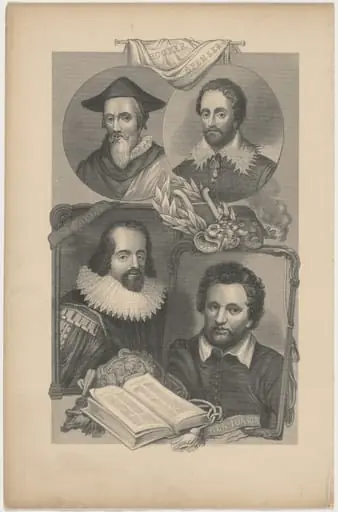 Hooker, Spenser, Lord Bacon, Ben Johnson
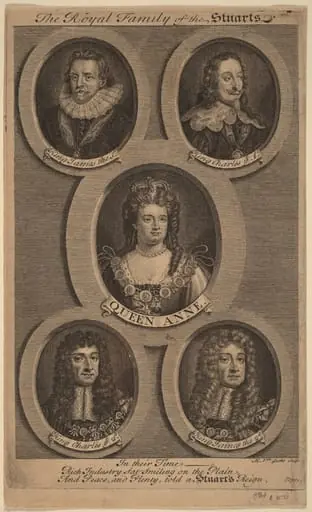 The Royal Family of the Stuarts
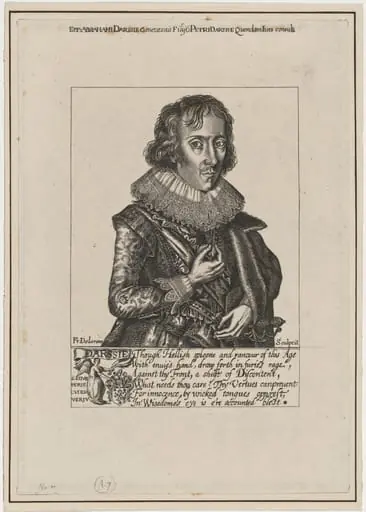 Abraham Darssie
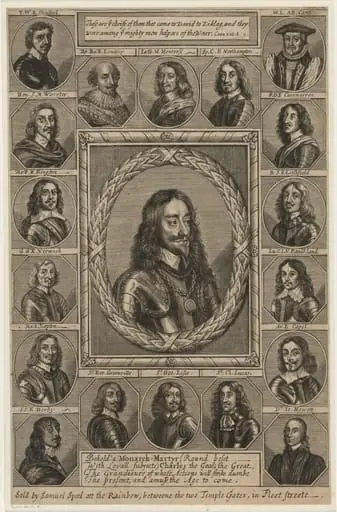 Charles I and His Supporters
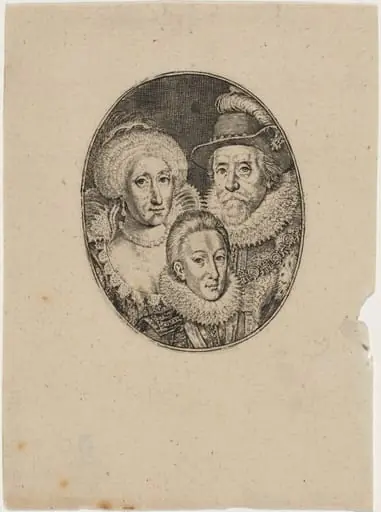 James I, Anne of Denmark, and Prince Charles
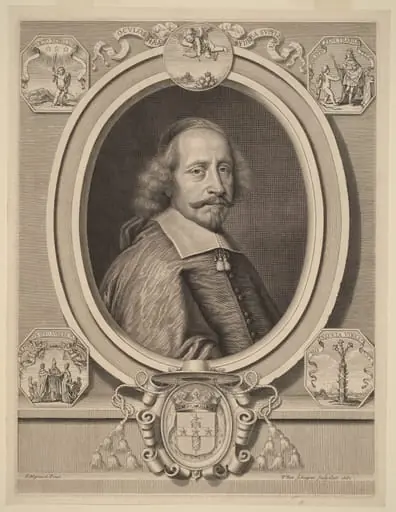 Cardinal Jules Mazarin
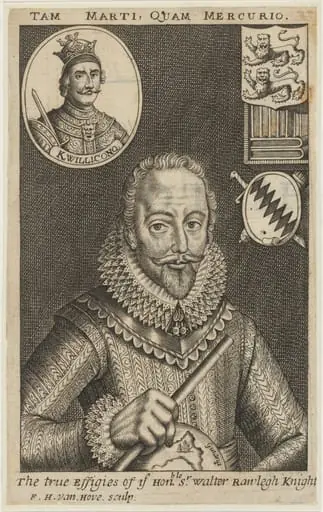 Sir Walter Raleigh