Artwork
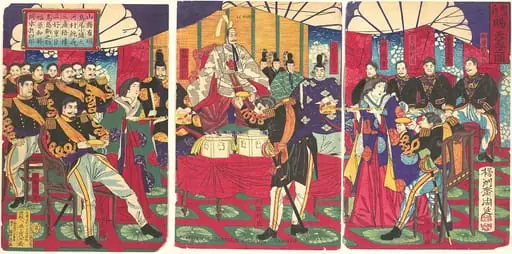
Taiseikan Shosho Shiten|Commanders Receiving the Emperor's Drinking Cups
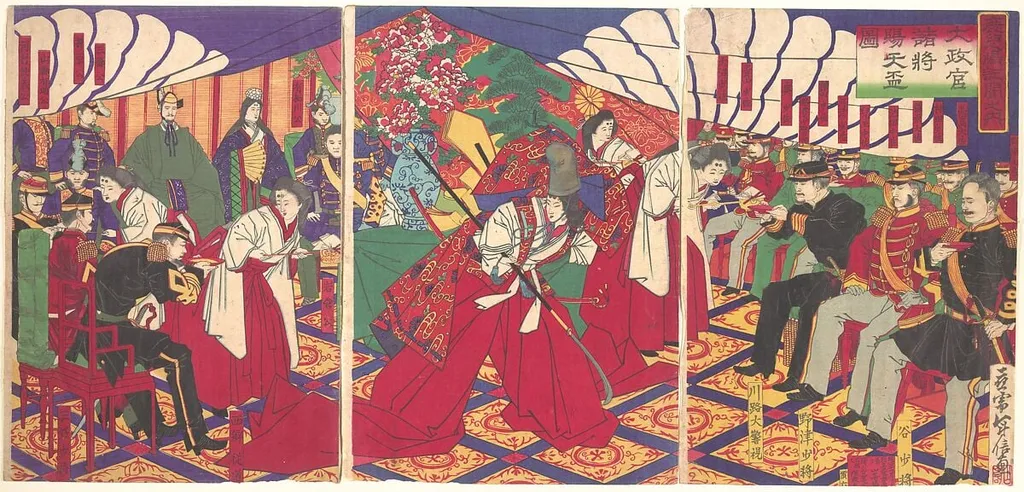
Taiseikan Shosho Shiten|Commanders Receiving the Emperor's Drinking Cups is an ink print by the Impressionist artist Yamazaki Toshinobu. It dates from 1886 and is held in the collection of the Metropolitan Museum of Art.
About this work
Overview
The work is part of The Metropolitan Museum of Art’s collection and illustrates a formal court ritual, likely tied to imperial patronage of the military elite.
Created in 1886 by Yamazaki Toshinobu, this triptych depicts ceremonial moments involving imperial attendants and military figures. Composed of three woodblock panels, it combines ink and color on paper, reflecting late Edo-period print traditions. The work is part of The Metropolitan Museum of Art’s collection and illustrates a formal court ritual, likely tied to imperial patronage of the military elite.
Subject & Meaning
The three panels portray distinct yet connected scenes of ritual and hierarchy. Left panel shows officials receiving imperial drinking vessels, symbolizing trust and favor. The center features a female performer, possibly a court dancer, engaged in ceremonial motion. The right panel displays uniformed officers in discourse, emphasizing military presence within the court. Together, they convey the integration of ritual, performance, and authority in Meiji-era imperial life.
Technique & Style
Yamazaki employed bold, flat areas of color—reds, greens, and golds—against intricate background patterns typical of ukiyo-e. Sharp outlines define figures, while facial details vary: some are rendered with precision, particularly in robe folds, while others appear deliberately blurred. The composition balances dynamic movement with structured symmetry, blending traditional Japanese print methods with emerging Western influences in perspective and spatial arrangement.
History & Provenance
Produced in 1886 during the early Meiji period, the triptych emerged as Japan modernized its institutions while preserving ceremonial traditions. It was likely commissioned for elite audiences, reflecting the state’s effort to visually reinforce imperial authority. The work entered The Metropolitan Museum of Art’s collection through early 20th-century acquisitions of Japanese prints, preserving its cultural context beyond its original audience.
Context
In the 1880s, Japan’s military was being reorganized along Western lines, yet imperial rituals remained central to national identity. This print captures the tension between modernization and tradition, portraying soldiers in uniform alongside courtly dancers and ceremonial acts. It reflects a broader cultural project: using visual art to legitimize the emperor’s role as both symbolic head and military patron during rapid societal change.
Legacy
Yamazaki Toshinobu’s work exemplifies the transitional phase in Japanese printmaking, where traditional ukiyo-e techniques accommodated new subject matter and subtle Western influences. While not widely known today, this triptych contributes to understanding how visual culture sustained imperial symbolism amid modernization. It remains a quiet record of how ceremony persisted even as Japan’s institutions transformed.
Artist & collection


 Untitled
 Yokohama Gankirō kodomo te odori no zu|Foreigners Enjoying Children's Kabuki at the Gankirō Tea House
 Untitled
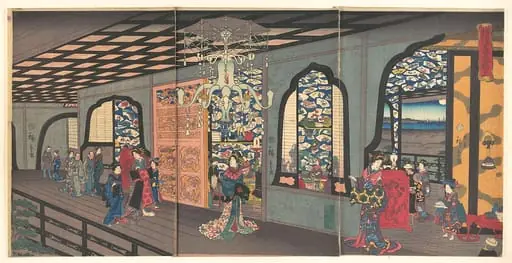 Yokohama Gankirō age|横浜岩亀楼上|Upper Floor of the Gankirō Tea House in Yokohama
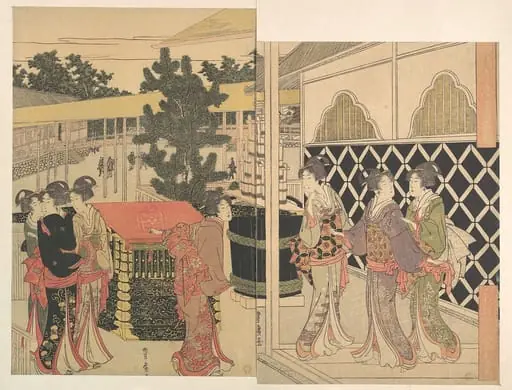 Horinouchi Myōhōji Eho Mairi no Zu|Pilgrimage to Myōhōji in Horinouchi, Edo
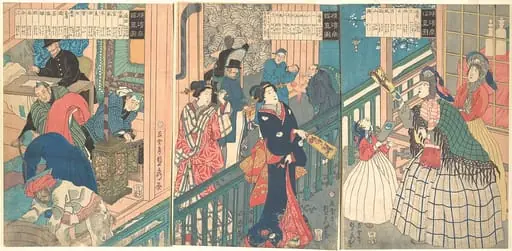 歌川(五雲亭)貞秀画 「横濱商館真圖」|A True View of a Trading House of a Yokohama Merchant
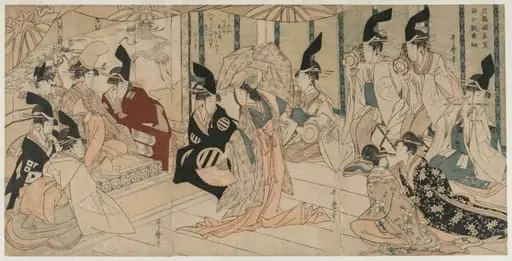 Scene Adapted from the play The Treasury of Loyal Retainers (Chushingura)
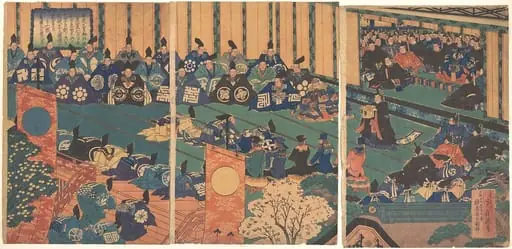 Untitled
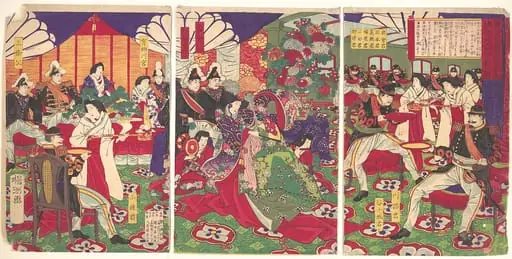 『鹿児島賊徒鎮静依諸将 天杯頂戴之図』|Leaders of the Pacification of the Kagoshima Rebels Celebrating with Cups of Wine from the Emperor (Kagoshima zokuto chinsei ni yotte shoshō tenhai chōdai no zu)
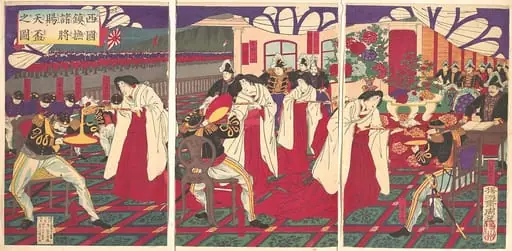 西国鎮静撫諸将天杯賜之図|Illustration of the Commanders who Pacified Western Japan, Receiving the Emperor's Gift Cups (Saigoku chinbu shoshō tenpai o tamau no zu)
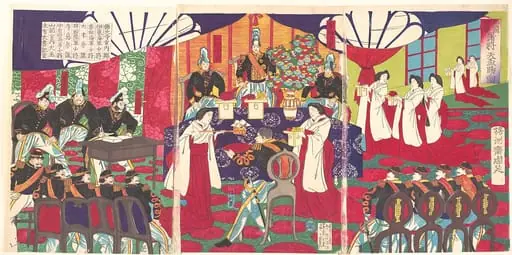 西国諸将鎮静天杯賜ル之図|Illustration of the Commanders who Pacified Western Japan, Receiving the Emperor's Gift Cups (Saigoku chinsei shoshō tenpai o tamawaru no zu)
 勲功之将天杯賜之図|Illustration of the Honored Commanders, Receiving the Emperor's Gift Cup (Kunkō no shō tenpai o tamau no zu)