Artwork
St. Alban's Abbey
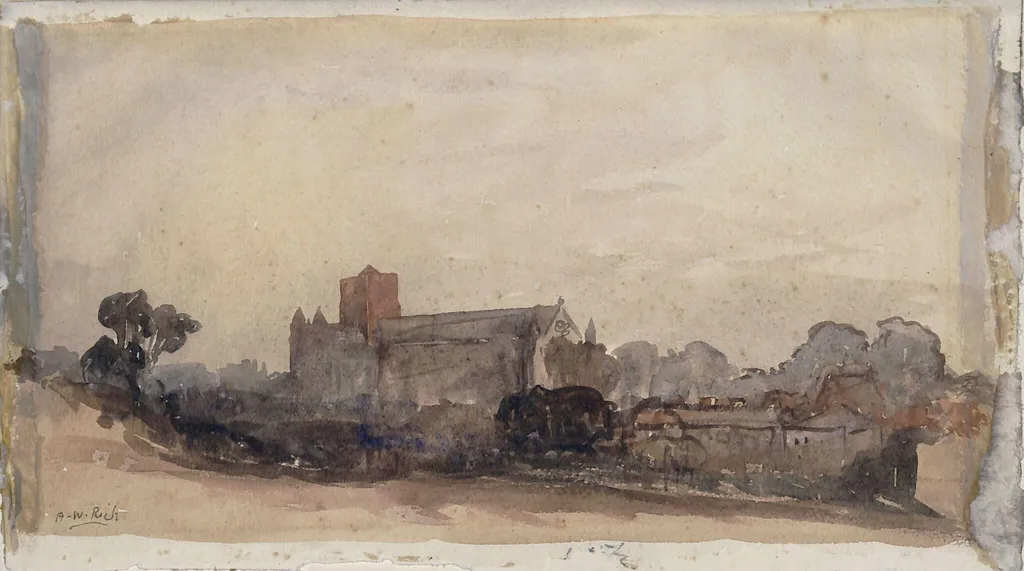
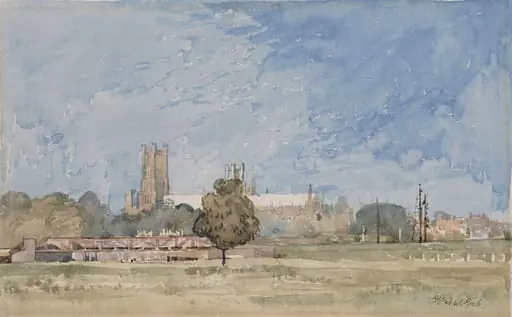
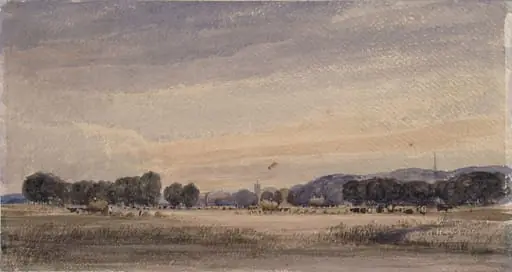
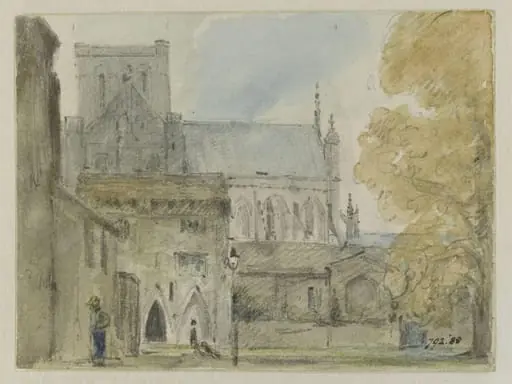
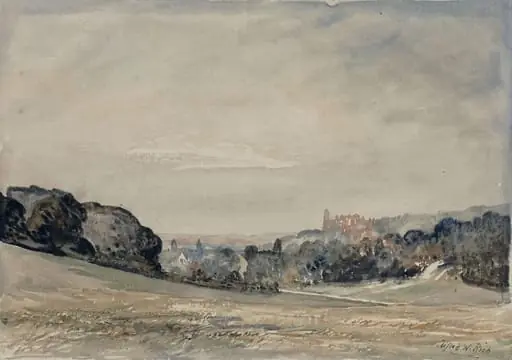
St. Alban's Abbey is a watercolor work on paper by the Arts and Crafts movement artist Alfred Rich. It dates from 1850 and is held in the collection of the Victoria and Albert Museum.
About this work
Overview
The composition balances quiet naturalism with a restrained sense of place, typical of 19th-century British topographical watercolours.
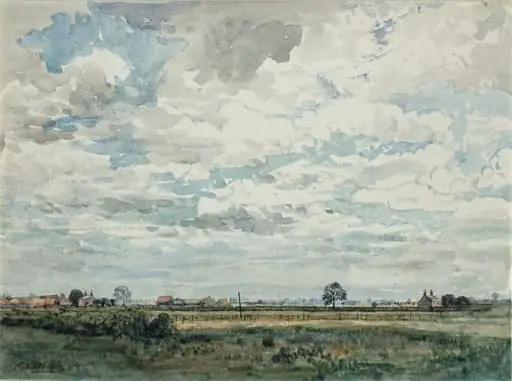
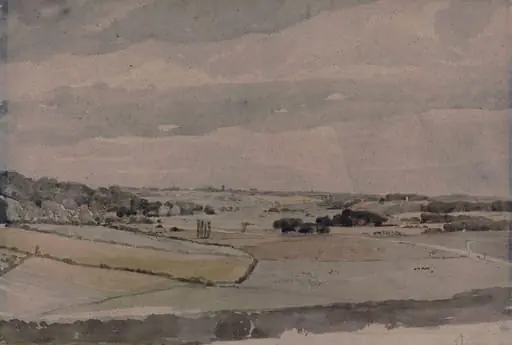
A watercolour painting by Alfred Rich depicts St. Alban's Abbey as a distant structure within a tranquil landscape. Rendered in delicate washes, the work emphasizes atmosphere over architectural detail. The artist's signature confirms authorship, situating the piece within his body of observational works. The composition balances quiet naturalism with a restrained sense of place, typical of 19th-century British topographical watercolours.
Subject & Meaning
The subject is St. Alban's Abbey, a historic religious site in Hertfordshire, England. Rich presents it not as a monument but as an integrated element within the surrounding countryside. The abbey's modest scale against expansive sky and open land suggests contemplation rather than grandeur. The scene invites quiet reflection, aligning with Victorian-era ideals of nature as a space for spiritual stillness.
Technique & Style
Rich employs soft, layered watercolour washes to build subtle tonal transitions across the landscape. Foreground vegetation is suggested with loose, feathery brushwork, while the abbey is rendered in muted, cool hues to recede visually. The sky blends pale blues and greys with minimal definition, enhancing the sense of calm. There is no sharp outline or dramatic contrast—instead, the effect is one of atmospheric harmony.
History & Provenance
The painting is attributed to Alfred Rich, a British artist active in the late 19th and early 20th centuries, known for landscape watercolours of English ecclesiastical sites. While specific ownership history is not documented, its subject and technique suggest it was likely created during a period of renewed interest in regional heritage. The signed surface indicates it was intended as a finished work, not a preparatory sketch.
Context
Rich's work emerged during a time when watercolour was widely used for topographical and amateur artistic practice in Britain. Depictions of abbeys and cathedrals often reflected cultural nostalgia for pre-Reformation architecture. Unlike romanticized interpretations, Rich's approach avoids embellishment, aligning with a growing trend toward documentary precision in landscape art of the period.
Legacy
The painting contributes to a modest but persistent tradition of British watercolourists who recorded ecclesiastical architecture with restraint. While not widely exhibited or collected, such works offer insight into how local landmarks were visually understood by contemporaries. Rich's quiet style reflects a broader shift away from dramatic spectacle toward intimate, observational art in the late Victorian era.
Artist & collection
Artist
Alfred Rich painted quiet English buildings in watercolour between about 1880 and 1920.