Artwork
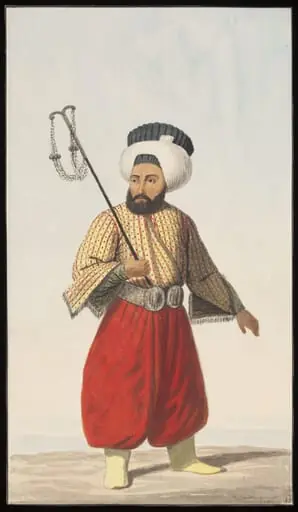
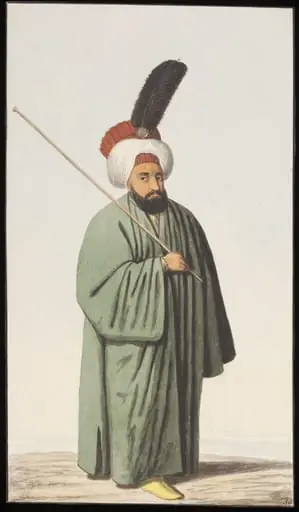
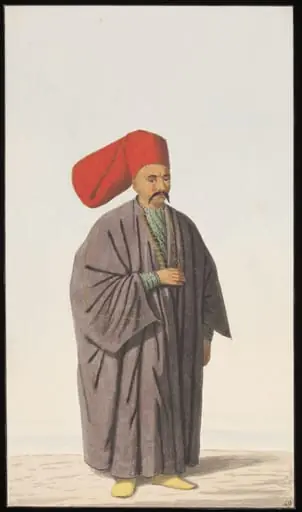
Çavus, or Palace Doorkeeper
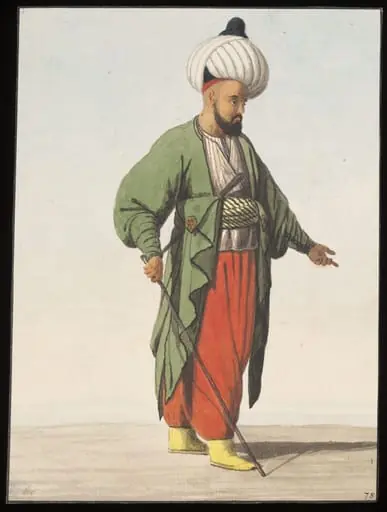
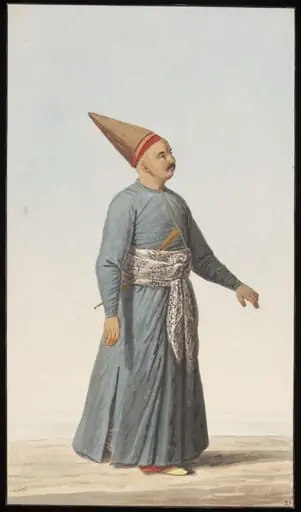
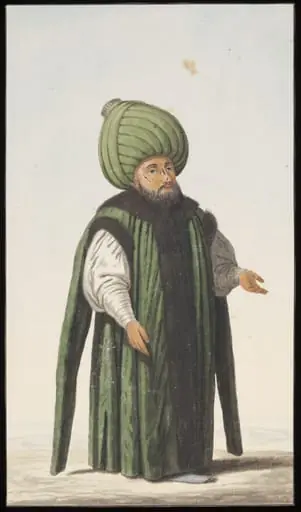
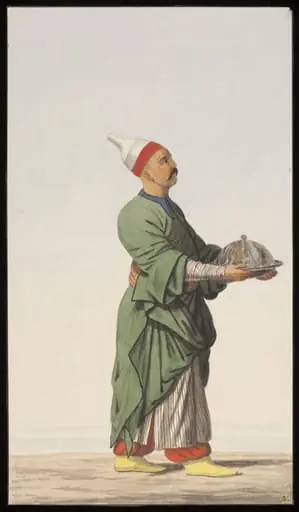
Çavus, or Palace Doorkeeper is a watercolor work on paper by the Romanesque artist Anonymous Greek artist. It dates from 1809 and is held in the collection of the Victoria and Albert Museum.
About this work
This watercolour shows a palace doorkeeper named Çavus. It was part of a big set made for a British diplomat in Istanbul.
Stratford Canning came to Turkey in 1808. He hired a local artist to paint what he saw. The artist mixed Ottoman watercolour techniques with European perspective.
Look up the Victoria and Albert Museum for more on this series.
Overview
This watercolour, titled "Çavus, or Palace Doorkeeper," is part of a larger collection of Ottoman scenes commissioned by the British diplomat Stratford Canning during his early years in Istanbul. Executed in the early nineteenth century, the work depicts a palace guard and exemplifies the blend of local artistic practice with European compositional ideas that characterises the series.
Subject & Meaning
The image portrays Çavus, a doorkeeper employed at a palace, rendered in a manner that emphasizes his role within the Ottoman courtly environment. By focusing on a single figure of service, the picture offers a glimpse into the everyday personnel who maintained the ceremonial spaces of the empire, reflecting Canning’s interest in the social fabric of Ottoman institutions.
Technique & Style
The artist combines the rich, saturated water‑and‑body colours typical of Ottoman miniature traditions with a linear perspective derived from European drawing conventions. This hybrid approach results in a vivid, densely coloured surface while still providing a sense of depth and spatial organization uncommon in purely Ottoman works of the period.
History & Provenance
Commissioned by Stratford Canning after his arrival in Istanbul in 1808, the series was produced by an unnamed Greek artist believed to be linked to Konstantin Kapidagli’s workshop. The original set remained in Canning’s family until his daughter Charlotte sold it to the Victoria and Albert Museum in 1895, where it resides today.
Artist & collection

![A Pasha travelling with his escort[?], by Anonymous Greek artist](https://artifactworldgallery.com/img/anonymous-greek-artist--a-pasha-travelling-with-his-escort--01de32b8fcf30843-w320.webp)