Artwork
The Sultan riding out in procession to Friday Prayers
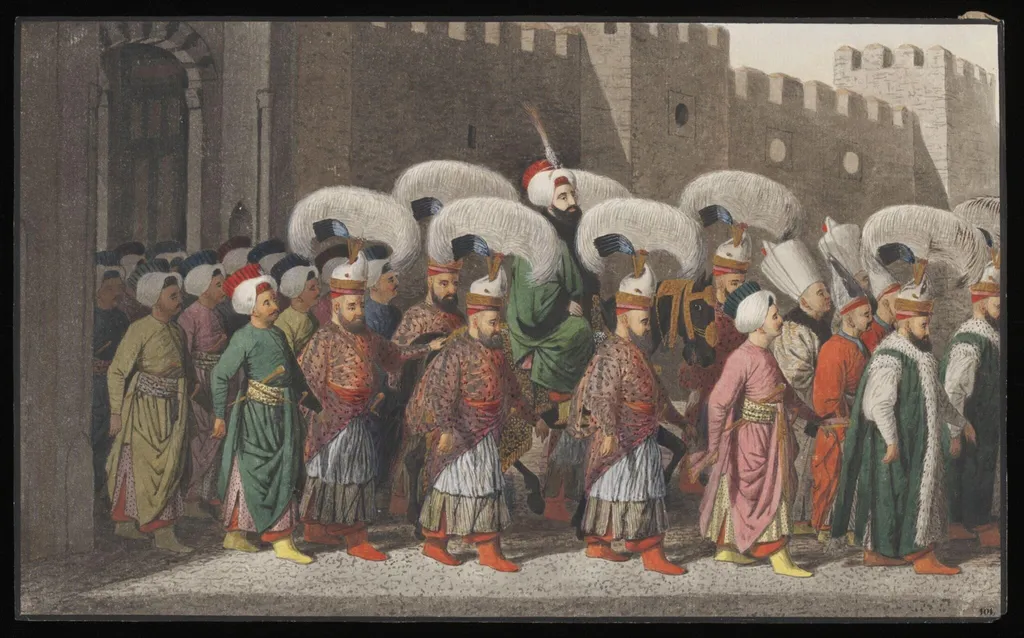
The Sultan riding out in procession to Friday Prayers is a watercolor work on paper by the Orientalist artist Anonymous Greek artist. It dates from 1809 and is held in the collection of the Victoria and Albert Museum.
About this work
Every Friday the Sultan left Topkapi Palace for Friday prayers with his guards close by.
This watercolor shows the Sultan riding out in procession to Friday Prayers. It was painted around 1809 by an unknown Greek artist. The scene captures a key moment in Istanbul’s daily life.
Every Friday the Sultan left Topkapi Palace for Friday prayers with his guards close by. His guards wore tall ostrich-feather hats that nearly hid him from view. The painting was part of a set ordered by a British diplomat named Stratford Canning.
Check out the Victoria and Albert Museum for this work.
Overview
This watercolour depicts Sultan Mahmud II departing Topkapi Palace for Friday prayers in 1809, part of a series commissioned by British diplomat Stratford Canning. The scene captures a routine yet ceremonial aspect of Ottoman court life, rendered in detailed water and bodycolour. Though the artist remains unidentified, stylistic elements suggest ties to the circle of Konstantin Kapidagli, blending Ottoman visual traditions with emerging European perspectival techniques.
Subject & Meaning
The painting illustrates the Sultan’s weekly public appearance for congregational prayers, a ritual reinforcing his religious and political authority. His figure is partially obscured by the tall ostrich-feather headdresses of his elite guards, the Solaks, emphasizing the ceremonial distance between ruler and subject. The procession reflects the structured hierarchy of the Ottoman court, where visibility was controlled to maintain imperial mystique.
Technique & Style
Executed in watercolour with opaque bodycolour, the work employs rich, layered pigments typical of Ottoman manuscript illustration. At the same time, it adopts European spatial conventions—clear horizon lines, receding architecture, and individualized figures—suggesting cross-cultural artistic exchange. The precision in rendering textures, from fabric to feathers, reveals a skilled hand familiar with both local and foreign visual practices.
History & Provenance
Commissioned by Stratford Canning during his early diplomatic posting in Istanbul, the series was created to document Ottoman institutions for a Western audience. Canning, who arrived in 1808, actively sought visual records of court customs. The watercolour entered British collections through his estate and is now held by the Victoria and Albert Museum, where it serves as a primary visual source for early 19th-century Ottoman ceremonial life.
Context
In the early 1800s, Istanbul was a site of intense diplomatic and cultural interest for Europeans. Canning’s commission coincided with Ottoman efforts at modernization under Mahmud II, who would later dismantle the Janissary corps. This image, made before major reforms, preserves a moment of traditional court ritual, offering insight into the empire’s self-presentation at a time of increasing external scrutiny.
Legacy
The painting stands as a rare visual record of Ottoman court ceremony from an insider’s perspective, mediated through a foreign patron’s lens. Its hybrid style reflects the fluid artistic environment of early 19th-century Istanbul, where local artisans adapted to European expectations. Though the artist’s name is lost, the work contributes to understanding how Ottoman visual culture was documented and interpreted by Western observers.
Artist & collection

![A Pasha travelling with his escort[?], by Anonymous Greek artist](https://artifactworldgallery.com/img/anonymous-greek-artist--a-pasha-travelling-with-his-escort--01de32b8fcf30843-w320.webp)
![A Dervish[?], by Anonymous Greek artist](https://artifactworldgallery.com/img/anonymous-greek-artist--a-dervish--3c8916f5a95abb6a-w320.webp) A Dervish[?]
A Dervish[?]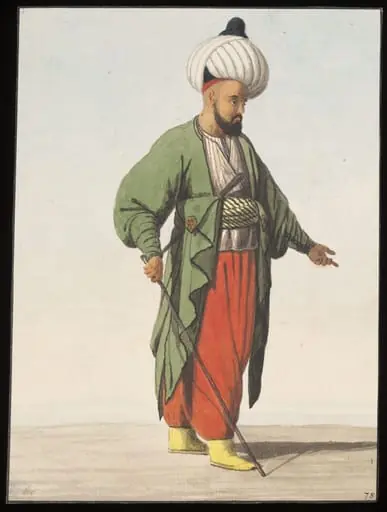 A Turkish official
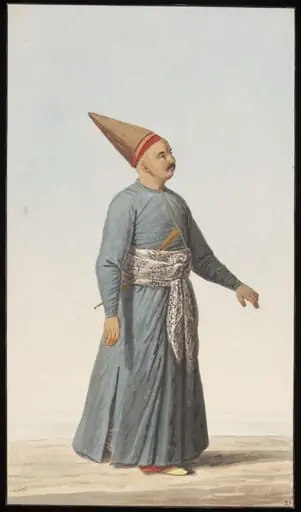 An official in the Sultan's palace
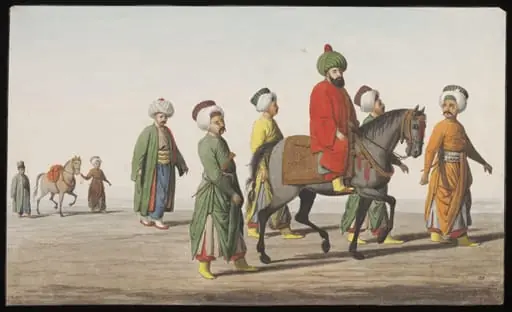 Kaymakam, or Govenor of Istanbul
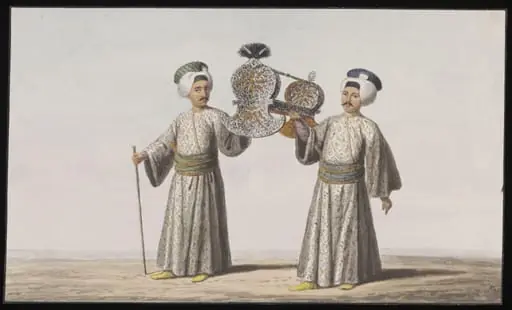 Besik alayi, or the ceremony of the Procession of the Cradle
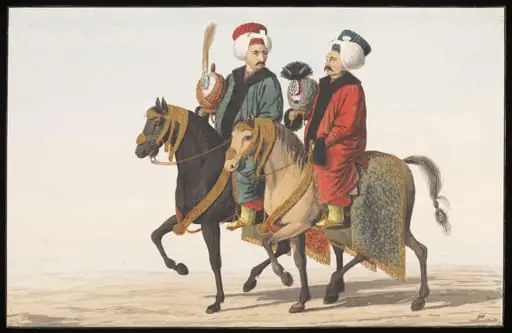 Two Royal Turban-Bearers on horseback
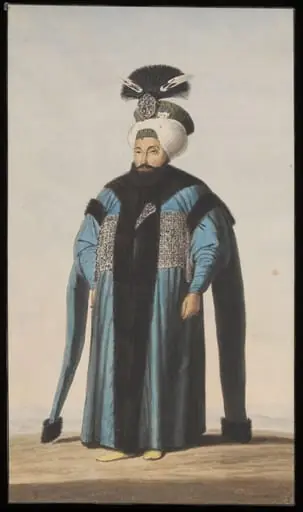 Portrait of Sultan Mahmud II of Turkey
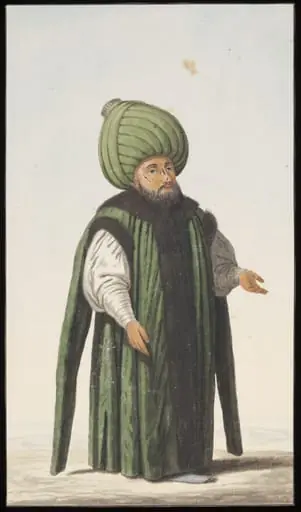 A senior Ottoman official
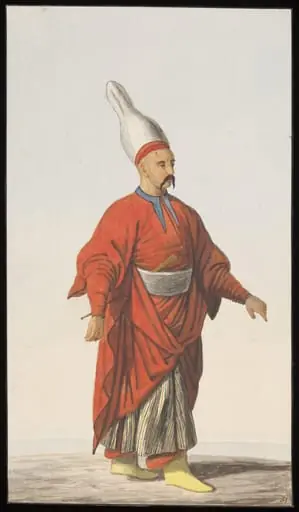 Kozbekçisi, or Steward of the Sultan's Wardrobe