Artwork
Topçular Barracks on the outskirts of Pera[?]
![Topçular Barracks on the outskirts of Pera[?], by Anonymous Greek artist, watercolor, 1809](https://artifactworldgallery.com/img/anonymous-greek-artist--topcular-barracks-on-the-outskirts-of-pera--81cd3e7e912c2328-w1024.webp)
Topçular Barracks on the outskirts of Pera[?] is a watercolor work on paper by the Romanticist artist Anonymous Greek artist. It dates from 1809 and is held in the collection of the Victoria and Albert Museum.
About this work
The scene was one of many views painted for British diplomat Stratford Canning.
This watercolor shows Ottoman barracks built in a Western style. They were part of Sultan Selim III’s push to modernize the army. By 1809, after his death, the buildings sat empty and falling apart.
The scene was one of many views painted for British diplomat Stratford Canning. He traveled Turkey in 1808, hiring local artists to document what he saw.
This work sits at the Victoria and Albert Museum.
Overview
This watercolour depicts the Topçular Barracks, a military complex on the outskirts of Pera, constructed during Sultan Selim III’s efforts to reform the Ottoman army along European lines. After the Sultan’s assassination in 1808, the site fell into disuse. The image is part of a larger collection commissioned by British diplomat Stratford Canning, who employed local artists to record Ottoman architecture and institutions during his early tenure in Istanbul.
Subject & Meaning
The barracks symbolize the tension between Ottoman modernization and political instability. Built to house a reformed military, they stood abandoned within a year of their completion, reflecting the fragility of Selim’s reforms. Canning’s commission captured such sites not as monuments, but as evidence of a society in transition—structures that embodied ambition, failure, and the quiet decay of reformist ideals.
Technique & Style
The work fuses Ottoman watercolour traditions—rich pigments, detailed textures—with European spatial conventions like linear perspective and tonal modeling. The artist, likely trained in the circle of Konstantin Kapidagli, rendered architectural forms with precision while retaining the luminous, layered washes typical of local practice. This hybrid style allowed Western viewers to recognize the subject while preserving its cultural specificity.
History & Provenance
The drawings were collected by Stratford Canning during his 1808–1812 posting in Istanbul. In 1810, British architect Charles Cockerell encountered the artist at the embassy and made copies of his architectural studies, now held in the British Museum. The original set remained in Canning’s family until 1895, when his daughter Charlotte donated it to the Victoria and Albert Museum, securing its preservation as a record of early 19th-century Istanbul.
Context
Canning’s commission coincided with a period of intense diplomatic interest in Ottoman reform. European envoys sought to document the empire’s institutions as they underwent rapid, often violent change. The barracks, though physically unremarkable, became a visual proxy for broader questions of modernization, resistance, and the limits of Western influence within Ottoman society.
Legacy
The series remains a rare visual archive of Ottoman architecture at a moment of transition, created not by foreign tourists but by a local artist working within a cross-cultural framework. Its survival and institutional preservation underscore its value as a document of both architectural history and the complex dynamics of diplomatic observation in the early 19th century.
Artist & collection

![A Pasha travelling with his escort[?], by Anonymous Greek artist](https://artifactworldgallery.com/img/anonymous-greek-artist--a-pasha-travelling-with-his-escort--01de32b8fcf30843-w320.webp)
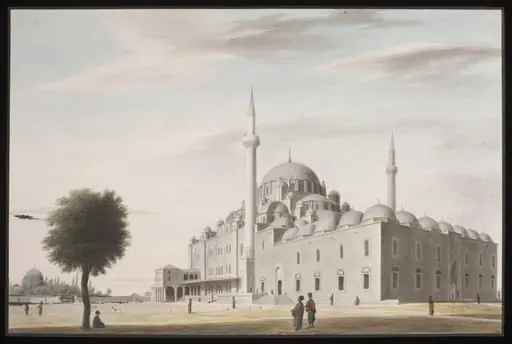 View of the Fatih Mehmet Camii
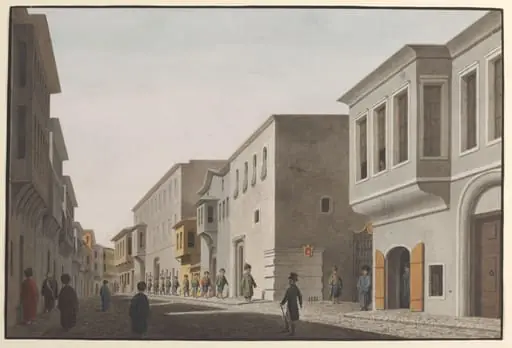 Street scene outside an embassy in Pera
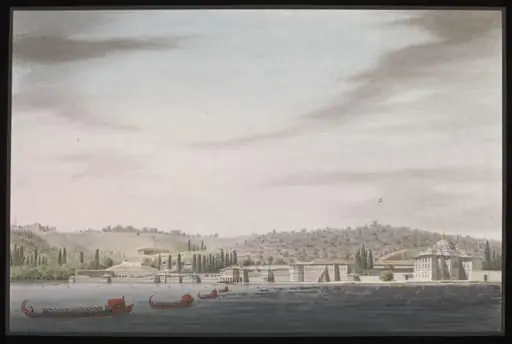 Besiktas on the Bosphorus
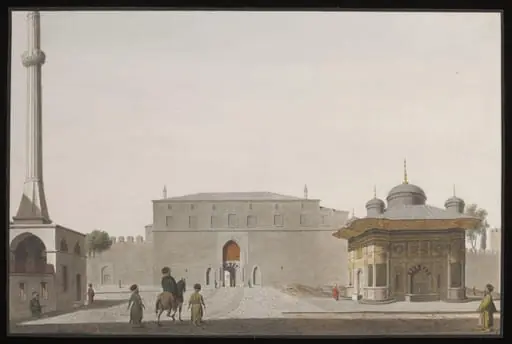 Bab-i-Hümayün (Imperial Gate) to Topkapi Sarayi, with the Fountain of Sultan Ahmet III
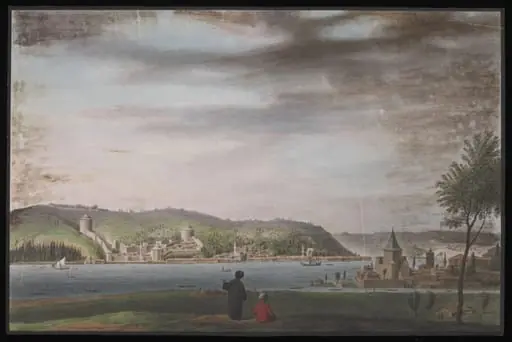 The Castles of Europe and Asia, Istanbul
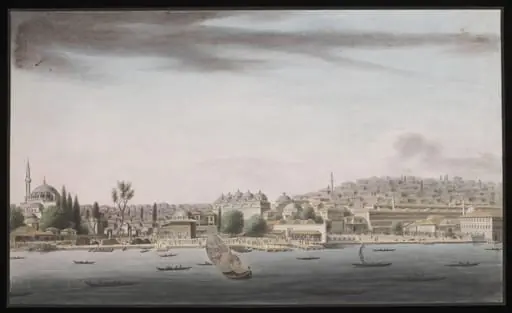 Panoramic view of the buildings on the shore at Tophane
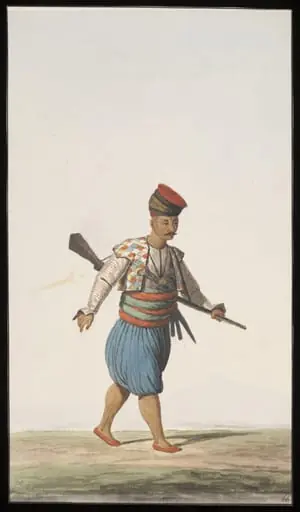 A heavily-armed man
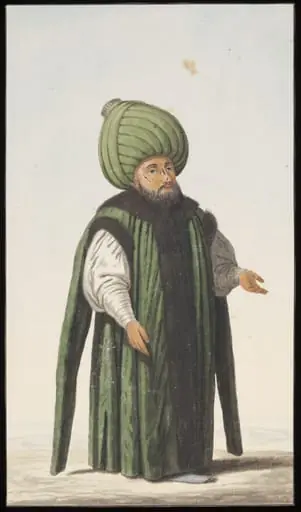 A senior Ottoman official
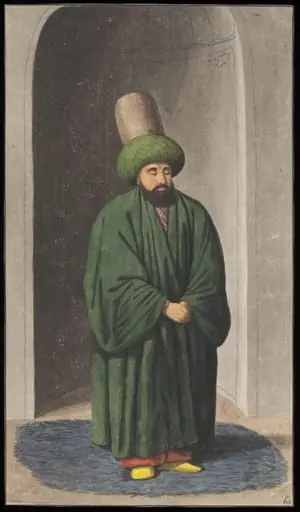
![A Dervish[?], by Anonymous Greek artist](https://artifactworldgallery.com/img/anonymous-greek-artist--a-dervish--3c8916f5a95abb6a-w320.webp) A Dervish[?]
A Dervish[?]