Artwork
Recto: (above) Panoramic Views of Jerez de la Frontera; (below) Barcelona

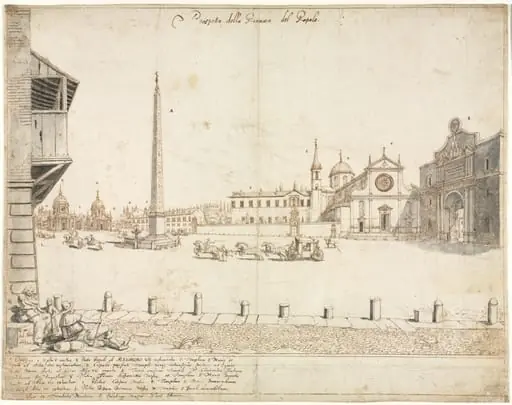
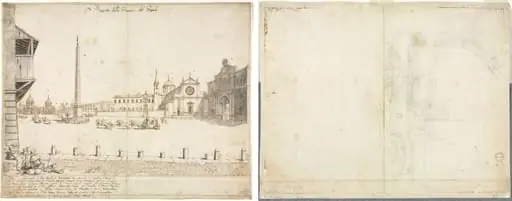
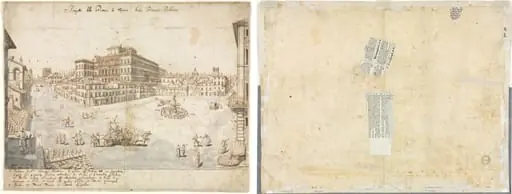
Recto: (above) Panoramic Views of Jerez de la Frontera; (below) Barcelona is a drawing by the Renaissance artist Anton van den Wyngaerde. It dates from 1563 and is held in the collection of the Victoria and Albert Museum.
About this work
Overview
The two sections are separated by a clear horizontal division, with no visual overlap between the towns.
This drawing by Anton van den Wyngaerde, dated 1563, combines two panoramic cityscapes—Jerez de la Frontera above and Barcelona below—each spanning three joined sheets. Executed in pen and ink, the work was originally one of thirty-one such views in a commissioned album. The format is elongated and horizontal, emphasizing the breadth of each urban landscape. The two sections are separated by a clear horizontal division, with no visual overlap between the towns.
Subject & Meaning
The drawing presents Jerez and Barcelona as ordered, densely built environments, likely intended to document urban form rather than convey symbolic meaning. Landmarks such as towers, bridges, and coastal harbors are labeled in small script, suggesting a topographical purpose. The inclusion of handwritten annotations implies the artist recorded details during on-site observation, treating the drawings as records of civic structure rather than idealized representations.
Technique & Style
Pen and ink lines define architecture and topography with precision. Cross-hatching creates subtle tonal variation to suggest depth and shadow, particularly on building facades and terrain. The artist’s hand is meticulous, with fine, controlled strokes rendering streets, walls, and rooftops. The scale is consistent within each view, though the two cities are rendered independently, without unified perspective, reflecting a documentary rather than artistic convention.
History & Provenance
The drawing was once part of a larger album of Spanish city views commissioned in the mid-16th century. After the album’s dispersal, individual sheets circulated among private collectors. In 1879, the two cityscapes were acquired by the museum as part of a group of drawings from a known collection. Their separation from the original set occurred sometime after their creation, though the exact timeline remains unclear.
Context
Van den Wyngaerde produced these views during a period of Habsburg interest in documenting Spanish territories. His work served administrative and political ends, offering visual inventories of key cities under royal authority. The precision of his renderings aligns with contemporary cartographic practices, blending observation with surveying methods. Such drawings were rarely intended for public display but rather for elite or institutional use.
Legacy
The drawing survives as a rare example of 16th-century Spanish urban documentation by a trained artist. Its survival outside the original album underscores the fragmentary nature of such collections. Today, it contributes to scholarly understanding of how cities were visually recorded before the advent of photography, preserving details of architecture and layout now altered or lost.
Artist & collection

Artist
Anton van den Wyngaerde was a prolific Flemish topographical artist who made panoramic sketches and paintings of towns in the southern Netherlands, northern France, England, Italy, and Spain.

 View of the Prato of the Villa Borghese
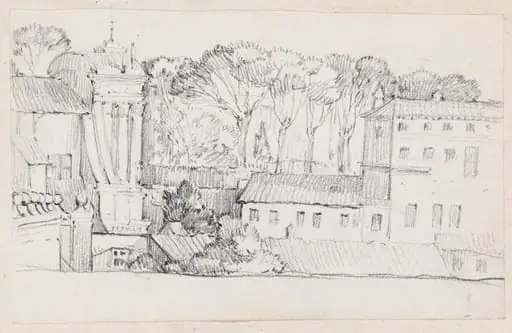 Roman Rooftops
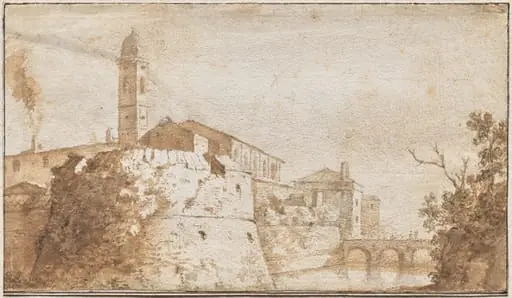 A View of Bracciano with the Church of S. Maria Assunta
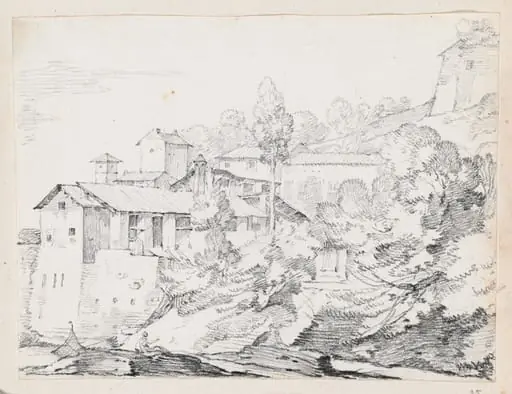 Italian Buildings on a Hillside
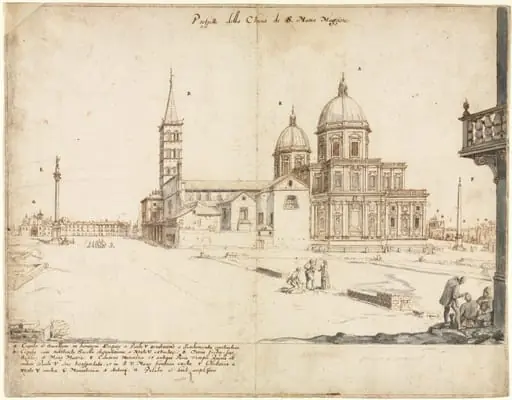 Eighteen Views of Rome: The Basilica of Santa Maria Maggiore
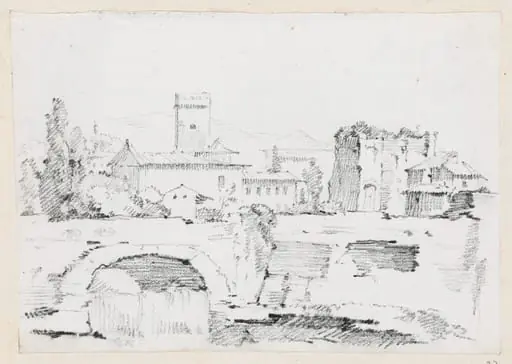 An Italian Town with a Stone Bridge and a Waterfall
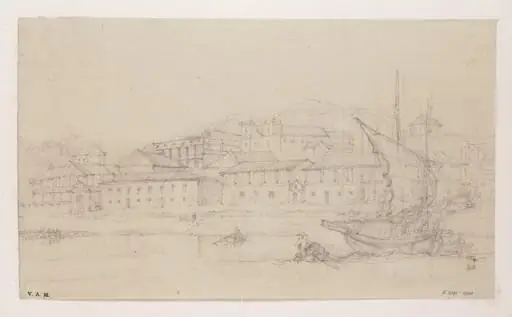 Macau with the church of S. Lourenço
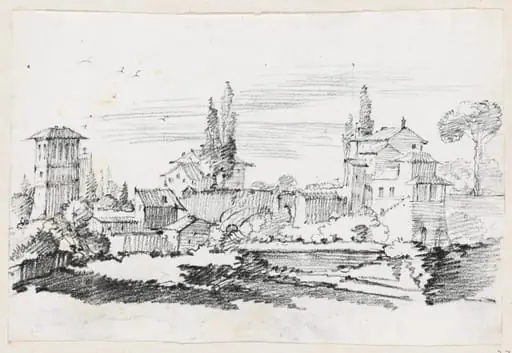 Houses in Italy
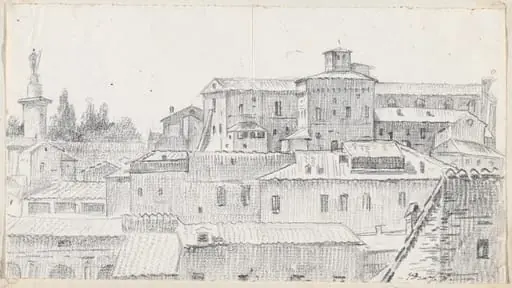 The Capitoline Hill