Artwork
La Biévre, Les Gobelins, Saint-Séverin: Le Quartier Saint-Séverin: La Rue des Prêtres Saint-Séverin
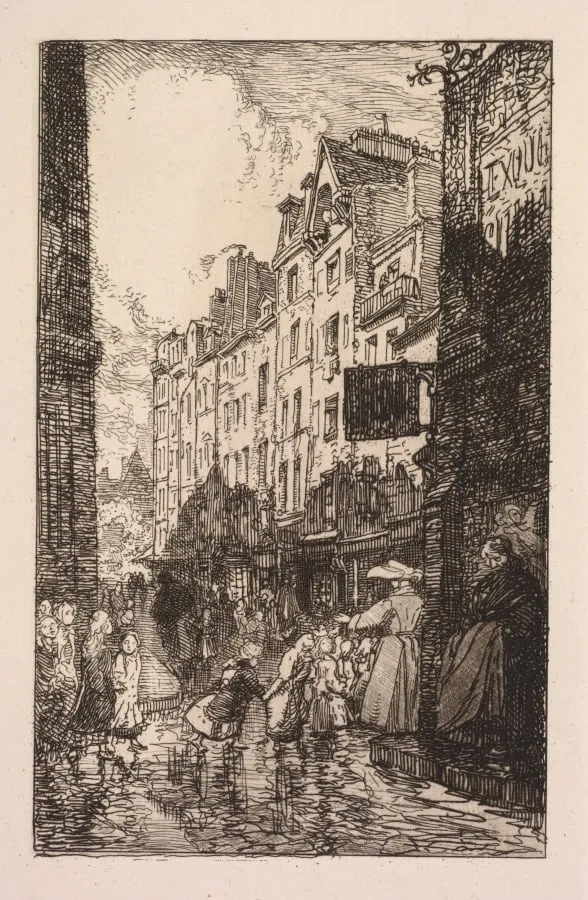
La Biévre, Les Gobelins, Saint-Séverin: Le Quartier Saint-Séverin: La Rue des Prêtres Saint-Séverin is a print by Auguste Lepère. It dates from 1901 and is held in the collection of the Cleveland Museum of Art. Created in 1901 by French artist Auguste Louis Lepère, this wood engraving portrays a quiet corner of Paris’s Saint-Séverin district.
About this work
Overview
Lepère, instrumental in the revival of wood engraving as a fine art medium, chose an ordinary urban moment rather than a monumental scene.
Created in 1901 by French artist Auguste Louis Lepère, this wood engraving portrays a quiet corner of Paris’s Saint-Séverin district. Lepère, instrumental in the revival of wood engraving as a fine art medium, chose an ordinary urban moment rather than a monumental scene. The print captures the texture of daily life in a working-class neighborhood, rendered with precise, hand-carved lines that emphasize the rhythm of the city’s architecture and movement.
Subject & Meaning
The scene centers on a narrow street after rain, where shallow pools reflect the surrounding buildings. Pedestrians move cautiously, while children play in the water, their actions unremarkable yet intimate. The composition avoids drama, instead highlighting the quiet resilience of urban life. The presence of laundry lines, worn facades, and uneven rooftops suggests a community shaped by time and practicality, not idealized beauty.
Technique & Style
Lepère employed traditional wood engraving, carving fine lines into the end grain of boxwood to achieve sharp detail and tonal variation. The dense network of cross-hatching defines shadows under eaves and the wet sheen of pavement, while the verticality of buildings is accentuated by tightly spaced vertical strokes. The absence of color focuses attention on form and texture, characteristic of the medium’s revival in early 20th-century printmaking.
History & Provenance
The print was produced during a period when French artists were re-examining printmaking as a serious artistic discipline. Lepère’s work was widely exhibited and collected, including by institutions such as the Cleveland Museum of Art. Though the specific provenance of this impression is not documented, its inclusion in museum collections reflects its recognition within the broader movement to elevate wood engraving beyond commercial illustration.
Context
In early 1900s Paris, rapid modernization coexisted with persistent old neighborhoods like Saint-Séverin. Lepère’s focus on such areas aligned with a growing interest in documenting the city’s lesser-remarked corners. Unlike the grand boulevards celebrated by some contemporaries, his work preserved the intimate, often damp and cluttered reality of streets where daily routines unfolded without spectacle.
Legacy
Lepère’s prints, including this one, helped reestablish wood engraving as a legitimate art form in Europe, influencing later generations of printmakers. His commitment to everyday subjects elevated the genre beyond mere documentation, affirming the artistic value of ordinary urban life. Today, such works are studied for their technical precision and their quiet testimony to the textures of pre-modern Parisian neighborhoods.
Artist & collection
Artist
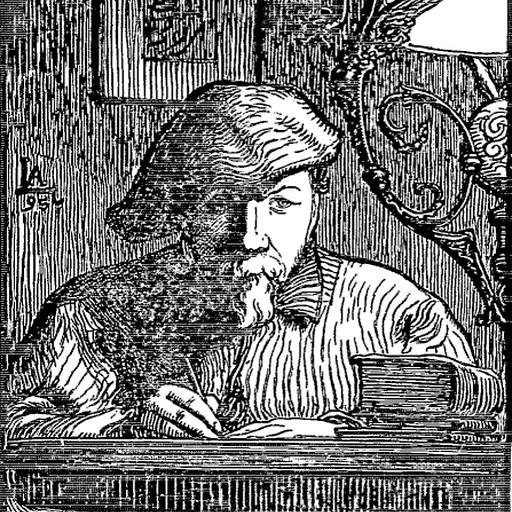
Louis-Auguste Lepère (30 November 1849 – 20 November 1918) was a French painter and etcher. Lepère is also considered a leader in the creative revival of wood engraving in Europe.

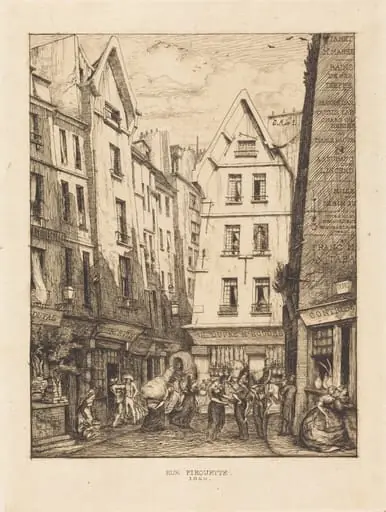 La Rue Pirouette aux halles, Paris (Pirouette Street, Near the Markets, Paris)
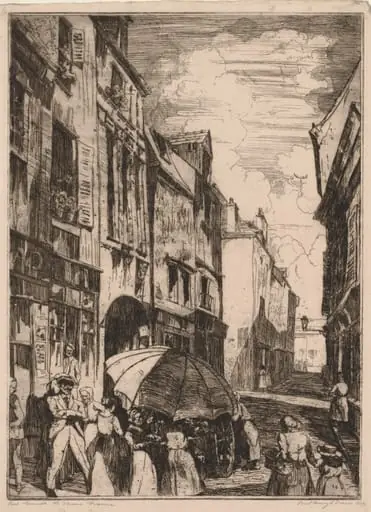 Rue Grande, Le Mans, France
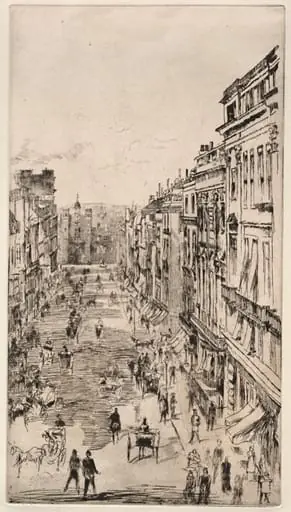 St. James Street
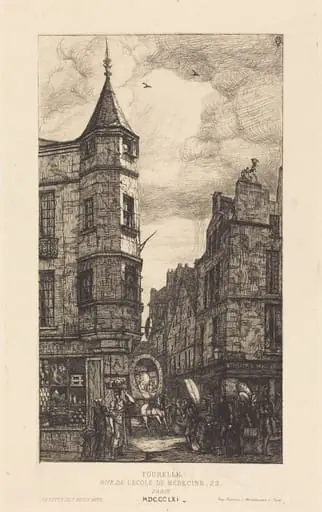 Tourelle, Rue de l'École de Médecine, 22, Paris
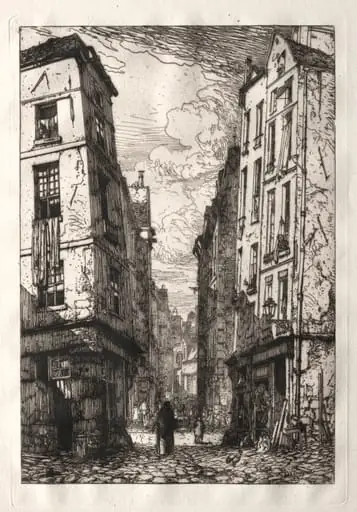 Rue des Marmousets (Old Paris)
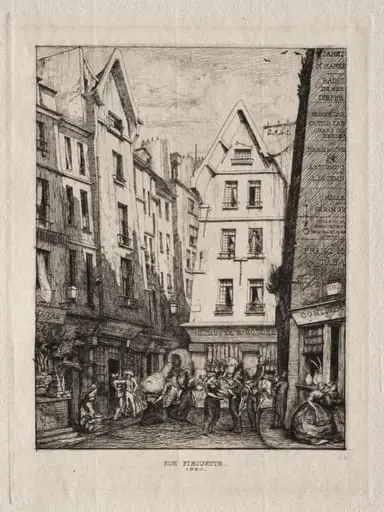 Pirouette Street, near the Markets, Paris
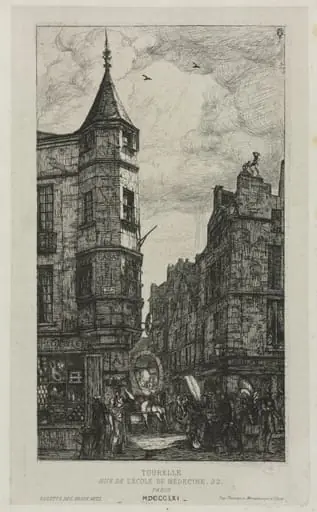 House with a Turret, No. 22, rue de L'Ecole de Médecine, Paris, (called the Turret of Marat)
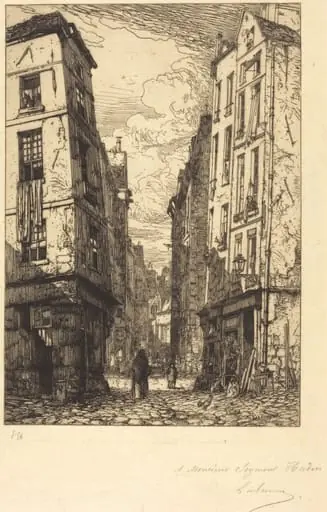 Rue des Marmousets (Quartier de la cite, vieux Paris)
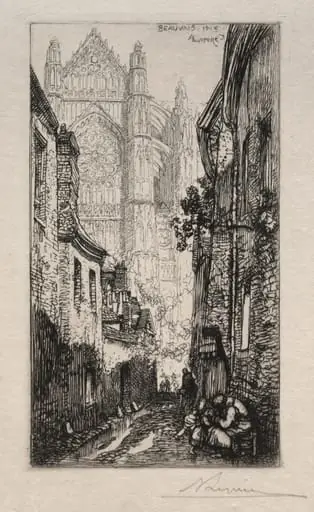 Narrow Street, Beauvais (Une Ruelle, Beauvais)