Artwork
Paris Almanac, 1897: Cover
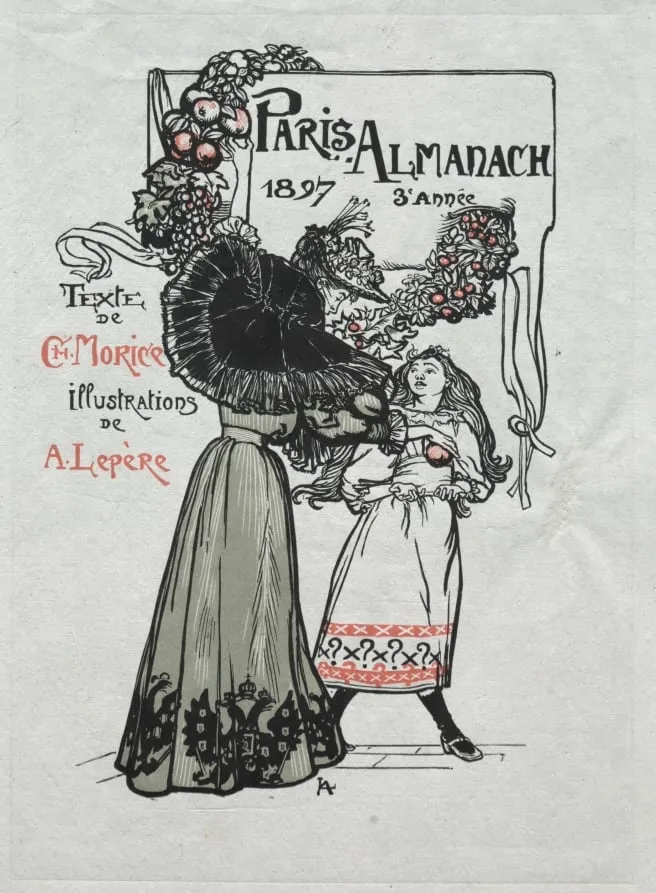
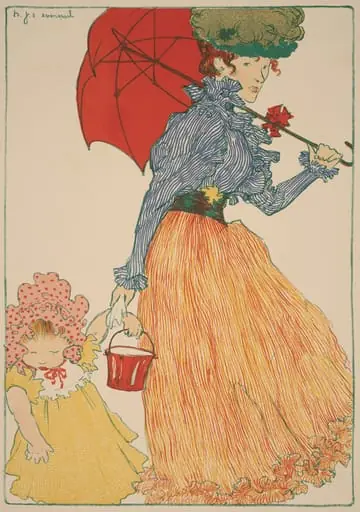
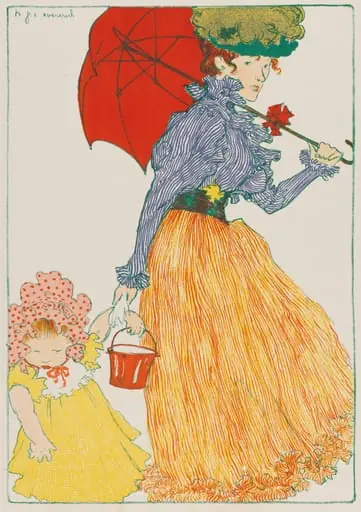
Paris Almanac, 1897: Cover is a print by the Impressionist artist Auguste Lepère. It dates from 1897 and is held in the collection of the Cleveland Museum of Art. Paris Almanac, 1897 is a print created by Auguste Louis Lepère in 1897, serving as the cover for the eponymous publication.
About this work
The woman is wearing a long dress with a floral pattern at the bottom, and the girl is wearing a white dress with a red pattern at the bottom.
The image shows a woman and a girl standing in front of a sign that reads "Paris Almanach 1897". The woman is wearing a long dress with a floral pattern at the bottom, and the girl is wearing a white dress with a red pattern at the bottom. The sign is decorated with flowers and fruit.
The woman is holding a large hat with a wide brim, and the girl is looking up at her. The background of the image is a light gray color.
The image appears to be a cover for an almanac, and it may have been created using a technique such as lithography. To learn more about the artist's use of color and composition, you could look up the work of Auguste Louis Lepère.
Overview
Paris Almanac, 1897 is a print created by Auguste Louis Lepère in 1897, serving as the cover for the eponymous publication. It showcases Lepère's proficiency in wood engraving, a medium he helped revive in late 19th-century Europe.
Subject & Meaning
The print depicts a woman and a girl standing before a decorated 'Paris Almanach 1897' sign. The woman, in a floral-patterned long dress, holds a wide-brimmed hat, while the girl, in a white dress with a red pattern, looks up at her. The scene conveys a sense of everyday life and possibly highlights the almanac's purpose as a household reference.
Technique & Style
Although initially suspected to be lithography based on visual cues, the actual technique used is wood engraving, characteristic of Lepère's revival efforts. The image features illustrative detail balanced with graphic clarity, set against a light gray background, with floral and fruit decorations on the sign.
History & Provenance
Created in 1897 for the Paris Almanac, specific details on its production process, initial reception, and current location are not provided. It remains a notable example of Lepère's work in wood engraving during its European revival.
Context
Emerging in the late 19th century, this work reflects the artistic movement to revive traditional printing techniques. Lepère's involvement in this movement positioned him as a key figure in European graphic arts of the time.
Legacy
While specific legacy details of 'Paris Almanac, 1897' are not given, the work contributes to Lepère's reputation as a wood engraving revivalist. His body of work, including this piece, continues to illustrate the aesthetic and technical values of late 19th-century European printmaking.
Artist & collection

Artist
Louis-Auguste Lepère (30 November 1849 – 20 November 1918) was a French painter and etcher. Lepère is also considered a leader in the creative revival of wood engraving in Europe.