Artwork
Veu de Jouy-le-Moutier
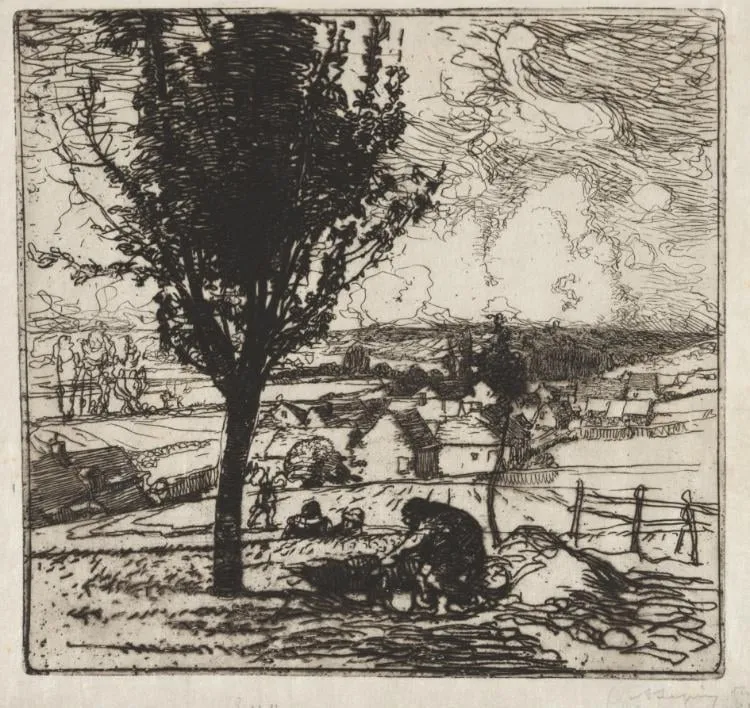
Veu de Jouy-le-Moutier is a print by the Impressionist artist Auguste Lepère. It dates from 1893 and is held in the collection of the Cleveland Museum of Art.
About this work
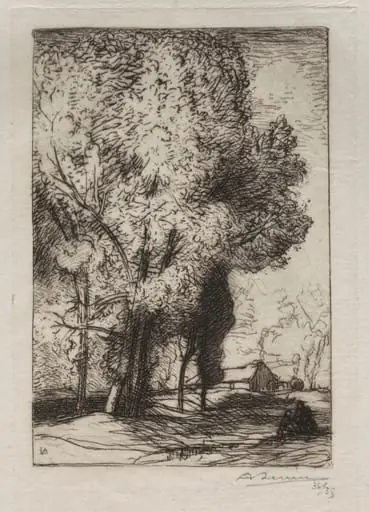
This print shows a quiet countryside scene. A lone tree stands near a fence, its branches dark against a sky full of swirling lines. In the background, a small house sits beside fields, and two people work near a cart.
The swirling sky feels almost like wind in motion. This print was made in 1893 by a French artist.
Look up Realism next to see how artists focused on everyday life.
Overview
Created in 1893 by French artist Auguste Louis Lepère, *Vue de Jouy-le-Moutier* is a wood engraving that captures a rural landscape near Paris.
Created in 1893 by French artist Auguste Louis Lepère, *Vue de Jouy-le-Moutier* is a wood engraving that captures a rural landscape near Paris. Lepère, a key figure in the late 19th-century revival of wood engraving as a fine art medium, used this technique to explore subtle tonal variations and textured surfaces. The work is part of the Cleveland Museum of Art’s collection, reflecting broader interest in printmaking as a vehicle for artistic expression beyond reproduction.
Subject & Meaning
The scene depicts a quiet agricultural setting: a solitary tree near a wooden fence, a modest dwelling, and two figures tending to a cart in a field. The composition avoids drama, emphasizing stillness and routine. The swirling sky, rendered with rhythmic lines, suggests atmospheric movement rather than narrative, reinforcing a contemplative mood. Lepère’s focus on ordinary rural life aligns with Realist traditions, valuing observation over idealization.
Technique & Style
Lepère employed wood engraving, carving fine lines into the end grain of hardwood to achieve detailed tonal gradations. The sky’s dynamic, swirling patterns contrast with the solid, linear forms of the fence and tree, creating a sense of motion against stillness. His precise hand and control of ink density allowed for nuanced shadows and textures, distinguishing his work from mass-produced prints and elevating the medium’s artistic credibility.
History & Provenance
The print was made during a period when European artists were reevaluating traditional print methods, seeking alternatives to photography and industrial reproduction. Lepère’s engagement with wood engraving was part of a broader movement to restore craftsmanship to printmaking. The work entered the Cleveland Museum of Art’s collection in the 20th century, where it remains as evidence of France’s late 19th-century print revival.
Context
In the 1890s, French artists like Lepère responded to rapid industrialization by turning to rural subjects and handcrafted techniques. Wood engraving, once used primarily for illustration, was reclaimed as a medium for personal expression. Lepère’s work intersected with the Arts and Crafts movement and the renewed interest in printmaking among French etchers, positioning him as a bridge between tradition and modern artistic inquiry.
Legacy
Lepère’s efforts helped reestablish wood engraving as a respected fine art form in Europe. His technical precision and attention to natural detail influenced later printmakers who valued the handmade over the mechanical. *Vue de Jouy-le-Moutier* stands as a quiet testament to a moment when artists sought to reconnect with the land and the craft of making, leaving a lasting imprint on the history of print.
Artist & collection
Artist
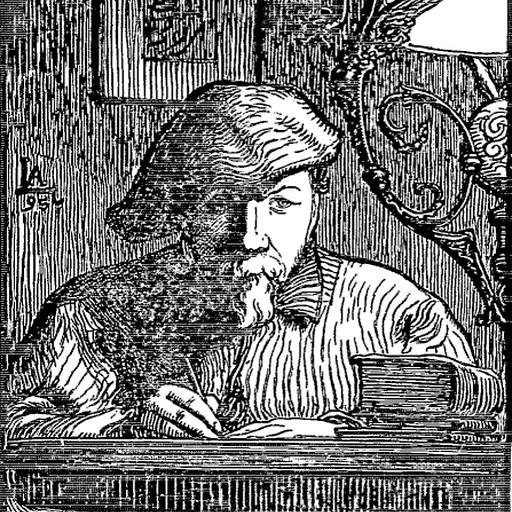
Louis-Auguste Lepère (30 November 1849 – 20 November 1918) was a French painter and etcher. Lepère is also considered a leader in the creative revival of wood engraving in Europe.

 Bourrine dans les Peupliers
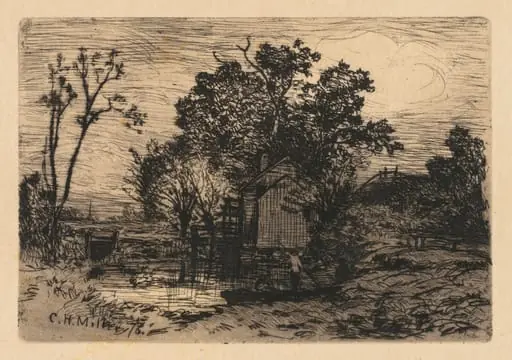 Cottage and Two Figures in a Boat
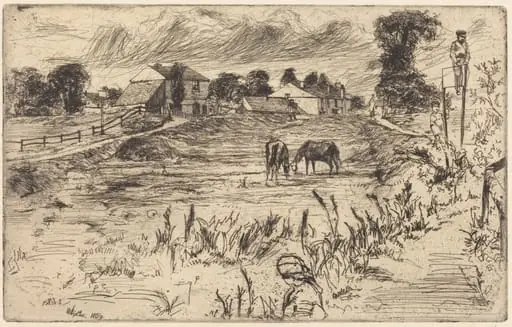 Landscape with Horses
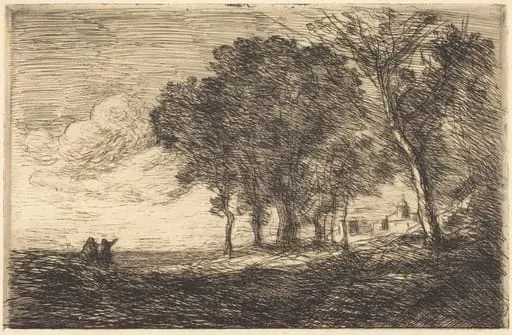 Italian Landscape (Paysage d'Italie)
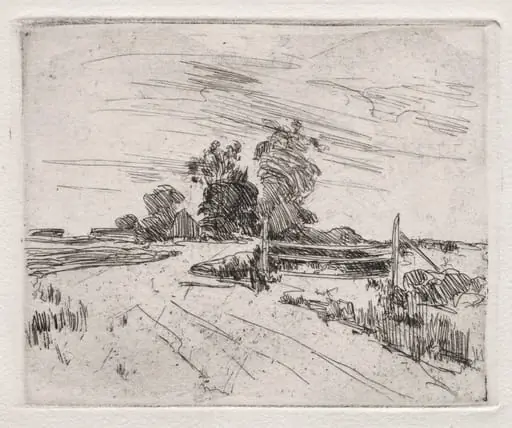 Branchville, Connecticut
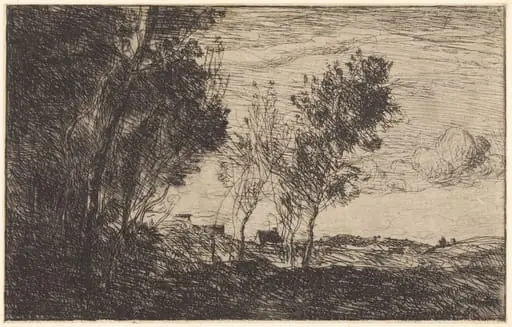 In the Dunes: Souvenir of The Hague (Dans les dunes: Souvenir du bois de La Haye)
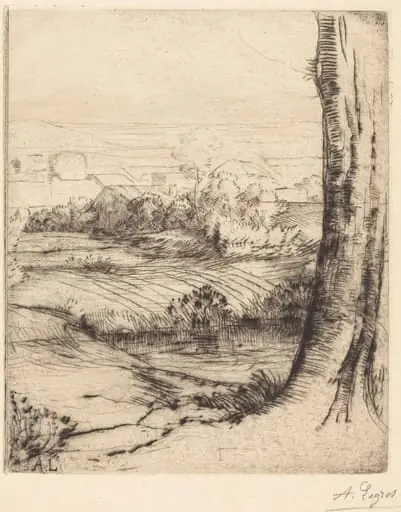 View of Reeds (Coin de roseau)
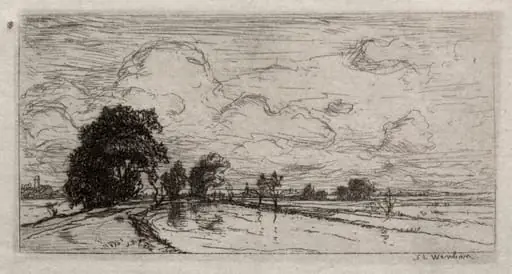 Flooded Landscape with Trees
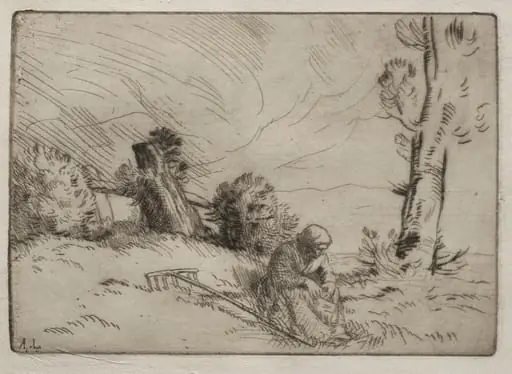 Peasant Woman Seated near a Hedge
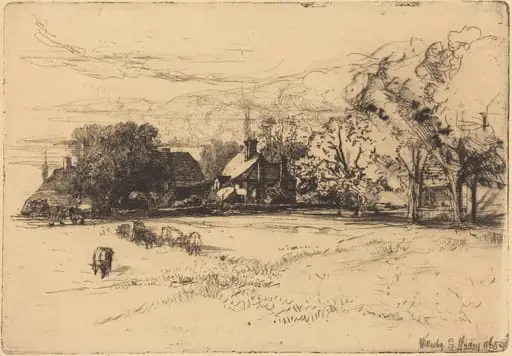 Old Willesley House
 Winter, Avondale
 Tramp with Bundle (Le chemineau a la besace)