Artwork
Adam Standing
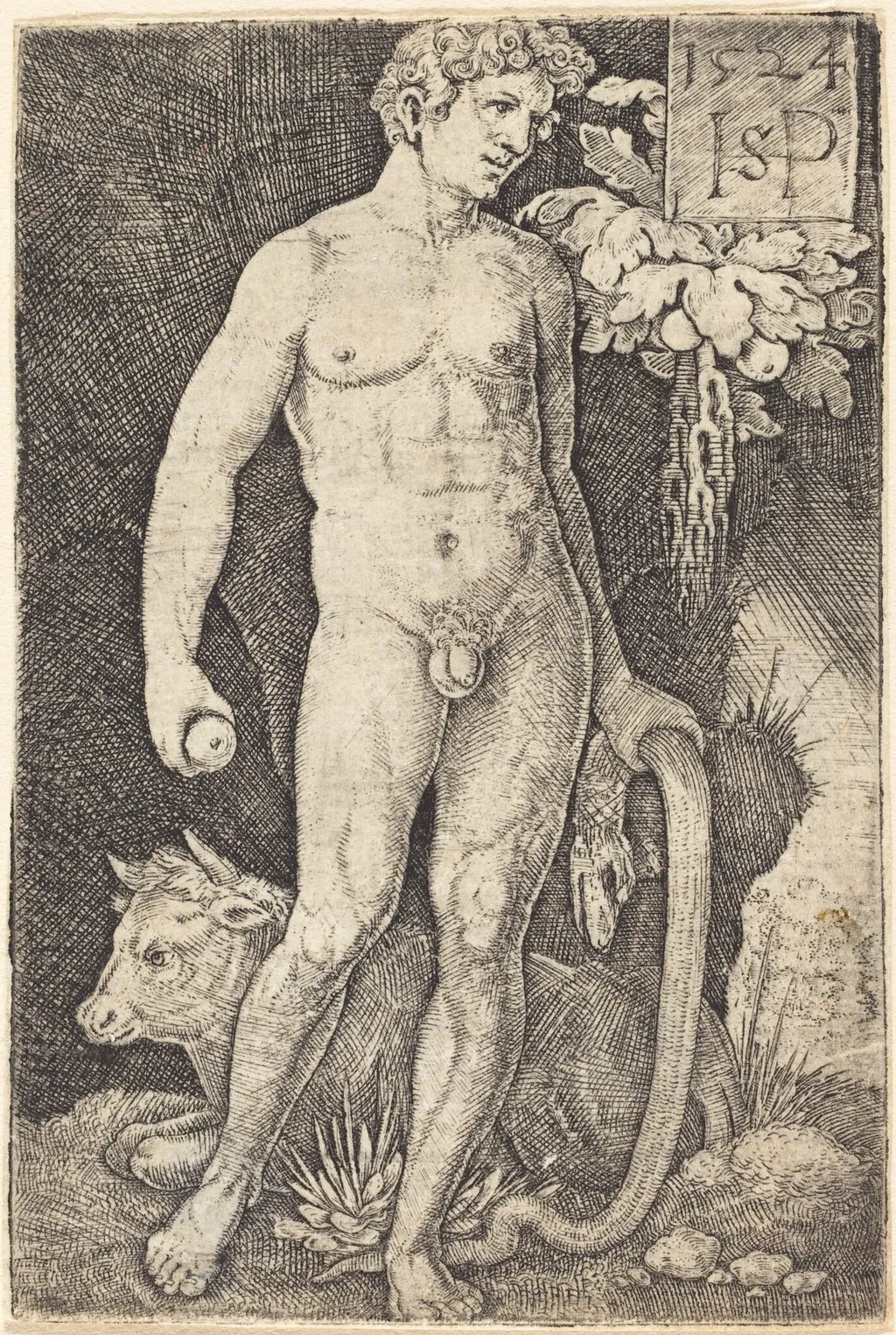
Adam Standing is an ink print by the Renaissance artist Sebald Beham. It dates from 1524 and is held in the collection of the National Gallery of Art.
About this work
Overview
Beham, known for his refined technique in printmaking, used fine lines to render a solitary male figure in a contemplative pose.
Created in 1524 by the Nuremberg artist Sebald Beham, *Adam Standing* is a small-scale engraving that reflects the precision and intimacy characteristic of the Little Masters. Beham, known for his refined technique in printmaking, used fine lines to render a solitary male figure in a contemplative pose. The work belongs to a broader tradition of German Renaissance prints that explored human form with restrained elegance.
Subject & Meaning
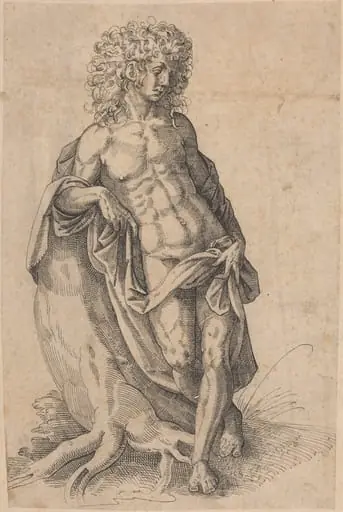
The figure depicts Adam in the moment after the Fall, shown nude except for a single leaf covering his modesty. He stands still, meeting the viewer’s gaze directly, evoking a sense of quiet self-awareness rather than narrative drama. The absence of context or action shifts focus to the human condition—vulnerability, shame, and presence—rendered with psychological subtlety rather than biblical spectacle.
Technique & Style
Beham employed fine, controlled engraving lines to model Adam’s form with remarkable economy. The surface is textured with delicate hatching and cross-hatching, creating volume without excess detail. His minimalist approach, typical of the Little Masters, emphasizes clarity and restraint, transforming the engraving plate into a field of subtle tonal gradations that suggest flesh and shadow with precision.
History & Provenance
Produced during Beham’s early career, the print emerged from Nuremberg’s thriving print culture, where artists like Dürer had established a market for small, collectible engravings. Though no specific early ownership records are documented, the work aligns with the circulation patterns of Little Masters prints among educated collectors in 16th-century Germany and the Low Countries.
Context
In the wake of the Reformation, religious imagery in Germany shifted toward personal, introspective representations. Beham’s Adam reflects this trend, avoiding overt moralizing in favor of quiet human presence. His focus on the nude figure, stripped of narrative embellishment, parallels humanist interests in individual experience and classical ideals of form.
Legacy
Beham’s *Adam Standing* exemplifies the Little Masters’ contribution to printmaking by elevating small-scale works to vehicles of psychological depth. Though less celebrated than Dürer, Beham’s influence endured in the tradition of intimate, finely wrought engravings that prioritized technical mastery and emotional restraint over grandeur.
Artist & collection
Artist
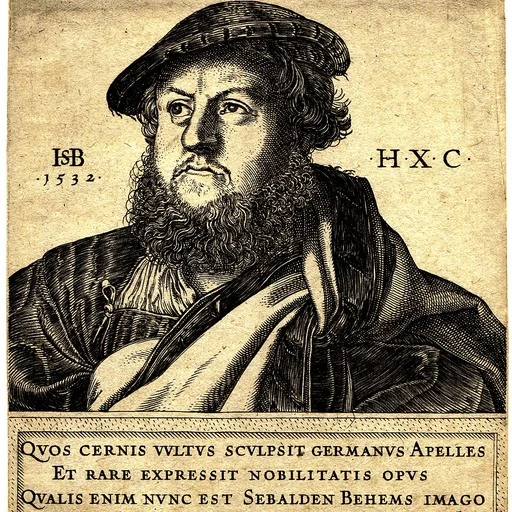
Sebald Beham (1500–1550) was a German painter and printmaker, mainly known for his very small engravings.


![The Farnese Hercules, three-quarter view turned to left [plate 3], by François Perrier](https://artifactworldgallery.com/img/francois-perrier--the-farnese-hercules-three-quarter-view-turned-to-left-plate--b0564bebaad016fa-w320.webp)
![The Farnese Hercules, front view [plate 2], by François Perrier](https://artifactworldgallery.com/img/francois-perrier--the-farnese-hercules-front-view-plate-2--cedb2cb031c3391b-w320.webp)