Artwork
Allegory of Christianity
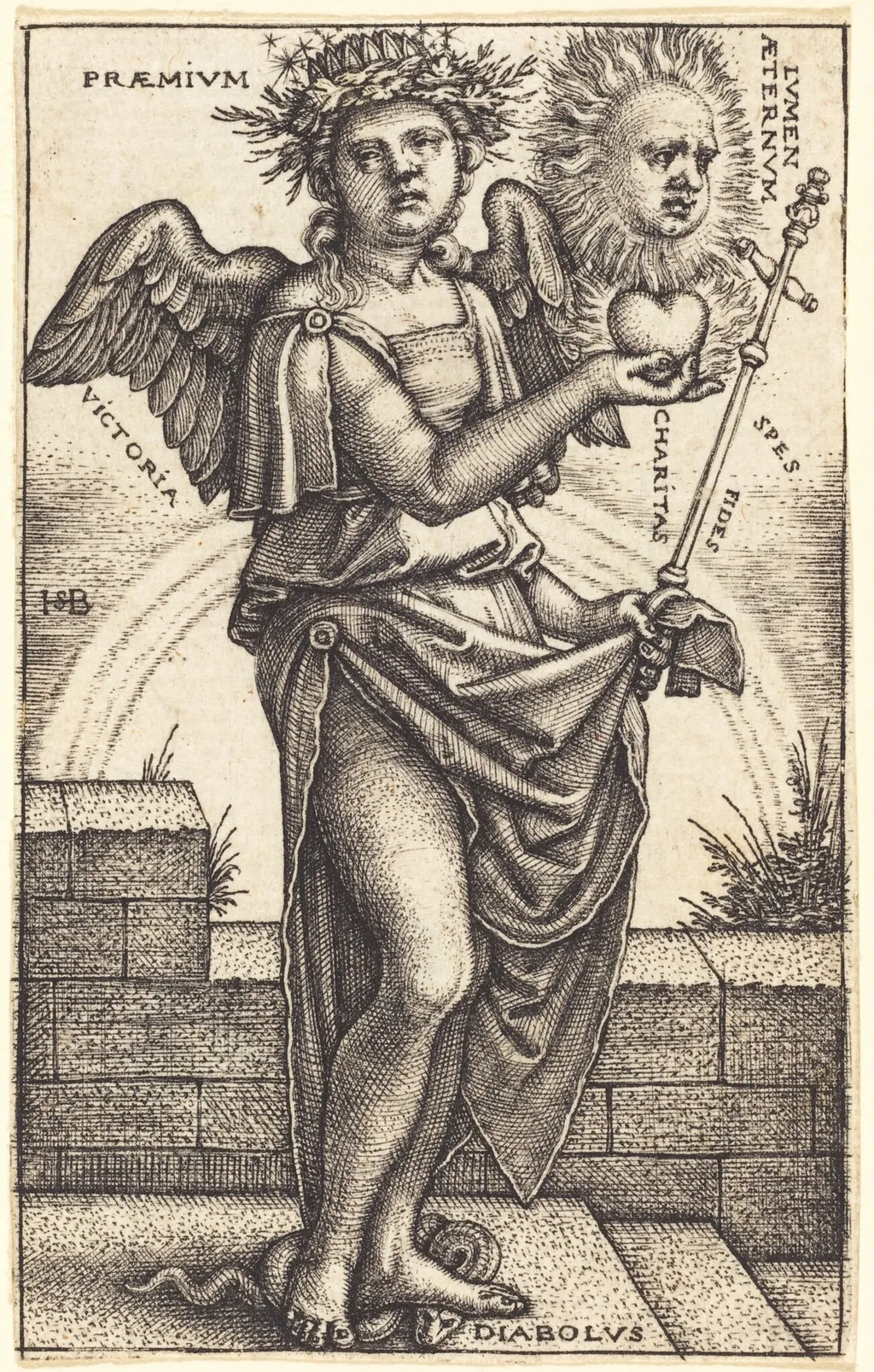
Allegory of Christianity is an ink print by the Renaissance artist Sebald Beham. It dates from 1544 and is held in the collection of the National Gallery of Art.
About this work
Overview
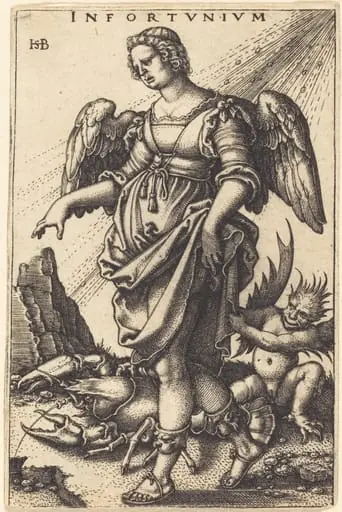
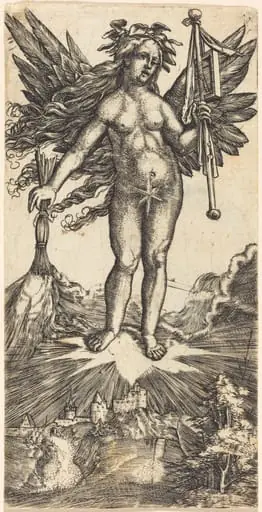
Sebald Beham’s *Allegory of Christianity* is a small‑scale engraving executed circa 1544. The print presents a winged, crowned female figure holding a scepter topped with a cross and a heart, set upon a stone platform before a plain wall. The composition is rendered in fine, linear detail characteristic of Beham’s work, and the overall tone is one of measured serenity.
Subject & Meaning
The scepter, crowned with a cross, signals ecclesiastical power, and the heart symbolizes the love central to Christian doctrine.
The central figure embodies an abstracted personification of Christian faith. The crown suggests divine authority, while the wings convey a spiritual, transcendent quality. The scepter, crowned with a cross, signals ecclesiastical power, and the heart symbolizes the love central to Christian doctrine. Together, these symbols create a visual allegory that communicates the virtues of devotion and divine governance.
Technique & Style
Executed with a burin on a copper plate, the engraving displays Beham’s hallmark precision and intricate line work. The artist employs cross‑hatching to model forms and suggest subtle shading, achieving a delicate balance between texture and flatness. The miniature format reflects the “Little Masters” tradition, wherein complex iconography is rendered on a compact surface without sacrificing clarity.
History & Provenance
Beham, a native of Nuremberg, produced the print during his later period after relocating to Frankfurt, where he continued his prolific output of prints and book illustrations. The work circulated among collectors of the time, typical of the print market that allowed relatively wide dissemination of his allegorical subjects across the Holy Roman Empire.
Context
Created in the mid‑sixteenth century, the engraving aligns with the Northern Renaissance’s interest in moralizing allegory and the use of printmaking to spread religious ideas. Amid the Reformation’s theological debates, such images served both devotional and didactic purposes, offering a visual synthesis of doctrinal concepts accessible to a literate and increasingly print‑savvy audience.
Artist & collection
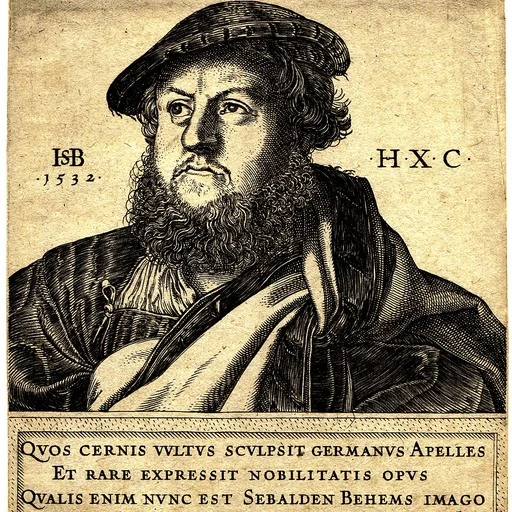
Artist
Sebald Beham (1500–1550) was a German painter and printmaker, mainly known for his very small engravings.