Artwork
Dance of the Gods of Love
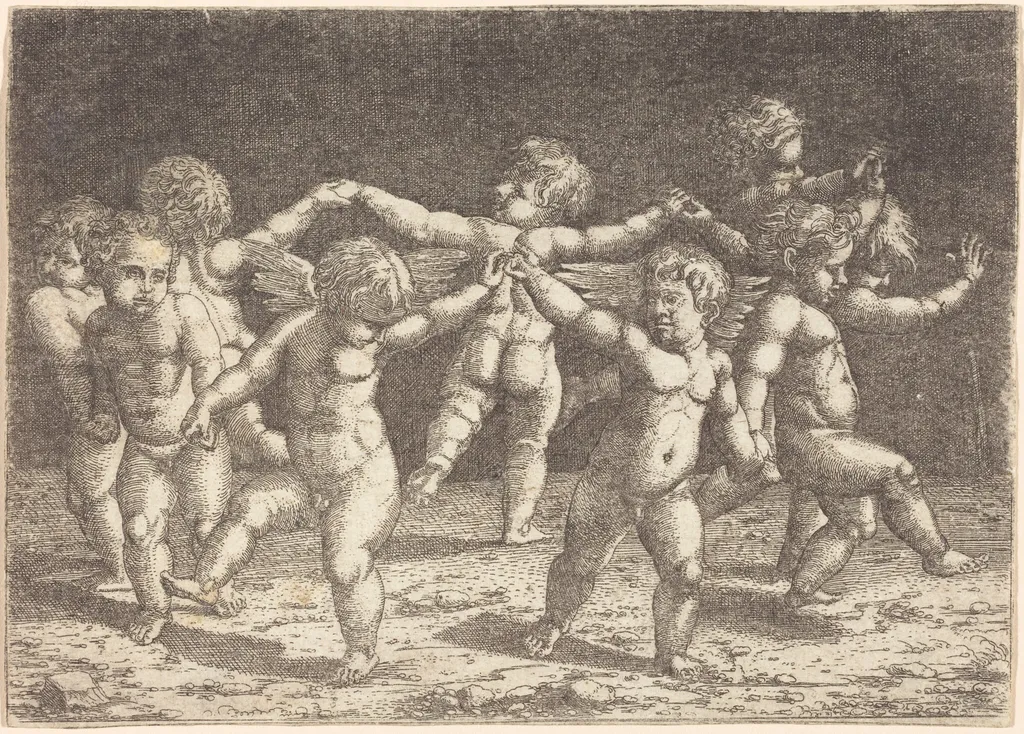
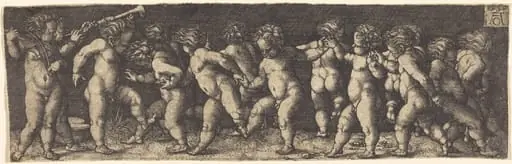
Dance of the Gods of Love is an ink print by the Renaissance artist Sebald Beham. It dates from 1525 and is held in the collection of the National Gallery of Art.
About this work
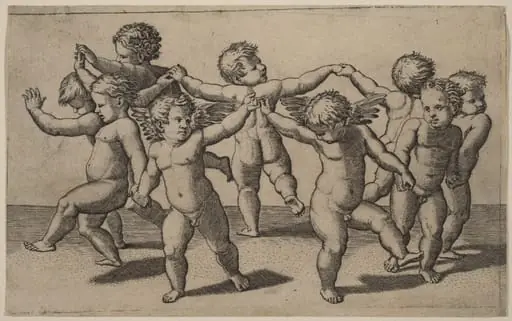
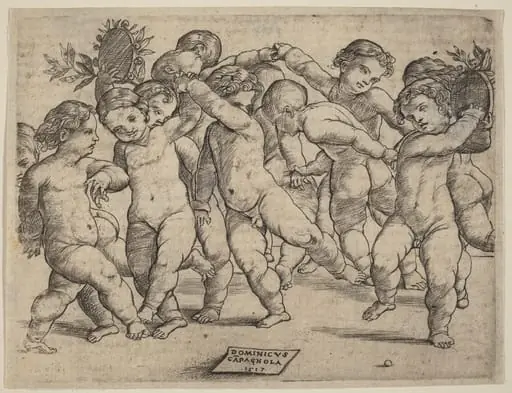
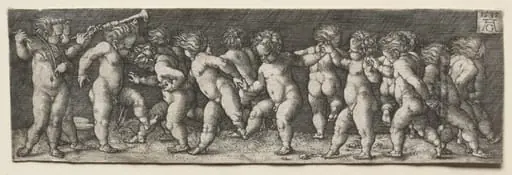
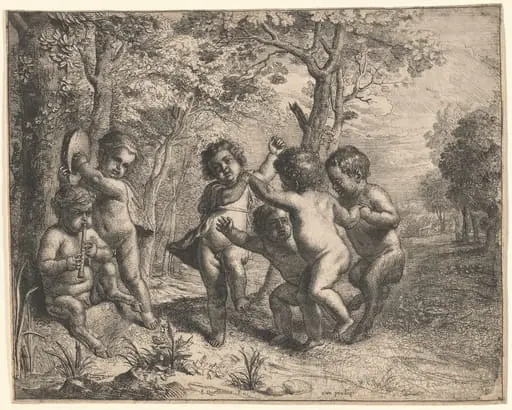
This etching shows tiny mythical figures dancing in a circle. Their bodies twist in wild, playful poses across the paper. Some hold instruments. Others look like they’re laughing mid-air.
Sebald Beham made this in 1544. He was one of three brothers all artists. This isn’t just decoration—it’s a tiny story cut into metal.
His brother Barthel Beham often used the same style.
Overview
Sebald Beham’s *Dance of the Gods of Love* is an etching executed in the early 1520s. The print belongs to the group of works known as the “Little Masters,” distinguished by their minute size and meticulous detail. Executed on copper plate, the image presents a compact, lively scene that exemplifies Beham’s skill in rendering complex narratives within a limited format.
Subject & Meaning
The work functions as a visual allegory rather than a straightforward illustration, inviting viewers to contemplate the exuberance of divine affection.
The composition depicts a circle of diminutive mythological figures engaged in a frenzied dance. The figures contort in exaggerated, playful poses, some clutching musical instruments while others appear to laugh mid‑air, suggesting a celebration of love’s chaotic energy. The work functions as a visual allegory rather than a straightforward illustration, inviting viewers to contemplate the exuberance of divine affection.
Technique & Style
Beham employed the etching process, incising fine lines into a copper plate before printing onto paper. The resulting lines are exceptionally crisp, allowing for intricate detailing of musculature, drapery, and facial expressions despite the small scale. The style reflects the Northern Renaissance’s emphasis on precision and the artist’s personal penchant for densely packed, narrative scenes.
History & Provenance
Created while Beham was active in Nuremberg, the print later circulated in the German art market and reached collectors in Frankfurt, where the artist eventually settled. The work is documented in several 16th‑century inventories, confirming its presence in private collections shortly after its production.
Context
Sebald Beham was one of three artistic brothers, all active in the German printmaking scene. His brother Barthel shared a similar aesthetic, often employing comparable compositional arrangements and delicate line work. The *Dance of the Gods of Love* thus reflects a familial workshop practice that contributed to the diffusion of the Little Masters’ visual language across the Holy Roman Empire.
Artist & collection
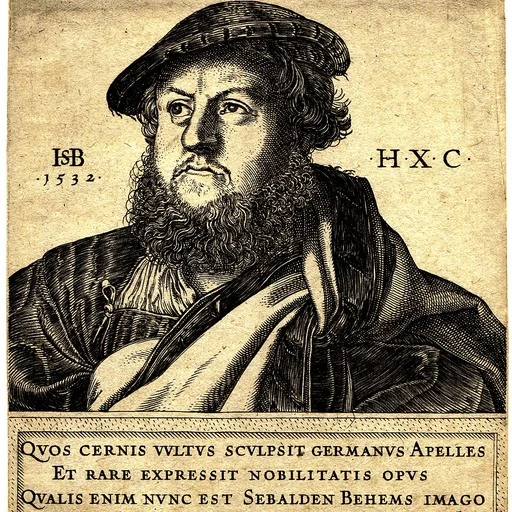
Artist
Sebald Beham (1500–1550) was a German painter and printmaker, mainly known for his very small engravings.