Artwork
View of Baggoths rath [Baggot Rath], a castle half a mile from Dublin [...]
![View of Baggoths rath [Baggot Rath], a castle half a mile from Dublin [...], by Gabriel, ca.1729-1817 Beranger, unspecified, 1790](https://artifactworldgallery.com/img/gabriel-ca-1729-1817-beranger--view-of-baggoths-rath-baggot-rath-a-castle-half-a-mile-from--c625749ddb0ab425-w1024.webp)
View of Baggoths rath [Baggot Rath], a castle half a mile from Dublin [...] is an unspecified work on paper by the Rococo painting artist Gabriel, ca.1729-1817 Beranger. It dates from 1790 and is held in the collection of the Royal Irish Academy. The work presents a tranquil landscape of the Baggot Rath ruins, situated a short distance from Dublin.
About this work
To learn more about the artist who created this piece, look up artist: Beranger, Gabriel, ca.
This painting shows a castle in ruins, with a man sitting on a grassy bank looking at it.
The castle is half-ruined, with trees and grass growing around it.
The man in the foreground seems to be studying the castle.
This painting is interesting because of its serene atmosphere.
The artist included a person in the scene, which adds a sense of scale to the castle.
To learn more about the artist who created this piece, look up artist: Beranger, Gabriel, ca.1729-1817.
Overview
The work presents a tranquil landscape of the Baggot Rath ruins, situated a short distance from Dublin. A solitary figure is seated on a grassy bank in the foreground, gazing toward the decayed stone structures. The composition balances the natural vegetation that encroaches upon the remnants with the human presence, establishing a quiet dialogue between past architecture and present observation.
Subject & Meaning
The painting captures the remnants of a once‑formidable castle now overtaken by nature, suggesting themes of transience and the passage of time. The seated individual, positioned at a comfortable viewing distance, functions as a surrogate for the viewer, inviting contemplation of the ruins’ historical weight while emphasizing the modest scale of human life against enduring stone.
Technique & Style
Executed in a restrained, almost documentary manner, the artist employs a muted palette that highlights the soft greens of the surrounding grass and trees against the weathered masonry. Careful delineation of texture conveys the crumbling walls, while the figure is rendered with enough detail to provide scale without detracting from the overall serenity of the scene.
History & Provenance
Created by Gabriel Beranger, an Irish draughtsman active in the late eighteenth and early nineteenth centuries, the image reflects his interest in recording Ireland’s antiquities. Beranger’s works were often compiled for antiquarian collections, and this view of Baggot Rath likely entered such a corpus, contributing to the visual documentation of Dublin’s peripheral historic sites.
Context
Baggot Rath, originally a medieval stronghold, fell into disrepair by the eighteenth century, becoming a subject for artists intrigued by Ireland’s architectural heritage. Beranger’s depiction aligns with a broader Enlightenment‑era fascination with ruins, where artists and scholars alike sought to preserve visual records of structures threatened by neglect or redevelopment.
Legacy
While not widely reproduced, the image remains a valuable reference for scholars studying the condition of Baggot Rath before later alterations. It exemplifies Beranger’s systematic approach to Irish topography, and continues to inform heritage preservation efforts by providing a visual benchmark of the site’s historic landscape.
Artist & collection
Artist
Gabriel, ca.1729-1817 Beranger
Gabriel Beranger made watercolors of Dublin and its surroundings in the late 1700s.
![A view of the round tower of Michael of Pole in the city of Dublin [...], by Gabriel, ca.1729-1817 Beranger](https://artifactworldgallery.com/img/gabriel-ca-1729-1817-beranger--a-view-of-the-round-tower-of-michael-of-pole-in-the-city-of--066346c3e06cc1f8-w320.webp) A view of the round tower of Michael of Pole in the city of Dublin [...]
A view of the round tower of Michael of Pole in the city of Dublin [...]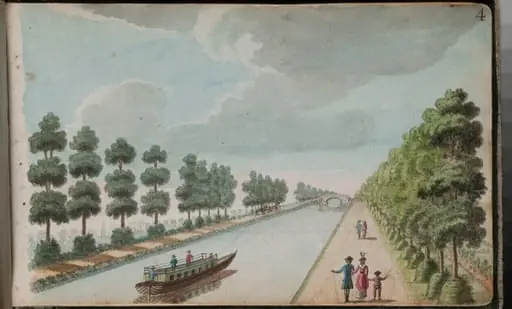 View of the Grand Canal, taken between the first bridge and the first lock looking towards Dublin
![View of the castle of Rabuck [Roebuck], 2 miles from Dublin [...], by Gabriel, ca.1729-1817 Beranger](https://artifactworldgallery.com/img/gabriel-ca-1729-1817-beranger--view-of-the-castle-of-rabuck-roebuck-2-miles-from-dublin--12853cdd66c2654f-w320.webp) View of the castle of Rabuck [Roebuck], 2 miles from Dublin [...]
View of the castle of Rabuck [Roebuck], 2 miles from Dublin [...]![Rathgar Castle, 1 1/2 miles from Dublin [...], by Gabriel, ca.1729-1817 Beranger](https://artifactworldgallery.com/img/gabriel-ca-1729-1817-beranger--rathgar-castle-1-1-2-miles-from-dublin--17cfe3f4e70405c2-w320.webp) Rathgar Castle, 1 1/2 miles from Dublin [...]
Rathgar Castle, 1 1/2 miles from Dublin [...]![Grange Castle, near Clondalken [Clondalkin], 6 miles from Dublin [...], by Gabriel, ca.1729-1817 Beranger](https://artifactworldgallery.com/img/gabriel-ca-1729-1817-beranger--grange-castle-near-clondalken-clondalkin-6-miles-from-dublin--29b767d07d01cfc8-w320.webp) Grange Castle, near Clondalken [Clondalkin], 6 miles from Dublin [...]
Grange Castle, near Clondalken [Clondalkin], 6 miles from Dublin [...]![View of Balymount [Ballymount] Castle, 3 miles from Dublin [...], by Gabriel, ca.1729-1817 Beranger](https://artifactworldgallery.com/img/gabriel-ca-1729-1817-beranger--view-of-balymount-ballymount-castle-3-miles-from-dublin--32c2f3cc4ed12e5f-w320.webp) View of Balymount [Ballymount] Castle, 3 miles from Dublin [...]
View of Balymount [Ballymount] Castle, 3 miles from Dublin [...]![A second view of Rathfarnham Castle, showing the front or entrance [...], by Gabriel, ca.1729-1817 Beranger](https://artifactworldgallery.com/img/gabriel-ca-1729-1817-beranger--a-second-view-of-rathfarnham-castle-showing-the-front-or-ent--3b1f8da88f33e09f-w320.webp) A second view of Rathfarnham Castle, showing the front or entrance [...]
A second view of Rathfarnham Castle, showing the front or entrance [...]![View of the Castle of Carrick, on the River Boyne, County of E[ast] Meath, 24 m[iles] fr[om] Dublin [...], by Gabriel, ca.1729-1817 Beranger](https://artifactworldgallery.com/img/gabriel-ca-1729-1817-beranger--view-of-the-castle-of-carrick-on-the-river-boyne-county-of-e--47a9c858b28e8890-w320.webp) View of the Castle of Carrick, on the River Boyne, County of E[ast] Meath, 24 m[iles] fr[om] Dublin [...]
View of the Castle of Carrick, on the River Boyne, County of E[ast] Meath, 24 m[iles] fr[om] Dublin [...]
![View of another castle at Monkstown [...], by Gabriel, ca.1729-1817 Beranger](https://artifactworldgallery.com/img/gabriel-ca-1729-1817-beranger--view-of-another-castle-at-monkstown--aa06605166c02b4a-w320.webp) View of another castle at Monkstown [...]
View of another castle at Monkstown [...]![View of Castle-knock, 3 miles from Dublin [...], by Gabriel, ca.1729-1817 Beranger](https://artifactworldgallery.com/img/gabriel-ca-1729-1817-beranger--view-of-castle-knock-3-miles-from-dublin--4e9a7099f4e41684-w320.webp) View of Castle-knock, 3 miles from Dublin [...]
View of Castle-knock, 3 miles from Dublin [...]![View of Cappoge Castle [...], by Gabriel, ca.1729-1817 Beranger](https://artifactworldgallery.com/img/gabriel-ca-1729-1817-beranger--view-of-cappoge-castle--885594fac18874cc-w320.webp) View of Cappoge Castle [...]
View of Cappoge Castle [...]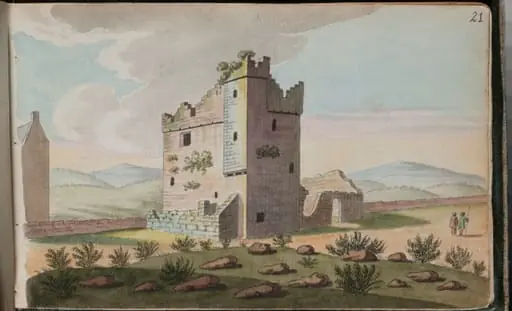 View of one of Dalkey's castles taken from the church yard on the opposite side
![View of Kilgoben [Kilgobbin] Castle, 5 miles from Dublin [...], by Gabriel, ca.1729-1817 Beranger](https://artifactworldgallery.com/img/gabriel-ca-1729-1817-beranger--view-of-kilgoben-kilgobbin-castle-5-miles-from-dublin--924293240c630cbc-w320.webp) View of Kilgoben [Kilgobbin] Castle, 5 miles from Dublin [...]
View of Kilgoben [Kilgobbin] Castle, 5 miles from Dublin [...]![View of the church and adjacent ruins at Dunshaghlin [Dunshaughlin], Co[unt]y of E[ast] Meath, 13 miles from Dublin [...], by Gabriel, ca.1729-1817 Beranger](https://artifactworldgallery.com/img/gabriel-ca-1729-1817-beranger--view-of-the-church-and-adjacent-ruins-at-dunshaghlin-dunshau--b4275bcb8c0ebd0f-w320.webp) View of the church and adjacent ruins at Dunshaghlin [Dunshaughlin], Co[unt]y of E[ast] Meath, 13 miles from Dublin [...]
View of the church and adjacent ruins at Dunshaghlin [Dunshaughlin], Co[unt]y of E[ast] Meath, 13 miles from Dublin [...]![A view of the ruins of Mallahidert [Mulhuddart] Church, on the road to Navan, at about 5 miles from Dublin [...], by Gabriel, ca.1729-1817 Beranger](https://artifactworldgallery.com/img/gabriel-ca-1729-1817-beranger--a-view-of-the-ruins-of-mallahidert-mulhuddart-church-on-the--3403306d8314c03b-w320.webp) A view of the ruins of Mallahidert [Mulhuddart] Church, on the road to Navan, at about 5 miles from Dublin [...]
A view of the ruins of Mallahidert [Mulhuddart] Church, on the road to Navan, at about 5 miles from Dublin [...]