Artwork
A view of the ruins of Mallahidert [Mulhuddart] Church, on the road to Navan, at about 5 miles from Dublin [...]
![A view of the ruins of Mallahidert [Mulhuddart] Church, on the road to Navan, at about 5 miles from Dublin [...], by Gabriel, ca.1729-1817 Beranger, unspecified, 1790](https://artifactworldgallery.com/img/gabriel-ca-1729-1817-beranger--a-view-of-the-ruins-of-mallahidert-mulhuddart-church-on-the--3403306d8314c03b-w1024.webp)
A view of the ruins of Mallahidert [Mulhuddart] Church, on the road to Navan, at about 5 miles from Dublin [...] is an unspecified work on paper by Gabriel, ca.1729-1817 Beranger. It dates from 1790 and is held in the collection of the Royal Irish Academy.
About this work
The painting shows old church ruins and a graveyard with two men in the foreground.
The painting shows old church ruins and a graveyard with two men in the foreground.
They're standing and sitting near the graves, holding sticks.
The men seem to be taking a moment to look at the old church.
The scene is quiet and peaceful, with the focus on the old ruins. The artist included everyday details like the sticks the men are holding.
This painting is similar to works by artist: Beranger, Gabriel, ca.1729-1817.
Overview
This artwork depicts the crumbling remains of Mulhuddart Church in County Dublin, situated along the road to Navan, approximately five miles from the city. The scene includes a surrounding graveyard and two figures in the foreground, one seated and one standing, both holding walking sticks. The composition emphasizes quiet solitude, with the ruins standing as silent witnesses to time’s passage.
Subject & Meaning
The two men, dressed in simple attire, appear to be travelers or local figures pausing amid the graves and ruins. Their stillness and the absence of narrative action suggest contemplation rather than purposeful movement. The sticks they carry hint at practical necessity, grounding the scene in everyday life, while the decaying church evokes themes of memory, decay, and the passage of time in a rural Irish landscape.
Technique & Style
The artist employs a restrained palette and soft, atmospheric brushwork to convey the quiet mood of the site. Details such as the texture of weathered stone and the sparse vegetation around the graves are rendered with observational precision. The figures are simplified but carefully placed to anchor the composition, drawing the viewer’s eye toward the architectural remnants without overwhelming them.
History & Provenance
The painting is attributed to Gabriel Beranger, an 18th-century Irish artist known for documenting ecclesiastical ruins across Ireland. This work likely dates from the 1770s–1790s, a period when Beranger traveled extensively to record sites of historical interest. The piece may have been part of a broader effort to preserve visual records of Ireland’s religious heritage before further deterioration.
Context
In late 18th-century Ireland, many medieval churches lay in disrepair following religious and political upheavals. Beranger’s work reflects a growing antiquarian interest in preserving the visual record of these sites. His depictions, including this one, were not idealized but recorded with documentary intent, offering insight into the state of Ireland’s ecclesiastical architecture during a time of transition.
Legacy
Beranger’s drawings and paintings of ruins became important references for later historians and archaeologists. This work, though modest in scale, contributes to a visual archive of Ireland’s ecclesiastical past. Its quiet realism distinguishes it from romanticized interpretations, offering instead a sober, unembellished glimpse into the landscape and its human interactions with decayed heritage.
Artist & collection
Artist
Gabriel, ca.1729-1817 Beranger
Gabriel Beranger made watercolors of Dublin and its surroundings in the late 1700s.
![A view of the round tower of Michael of Pole in the city of Dublin [...], by Gabriel, ca.1729-1817 Beranger](https://artifactworldgallery.com/img/gabriel-ca-1729-1817-beranger--a-view-of-the-round-tower-of-michael-of-pole-in-the-city-of--066346c3e06cc1f8-w320.webp) A view of the round tower of Michael of Pole in the city of Dublin [...]
A view of the round tower of Michael of Pole in the city of Dublin [...]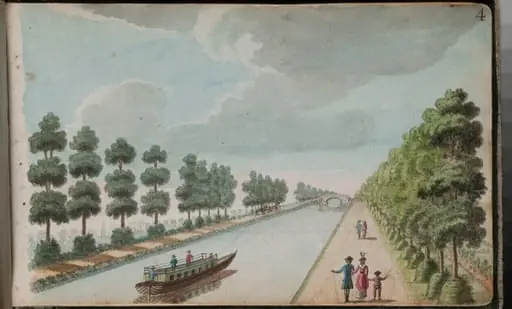 View of the Grand Canal, taken between the first bridge and the first lock looking towards Dublin
![View of the castle of Rabuck [Roebuck], 2 miles from Dublin [...], by Gabriel, ca.1729-1817 Beranger](https://artifactworldgallery.com/img/gabriel-ca-1729-1817-beranger--view-of-the-castle-of-rabuck-roebuck-2-miles-from-dublin--12853cdd66c2654f-w320.webp) View of the castle of Rabuck [Roebuck], 2 miles from Dublin [...]
View of the castle of Rabuck [Roebuck], 2 miles from Dublin [...]![Rathgar Castle, 1 1/2 miles from Dublin [...], by Gabriel, ca.1729-1817 Beranger](https://artifactworldgallery.com/img/gabriel-ca-1729-1817-beranger--rathgar-castle-1-1-2-miles-from-dublin--17cfe3f4e70405c2-w320.webp) Rathgar Castle, 1 1/2 miles from Dublin [...]
Rathgar Castle, 1 1/2 miles from Dublin [...]![Grange Castle, near Clondalken [Clondalkin], 6 miles from Dublin [...], by Gabriel, ca.1729-1817 Beranger](https://artifactworldgallery.com/img/gabriel-ca-1729-1817-beranger--grange-castle-near-clondalken-clondalkin-6-miles-from-dublin--29b767d07d01cfc8-w320.webp) Grange Castle, near Clondalken [Clondalkin], 6 miles from Dublin [...]
Grange Castle, near Clondalken [Clondalkin], 6 miles from Dublin [...]![View of Balymount [Ballymount] Castle, 3 miles from Dublin [...], by Gabriel, ca.1729-1817 Beranger](https://artifactworldgallery.com/img/gabriel-ca-1729-1817-beranger--view-of-balymount-ballymount-castle-3-miles-from-dublin--32c2f3cc4ed12e5f-w320.webp) View of Balymount [Ballymount] Castle, 3 miles from Dublin [...]
View of Balymount [Ballymount] Castle, 3 miles from Dublin [...]![A second view of Rathfarnham Castle, showing the front or entrance [...], by Gabriel, ca.1729-1817 Beranger](https://artifactworldgallery.com/img/gabriel-ca-1729-1817-beranger--a-second-view-of-rathfarnham-castle-showing-the-front-or-ent--3b1f8da88f33e09f-w320.webp) A second view of Rathfarnham Castle, showing the front or entrance [...]
A second view of Rathfarnham Castle, showing the front or entrance [...]![View of the Castle of Carrick, on the River Boyne, County of E[ast] Meath, 24 m[iles] fr[om] Dublin [...], by Gabriel, ca.1729-1817 Beranger](https://artifactworldgallery.com/img/gabriel-ca-1729-1817-beranger--view-of-the-castle-of-carrick-on-the-river-boyne-county-of-e--47a9c858b28e8890-w320.webp) View of the Castle of Carrick, on the River Boyne, County of E[ast] Meath, 24 m[iles] fr[om] Dublin [...]
View of the Castle of Carrick, on the River Boyne, County of E[ast] Meath, 24 m[iles] fr[om] Dublin [...]
![View of the church and adjacent ruins at Dunshaghlin [Dunshaughlin], Co[unt]y of E[ast] Meath, 13 miles from Dublin [...], by Gabriel, ca.1729-1817 Beranger](https://artifactworldgallery.com/img/gabriel-ca-1729-1817-beranger--view-of-the-church-and-adjacent-ruins-at-dunshaghlin-dunshau--b4275bcb8c0ebd0f-w320.webp) View of the church and adjacent ruins at Dunshaghlin [Dunshaughlin], Co[unt]y of E[ast] Meath, 13 miles from Dublin [...]
View of the church and adjacent ruins at Dunshaghlin [Dunshaughlin], Co[unt]y of E[ast] Meath, 13 miles from Dublin [...]![View of the inside of the old church at Killester, 2 1/2 miles from Dublin [...], by Gabriel, ca.1729-1817 Beranger](https://artifactworldgallery.com/img/gabriel-ca-1729-1817-beranger--view-of-the-inside-of-the-old-church-at-killester-2-1-2-mile--abfebd83941373b2-w320.webp) View of the inside of the old church at Killester, 2 1/2 miles from Dublin [...]
View of the inside of the old church at Killester, 2 1/2 miles from Dublin [...]![View of another castle at Monkstown [...], by Gabriel, ca.1729-1817 Beranger](https://artifactworldgallery.com/img/gabriel-ca-1729-1817-beranger--view-of-another-castle-at-monkstown--aa06605166c02b4a-w320.webp) View of another castle at Monkstown [...]
View of another castle at Monkstown [...]![View of Cappoge Castle [...], by Gabriel, ca.1729-1817 Beranger](https://artifactworldgallery.com/img/gabriel-ca-1729-1817-beranger--view-of-cappoge-castle--885594fac18874cc-w320.webp) View of Cappoge Castle [...]
View of Cappoge Castle [...]![View of Baggoths rath [Baggot Rath], a castle half a mile from Dublin [...], by Gabriel, ca.1729-1817 Beranger](https://artifactworldgallery.com/img/gabriel-ca-1729-1817-beranger--view-of-baggoths-rath-baggot-rath-a-castle-half-a-mile-from--c625749ddb0ab425-w320.webp) View of Baggoths rath [Baggot Rath], a castle half a mile from Dublin [...]
View of Baggoths rath [Baggot Rath], a castle half a mile from Dublin [...]![View of Castle-knock, 3 miles from Dublin [...], by Gabriel, ca.1729-1817 Beranger](https://artifactworldgallery.com/img/gabriel-ca-1729-1817-beranger--view-of-castle-knock-3-miles-from-dublin--4e9a7099f4e41684-w320.webp) View of Castle-knock, 3 miles from Dublin [...]
View of Castle-knock, 3 miles from Dublin [...]![View of the remains of a druidical monument at Douth [Dowth], Co[unty] of Meath, 2 miles from Slane, & 24 miles from Dublin [...], by Gabriel, ca.1729-1817 Beranger](https://artifactworldgallery.com/img/gabriel-ca-1729-1817-beranger--view-of-the-remains-of-a-druidical-monument-at-douth-dowth-c--599f96d588ed28a4-w320.webp) View of the remains of a druidical monument at Douth [Dowth], Co[unty] of Meath, 2 miles from Slane, & 24 miles from Dublin [...]
View of the remains of a druidical monument at Douth [Dowth], Co[unty] of Meath, 2 miles from Slane, & 24 miles from Dublin [...]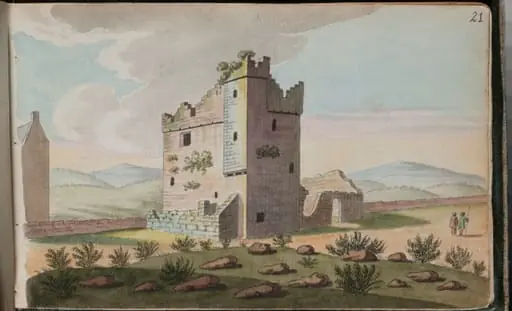 View of one of Dalkey's castles taken from the church yard on the opposite side
![View of a cromliach [cromlech] on the lands of Loughlins town, 7 miles from Dublin [...], by Gabriel, ca.1729-1817 Beranger](https://artifactworldgallery.com/img/gabriel-ca-1729-1817-beranger--view-of-a-cromliach-cromlech-on-the-lands-of-loughlins-town--2ec5dcc741513545-w320.webp) View of a cromliach [cromlech] on the lands of Loughlins town, 7 miles from Dublin [...]
View of a cromliach [cromlech] on the lands of Loughlins town, 7 miles from Dublin [...]