Artwork
View of an Italian Town (after Titian or Domenico Campagnola)
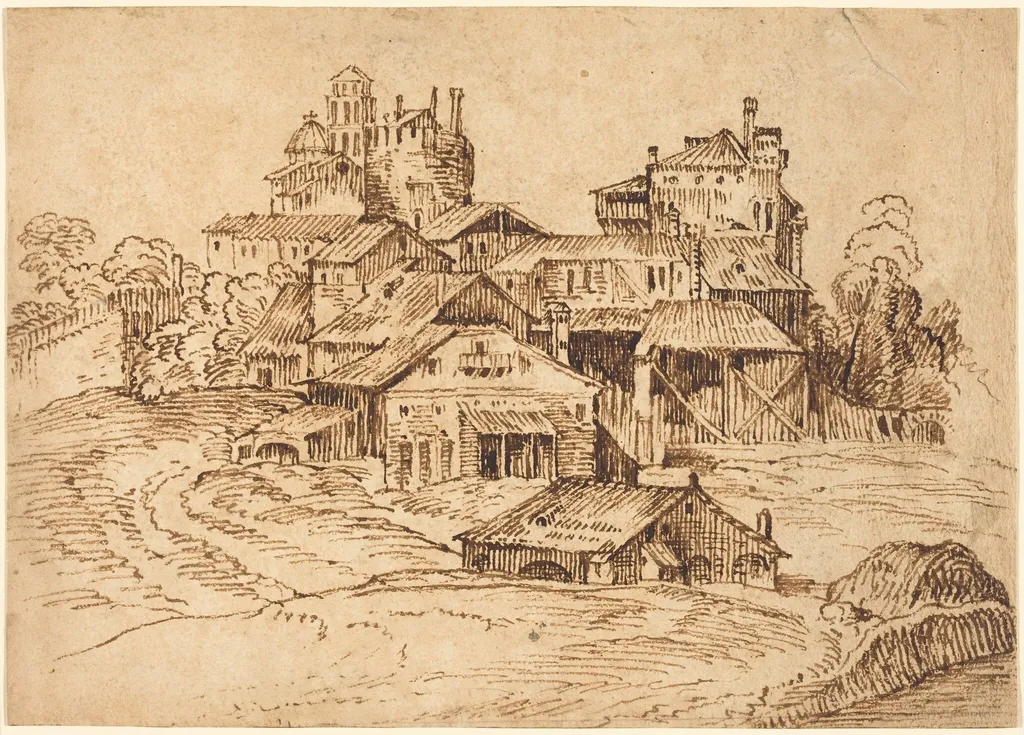
View of an Italian Town (after Titian or Domenico Campagnola) is an ink drawing by the Renaissance artist Bolognese 17th Century. It dates from 1520 and is held in the collection of the National Gallery of Art.
About this work
Overview
This drawing depicts a small, rustic Italian hillside town with wooden buildings ascending the slope, characterized by steep, shingled roofs, chimneys, and a landscape dotted with trees on uneven, rocky ground.
Subject & Meaning
The subject is a serene, everyday Italian townscape, likely inspired by the works of Titian or Domenico Campagnola. The scene conveys a sense of natural, unpretentious living, with the arrangement of buildings and trees suggesting a harmonious coexistence of nature and human settlement.
Technique & Style
Executed in pen and brown ink on laid paper, the drawing features fine, scratchy lines. The artist employed cross-hatching to achieve depth and shading, evident in the layered, crisscrossed lines that create darker areas, adding texture and visual interest.
History & Provenance
The drawing's direct attribution and exact date are unspecified, indicated only as being 'after' Titian or Domenico Campagnola, suggesting it is either a later work inspired by these artists or an unattributed piece from their broader stylistic influence.
Context
Created in the tradition of Renaissance Italian landscape drawing, this work reflects the period's interest in capturing everyday life and natural environments. The use of brown ink and cross-hatching aligns with common practices of the time.
Artist & collection

Artist
This artist drew religious scenes and Italian landscapes in the 17th century using red chalk and brown ink.

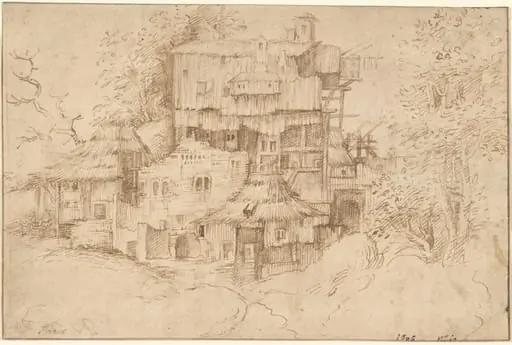 A Complex of Rustic Houses Built Over Ruins
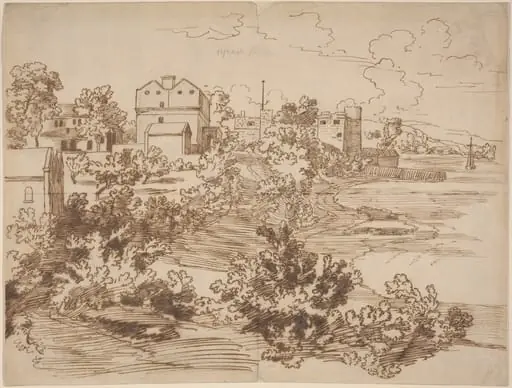 Upnor Castle
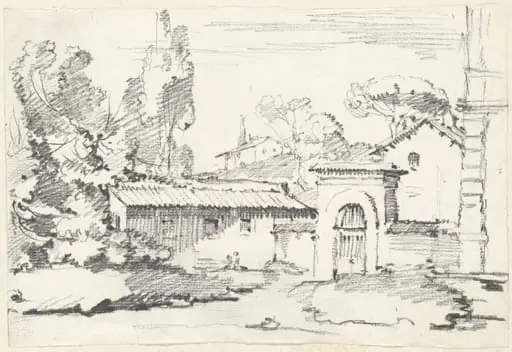 Entrance to the Gardens of the Villa Giulia
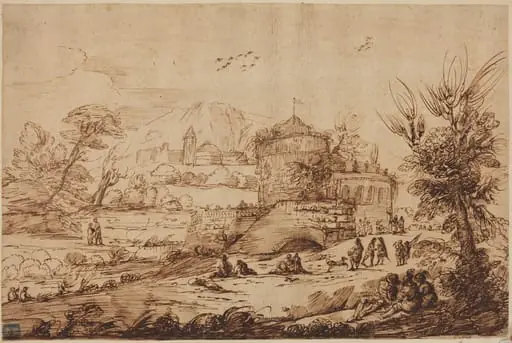 Landscape with Fortress and River
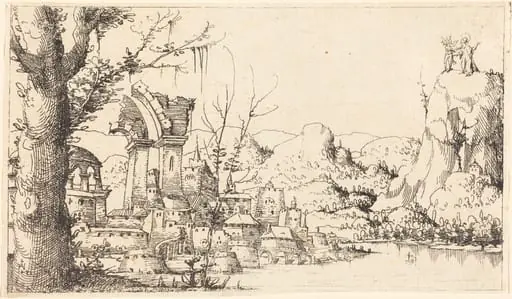 River Landscape with the Temptation of Christ
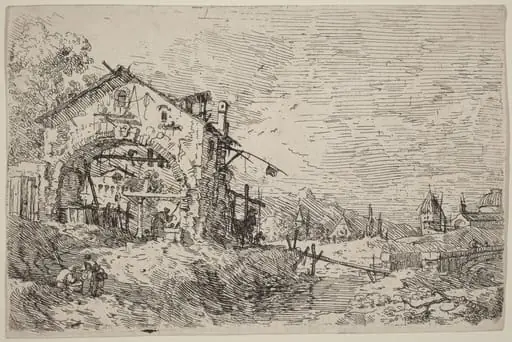 Landscape with a Woman at a Well
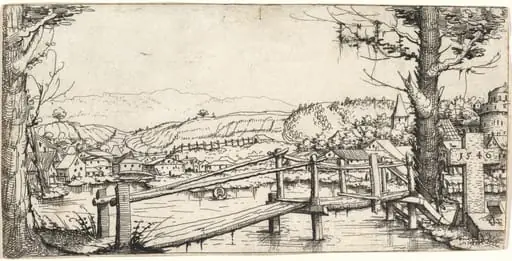 River Landscape with a Footbridge
 Houses in Italy
 View of a City near a River
 Road into a Village
![Figures on the Anthoniesdijk Entering Houtewael [verso], by Rembrandt](https://artifactworldgallery.com/img/rembrandt--figures-on-the-anthoniesdijk-entering-houtewael-verso--34adc78d6ee3c51d-w320.webp) Figures on the Anthoniesdijk Entering Houtewael [verso]
Figures on the Anthoniesdijk Entering Houtewael [verso] The Roman Campagna with an Ancient Fountain