Artwork
River Landscape with a Footbridge
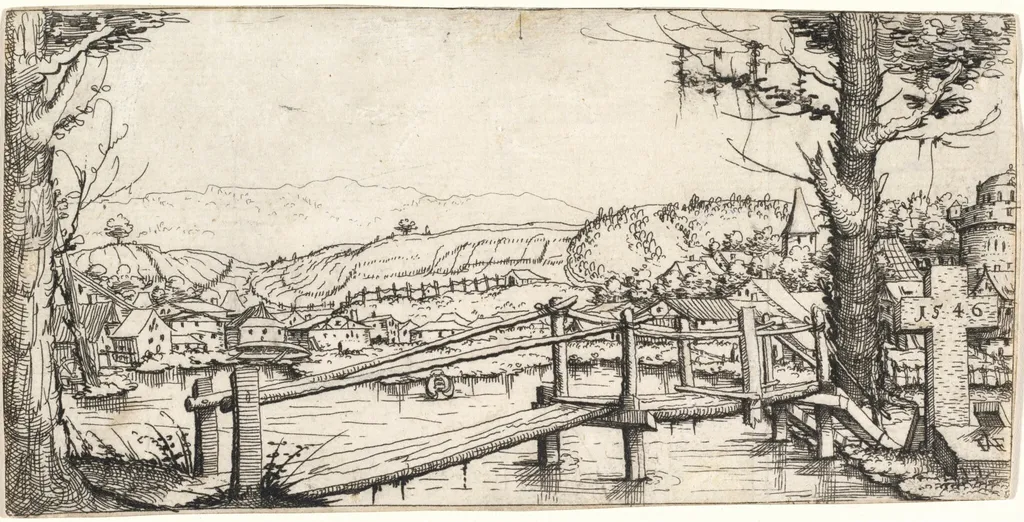
River Landscape with a Footbridge is an ink print by the Renaissance artist Augustin Hirschvogel. It dates from 1546 and is held in the collection of the National Gallery of Art.
About this work
Houses with pointed roofs line the riverbank, and trees with bare branches stand on the left side, their roots dipping into the water.
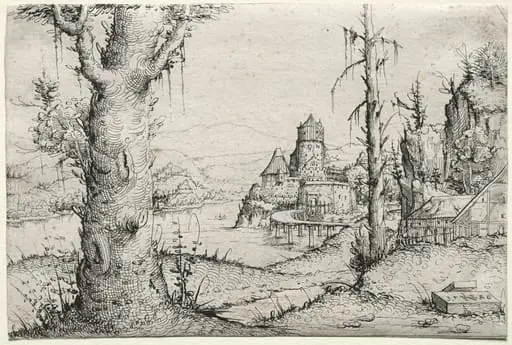
This sketch shows a quiet river winding through a small town. A wooden bridge with a slight curve crosses the water, connecting two sides of the area. Houses with pointed roofs line the riverbank, and trees with bare branches stand on the left side, their roots dipping into the water.
The artist used fine lines to create depth, making the distant buildings look smaller. The date "1546" is written in the corner, showing this was made over 500 years ago.
Next, check out how this work was made with the technique: etching.
Overview
Created in 1546 by the German artist Augustin Hirschvogel, this etching on laid paper is one of thirty-five small landscape prints produced between 1545 and 1549. Hirschvogel, known for his work in cartography and mathematics, turned his precision to intimate natural scenes. The piece belongs to a cohesive series that helped define the Danube School’s approach to landscape, emphasizing quiet observation over grand narrative.
Subject & Meaning
The scene depicts a modest riverside settlement with a gently arched wooden footbridge linking its two banks. Sparse dwellings with steep roofs line the water’s edge, while bare trees with roots trailing into the stream anchor the composition. There is no human activity visible—only the stillness of a rural moment. The work suggests an appreciation for ordinary places, valued for their quiet order rather than symbolic weight.
Technique & Style
Hirschvogel employed fine, controlled etching lines to model form and distance, using density and spacing to suggest depth. The buildings recede subtly into the background through scaled reduction and lighter line work, while the foreground trees are rendered with sharper, more concentrated strokes. The texture of the laid paper enhances the tonal subtlety, allowing the ink to settle unevenly and lend a natural, atmospheric quality to the scene.
History & Provenance
The print was made during Hirschvogel’s most active period in Nuremberg, where he collaborated with publishers to distribute his landscape series. Though few original impressions survive in public collections, the work’s date and signature are consistently present in known examples. Its production coincided with rising interest in secular landscapes among German collectors, shifting focus from religious iconography to observed nature.
Context
Hirschvogel’s landscapes emerged alongside the Danube School’s broader movement, which favored intimate, non-narrative views of the natural world over traditional religious or mythological subjects. Unlike Italian Renaissance landscapes, these works avoided idealization, instead capturing regional topography with topographical accuracy. His background in cartography informed this precise, measured approach to spatial representation.
Legacy
Though Hirschvogel is less known today than his contemporaries, his etchings contributed to the development of landscape as an independent genre in Northern Europe. His technical discipline and attention to local scenery influenced later printmakers who sought to depict the everyday environment with clarity and restraint. The series remains a quiet but significant record of 16th-century German visual culture.
Artist & collection
Artist
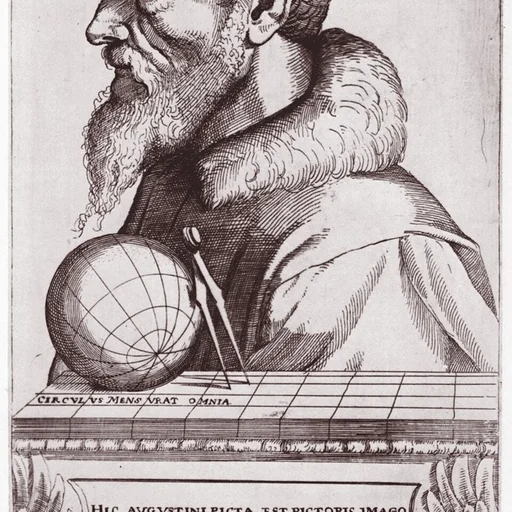
Augustin Hirschvogel (1503 – February 1553) was a German artist, mathematician, and cartographer known primarily for his etchings.


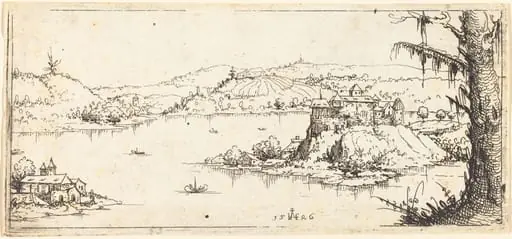 Landscape with a Large Lake at Center
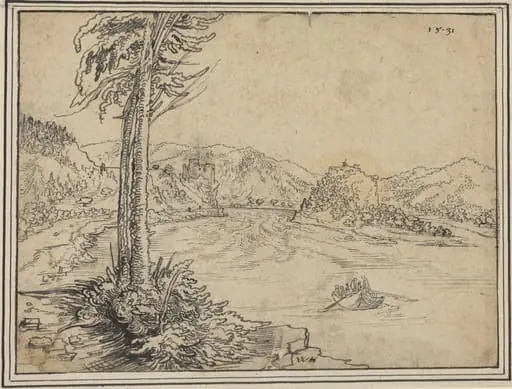 The Rapids of the Danube near Grein
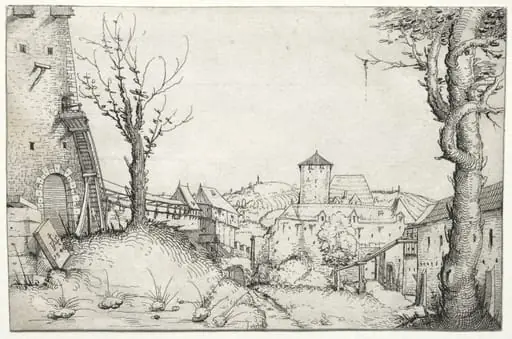 Courtyard of a castle
![Landscape with Sail Boats [bottom plate], by Augustin Hirschvogel](https://artifactworldgallery.com/img/augustin-hirschvogel--landscape-with-sail-boats-bottom-plate--80a2ff7dde9c982b-w320.webp) Landscape with Sail Boats [bottom plate]
Landscape with Sail Boats [bottom plate]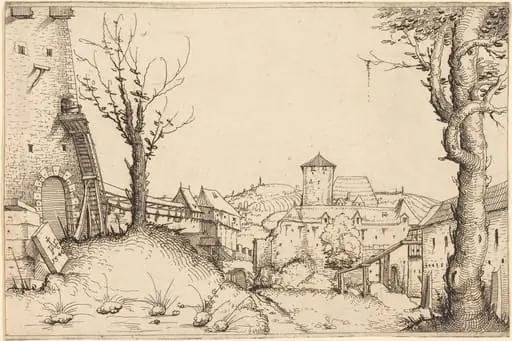 Courtyard of a Castle
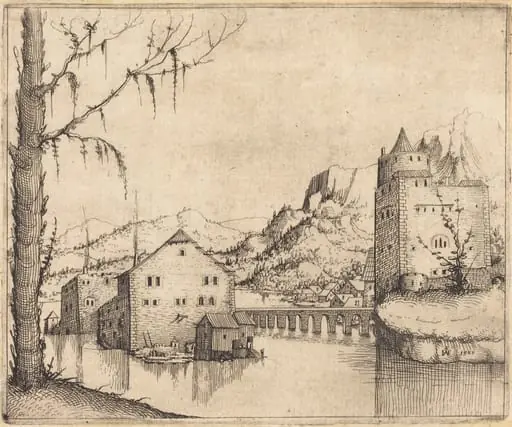 River Landscape with Two Buildings
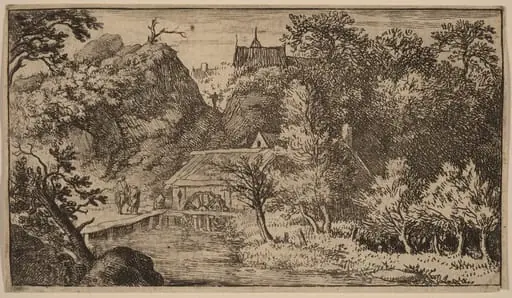 Water Mill at the Foot of a Mountain
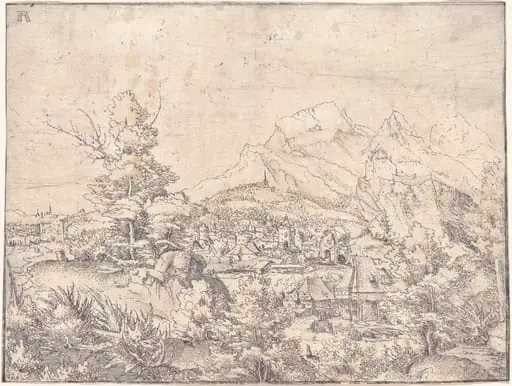 The Great Landscape with the Water Mill
 Landscape with Sail Boats
 River Landscape with Large Tree at Left