Artwork
Everyman
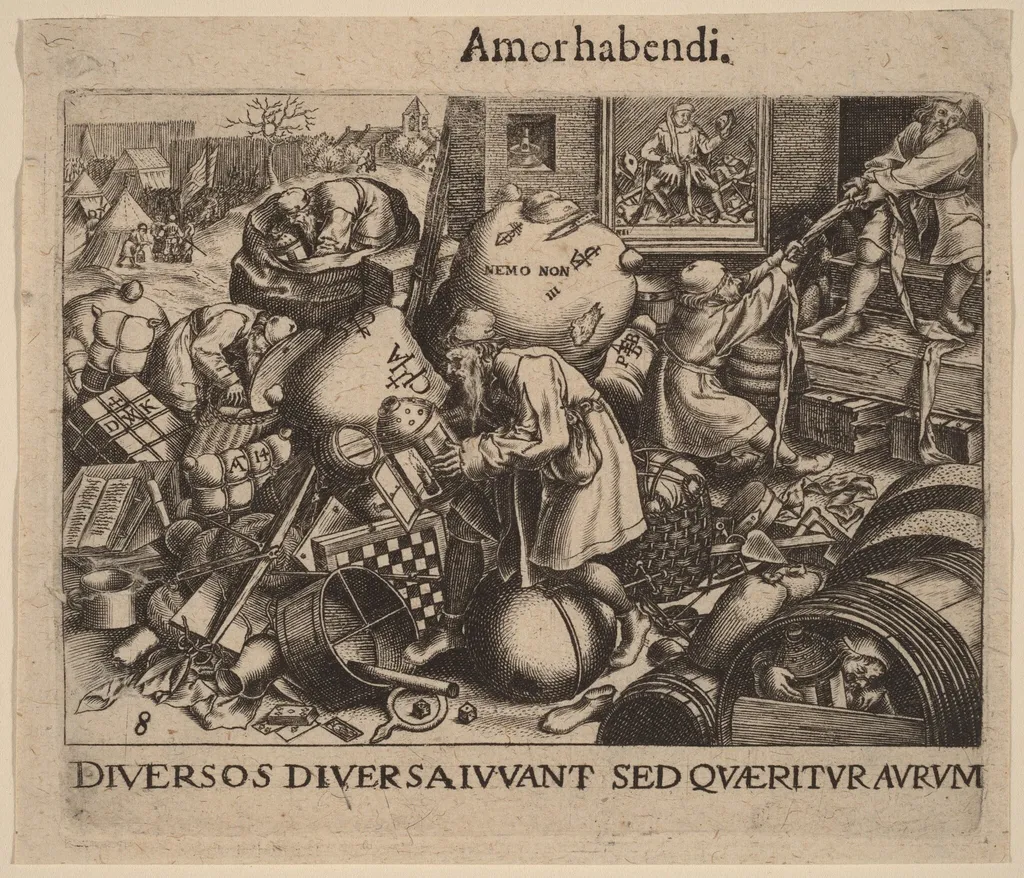
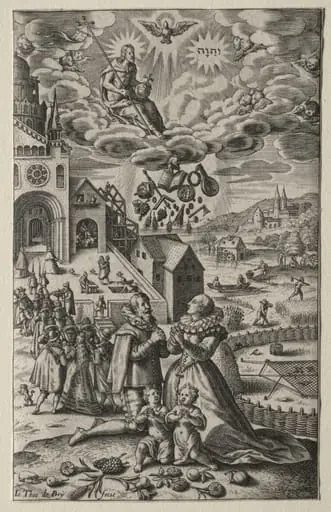
Everyman is an ink print by the Renaissance artist Johann Theodor de Bry. It dates from 1592 and is held in the collection of the National Gallery of Art.
About this work
Overview
A banner bearing the Latin phrase “Nemo Non” and a cross hovers above the chaos, reinforcing the work’s allegorical tone.
Johann Theodor de Bry’s 1592 engraving titled *Everyman* presents a densely populated, monochrome tableau. Figures are entangled in a net-like composition, with a central, richly dressed individual clutching a heart while surrounding characters scramble amid scattered objects such as weapons, books and a globe. A banner bearing the Latin phrase “Nemo Non” and a cross hovers above the chaos, reinforcing the work’s allegorical tone.
Subject & Meaning
The scene functions as an allegory of human existence, juxtaposing material wealth, intellectual pursuits, and spiritual concerns. The central figure’s heart suggests personal desire or mortality, while the tangled crowd evokes the entanglements of life’s ambitions and anxieties. The Latin inscription, translating roughly to “no one not,” underscores the universal nature of the depicted struggles.
Technique & Style
Executed as an engraving, the image relies on incised lines on a metal plate, allowing de Bry to achieve fine detail and stark contrast. The artist’s meticulous hatching creates texture in clothing, objects, and background elements such as a distant castle and a chessboard, demonstrating the high level of craftsmanship typical of late‑Renaissance printmaking.
History & Provenance
Created in 1592, the print emerges from de Bry’s prolific workshop, known for disseminating illustrated books and moralizing images across Europe. While specific ownership records are scarce, the work has been catalogued in several major print collections, reflecting its circulation among collectors of emblematic and didactic prints in the early modern period.
Context
*Everyman* belongs to a broader tradition of moral allegories that flourished in the late sixteenth century, echoing contemporary literature such as the English morality play of the same name. The engraving’s emphasis on universal human concerns aligns with the period’s preoccupation with didactic art that instructed viewers on the transience of earthly pursuits.
Legacy
The print exemplifies the capacity of engraving to convey complex narratives within a single, compact image. Its dense composition and symbolic content have informed later studies of early modern visual rhetoric, and it remains a reference point for scholars examining the intersection of art, literature, and moral philosophy in the Renaissance.
Artist & collection

Artist
Johann Theodor de Bry (1561–1623) was a German artist, born in Strasbourg.