Artwork
H Beard Print Collection
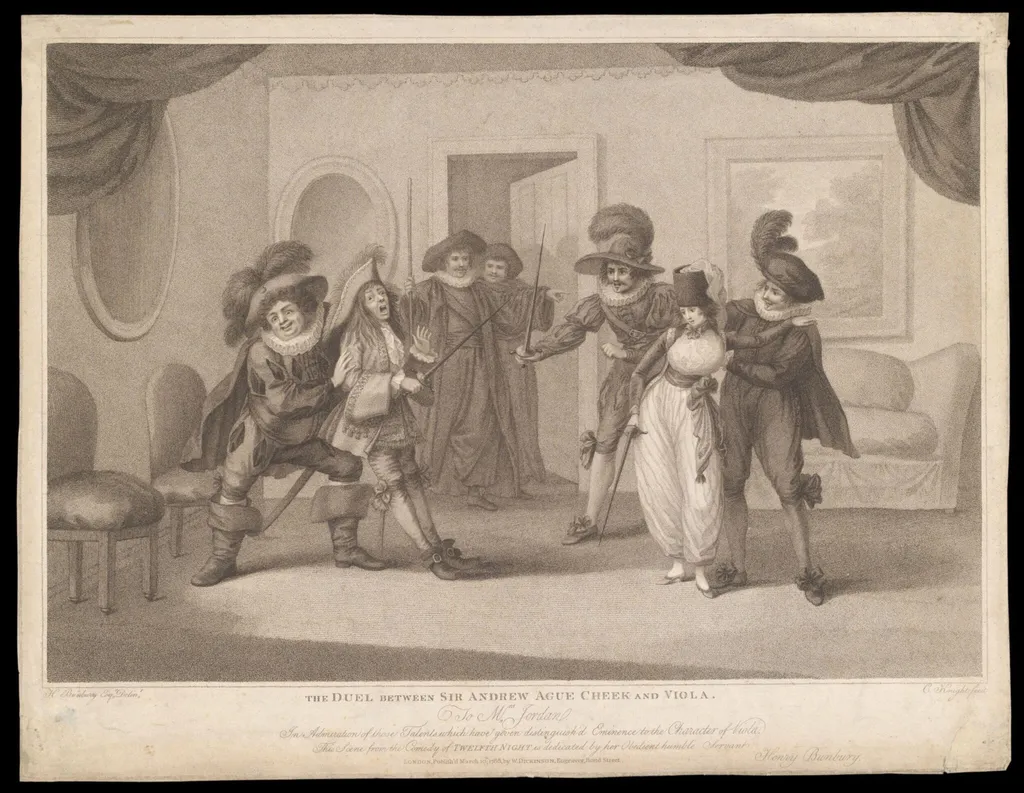
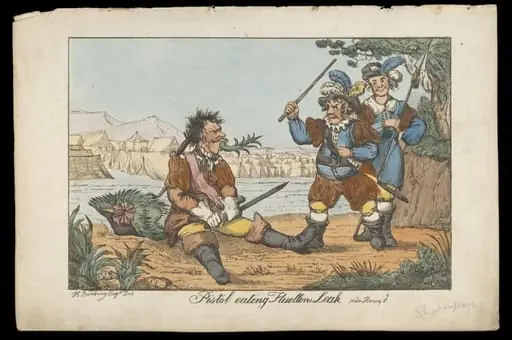
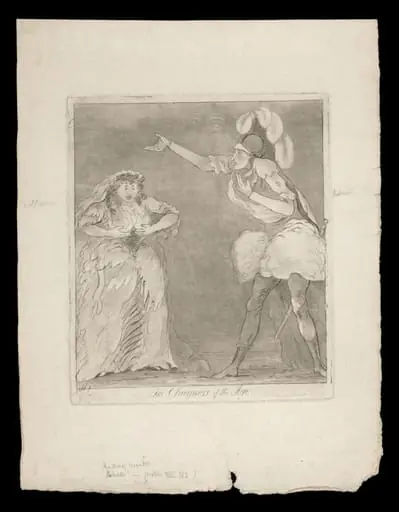
H Beard Print Collection is a print by the Romanticist artist Henry William Bunbury. It dates from 10 and is held in the collection of the Victoria and Albert Museum. This 1788 print illustrates a staged duel between Sir Andrew Ague Cheek and Viola, a moment drawn from Shakespeare’s Twelfth Night.
About this work
This print is from 1788.
It shows a scene from a play.
The print is held at the Victoria and Albert Museum, which has a large collection of art from this time period, and was published by an engraver, giving insight into the print's creation and distribution.
You can learn more about this type of art by looking into the movement: Romanticism.
Overview
This 1788 print illustrates a staged duel between Sir Andrew Ague Cheek and Viola, a moment drawn from Shakespeare’s Twelfth Night. Produced in London by the engraver W. Dickinson, the image was distributed as a popular theatrical souvenir and now resides in the Victoria and Albert Museum’s print collection.
Subject & Meaning
The scene captures the comic misunderstanding that leads the two characters to challenge each other to a duel, a device Shakespeare uses to explore themes of identity and mistaken perception. By visualising this episode, the print emphasizes the play’s blend of humor and social satire.
Technique & Style
Executed as an engraved print, the work relies on line incisions to model figures and suggest depth, characteristic of late‑eighteenth‑century printmaking. The composition balances detailed costuming with a clear narrative focus, reflecting the period’s interest in theatrical representation.
History & Provenance
Printed by W. Dickinson, a London engraver active in the 1780s, the image was likely sold to theatre‑goers as a keepsake of the performance. The Victoria and Albert Museum acquired the piece as part of its broader effort to document British print culture of the era.
Context
The print emerges during the early Romantic period, when artists and publishers increasingly turned to literary and dramatic subjects for visual interpretation. Such works catered to a growing public appetite for accessible art that linked popular theatre with the expanding print market.
Artist & collection
Artist
Henry Bunbury made prints and watercolors in the late 1700s, poking gentle fun at everyday life and odd little scandals.